1 • A touch of bipolarism
Clarity is important.
When we talk to the doctor, we want them to speak clearly.
Let’s be clear: they should be sensitive, have tact, delicacy, empathy… but if they start to beat around the bush too much, it has the opposite effect:

When we have a job interview or sign a contract, everything must be clear and unambiguous down to the smallest details.
We “demand” that there be no ambiguity whatsoever.

After all:
- Clarity is important when it comes to health;
- Clarity is important when it comes to work (and money!);
- Clarity is important in many other contexts that involve “matters-of-utmost-importance”…
However, when it comes to religion, this rule doesn’t apply.
2 • The religion of confetti, meringues, and maple syrup
One can say that a religion “has breathtaking art”: frescoes, rose windows, spires, minarets, mosaics, crucifixes…

It can be described as “fascinating,” “folkloric,” “interesting,” “intriguing,” “enchanting”…
…
However, the truth (or falseness) of a religion is not discussed…
- …sometimes because someone has received the “divine revelation” that their religion is the true one (information often received from mom and dad, who got it from grandparents, who got it from etc.)… so there’s “little to discuss”;
- …other times because a person is atheist, and “anything related to religion is nonsense concocted by the mind of Homo sapiens”… and even in this case, there isn’t much room for dialogue.
Well, everyone has their cognitive biases.
However, another thing often happens: in the muffled context in which we live, the level of political correctness in our blood has reached such heights that many people think:
“In reality, all religions are true; because, deep down, each of them is a different manifestation of that one universal religion that God has spread around the world…”
…
“…indeed, it is God Himself who has spread into a bit of everything: in plants, in flowers, in the air, in our hearts!”
Now…
I can’t help it…
Every time someone says a similar sentence, something like this comes to mind:

This depiction of God blends together two ideas that, despite seeming “very original,” are anything but modern.
I’m talking about (excuse the strong language):
- Religious syncretism: (According to Wikipedia) this term refers to the “the blending of religious belief systems into a new system, or the incorporation of other beliefs into an existing religious tradition”… in practice, it’s like making a mashup of various religions, blending their characteristics (you can check Wikipedia: syncretism is as old as the world).
- Immanence: (this one is a bit tough!) If God is “outside the world” (as in Judaism, Islam, etc.), it is said to be “transcendent”; the opposite term – “immanent” – is used to indicate when God is “in the world”: for example, in Greek paganism, it was believed that the gods lived on Mount Olympus; or in “New Age” religions, where it is said that God is in nature, in animals, etc.
These two ideas are very popular nowadays because they seem to be:
- Tolerant: by taking “a bit of stuff” from each religion, it is hoped that none will feel offended;
- Accommodating: they have the right amount of relativism, which is an attitude that appeals to everyone (I recently mentioned some “weak points” of relativism);
- Ecological: if God is in trees and in the air, maybe it’s high time we stop polluting…
- Convenient: the fact that “all religions are somewhat true” translates into everyday life as: “I don’t need to follow any religion.”
3 • A bit of logic
There’s a concept – in classical logic – that I have always found very interesting.
It’s called the principle of non-contradiction.
Formulated by Aristotle (in the 4th century BCE) and used repeatedly by a host of philosophers throughout history, this principle states (more or less… borrowing from Wikipedia):
It is impossible that the same thing belong and not belong to the same thing at the same time and in the same respect.
(ARISTOTLE, Metaphysics, Book Γ, chap. 3, 1005b 19-20)
In other words:
“It cannot be true that:
- proposition A and…
- …proposition B, which asserts the opposite of A…
…are both true at the same time and in the same way.”
3.1 • Optional paragraph for the know-it-alls (if you’re not a know-it-all, you can skip to the next) (click to view the optional paragraph)
I bet that nine out of ten know-it-alls, after reading the principle of non-contradiction, have tried to find an “extreme case” to prove the principle false… something like:
I would therefore invite you to reread the statement of the principle more carefully: you’ll notice it ends with “(both true) at the same time and in the same respect.“
(To stay with the example of the wall) if we consider:
- …different perspectives from which to observe the wall (from above? from below? backlit?)
- …different times when the wall is observed (during the day? at night?)
- …different people trying to observe the wall (a colorblind person? a blind person?)
- etc.
…none of these “cases” make the principle false! Simply, they do not involve equalities “at the same time and in the same respect.”
However, the principle remains valid.
4 • They cannot all be true!
Okay, interesting… but what does the principle of non-contradiction have to do with the discussion we were having about religions?
It matters because if the principle is true (and it is!), the following corollary holds:
Religions cannot all be true (at the same time and in the same way).
Why?
Because most religions assert “truths” (about God, about humanity, about the meaning of life, etc.) that are incompatible with those of other religions!
Note: Let it be clear that I am well aware that among various religions, there is a convergence of views on many issues; for example, regarding many ethical and anthropological aspects, etc…
…but often it happens that the answer a Christian would give to certain questions (which are foundational to their faith) explicitly contradicts the answer a Muslim would give, or a Jew, or a Hindu, and vice versa.
Let’s give some examples:
- Is life singular? Jews, Christians, Muslims (and others) say one thing; Buddhists, Hindus (and others) assert the exact opposite;
- Is Jesus God? Christians answer this question in one way; for many of his fellow countrymen, however, Jesus was not God but a blasphemer; for Islam, Jesus is not God but a prophet (in the Quran, the story of the Miʿrāj recounts the ascent to heaven of Muhammad, where he meets all the prophets of Islam who preceded him – among whom is also Jesus);
- Is Muhammad a prophet? If he is a prophet (meaning, if what the angel Gabriel revealed to him and Muhammad reported in the Quran is true), my life will take a certain direction; if he is not a prophet, my life will have a very different trajectory – while still respecting Muslims, the Quran, the Sunnah, etc.
- Is reaching Nirvāṇa (i.e., “the extinction of passions” and “freedom from desire”) the purpose of life? If what Buddhism says is true, it cannot be true that in the Christian paradise, man enjoys the vision of the face of God (cf. Catechism of the Catholic Church, points 1020-1065);
- And so on…
The principle of non-contradiction doesn’t say whether a religion is true or false.
But it asserts that “someone is mistaken.”
Perhaps only some. Perhaps all. Perhaps me.
The point is, someone’s clearly barking up the wrong tree.
5 • Dialogue, dialogue, dialogue (but for real!)
I am a scrupulous person, so I can’t help but wonder if Christianity is not a massive foolishness… (*)
(*) (I usually ask myself this question between 6 and 8 times a day)

There is an Italian proverb that says:
Seek harmony in the family, sincerity in a friend.
Let’s suppose that Christianity is false, and Hinduism is true – well, I wouldn’t want my friend Ashwatthama Chaudhary to come and tell me:
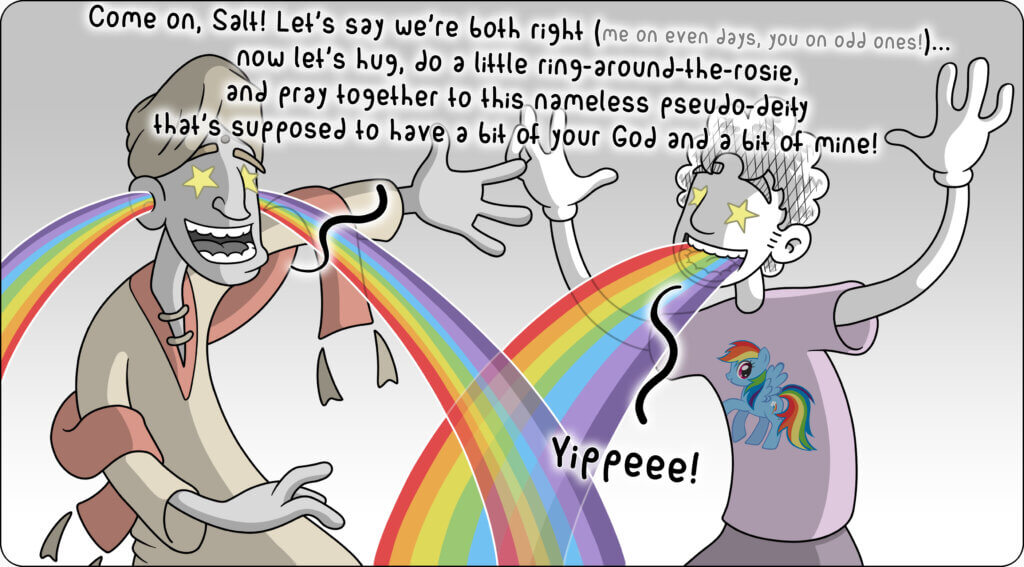
NO!
Instead, I would like him – by engaging in a dialogue with me (preferably with a calm tone), using his words, his life testimony, sensible reasoning, actions, gestures, and every possible human experience (rational, sensory, psychological, emotional, intellectual, speculative, whatever-you-like), and (why not?) with the help of God, to show me that I am mistaken… in other words, help me convert! (*)

In other words, said more clearly: the rule of gentleness, respect, and calmness (which I referred to when talking about Christians and politics) also applies (and especially) in interreligious dialogue.
With this clarification, however, what I wrote above still holds: I don’t want to live deluding myself with something untrue!
My best friend (who is not a Christian!) is my best friend because he ALWAYS gives me his perspective on reality…
…and not a sugar-coated version that “doesn’t offend me,” that works “a little for me and a little for him.”
I believe the same applies among different peoples, cultures, and religions.
In other words: the solution to the problem of wars between religions is not the childish irenicism that, for the sake of political correctness, removes from the dialogue the only thing we both desire (the search for truth) and waters down everything, relativizing…
…but a more fruitful dialogue, so that – starting from different positions – both I and a follower of another religion can both reach that one Truth that quenches us.
It is not necessarily “halfway” (indeed, perhaps one of us already glimpses it and just needs to help the other to grasp it… or maybe one already lives it in fullness within their religion – which might be “the true one”).
Paraphrasing Benedict XVI:
Truth without charity kills. But charity without truth deceives.
(Cf. BENEDICT XVI, Encyclical Letter Caritas in Veritate, n. 3-6)
Conclusion
Tolerance is very useful.
It allows us to coexist – in the hustle and bustle of the globalized society we live in – among people of different ethnicities, cultures, religions, and political ideas…
…all good and well…
…but if two religions explicitly contradict each other, they cannot both be true – regardless of how much we “strive” to become tolerant!
It’s not a matter of being good or bad.
It’s a matter of logic.
salt
(Spring 2020)
- ANDY WRASMAN, Contradict: They Can't All Be True, WestBow Press 2014
- LUIGI GIUSSANI, All'origine della pretesa cristiana, BUR Rizzoli, Milano 2013
- JOSEPH RATZINGER, Fede, verità, tolleranza. Il cristianesimo e le religioni del mondo, Cantagalli, Bologna 2005
- CONGREGAZIONE PER LA DOTTRINA DELLA FEDE, Dichiarazione "Dominus Iesus" circa l'unicità e l'universalità salvifica di Gesù Cristo e della Chiesa, Libreria Editrice Vaticana, Città del Vaticano 2000
- BRUNO MASTROIANNI, La disputa felice, Dissentire senza litigare sui social network, sui media e in pubblico, Franco Cesati editore, Firenze 2017
- MAURO MOSCONI, SIMONE RICCARDI, Fallaciae - Le prime, uniche e originali carte delle fallacie a fumetti, PSYCOMIX S.r.l