1 • If God exists, why…
If God exists, why doesn’t He show Himself clearly?
What does it cost Him?
Why not “open the tap” of miracles?
Wouldn’t everything be easier?
Think about the time saved, instead of seeking answers in the Bible, whose correct interpretation is a tragedy…

Does God exist or not?
In Fyodor Dostoevsky‘s “The Brothers Karamazov” (1821-1881), Ivan Karamazov dismisses the question with a quip when his father Fyodor Pavlovich asks him:
“But once and for all: Does God exist or not? Once and for all!”
“Once and for all, no!”
“And who makes a mockery of men, Ivan?”
“It must be the devil,” Ivan chuckled.
(FYODOR DOSTOEVSKY, I fratelli Karamazov, Mondadori, MilanO 2010, Kindle version, 21%, ch. VIII)
Setting aside Russian humor, let’s try to consider the possible existence of God…
2 • If God exists, He is certainly hidden…
Blaise Pascal (1623-1662), French mathematician, physicist, philosopher, and theologian, wrote in his “Pensées“:
Any religion that says God is not hidden is not true, since God is hidden; and all religions that do not explain this are not instructive.
(BLAISE PASCAL, Pensées, BUR, Milano 2013, Kindle version, 70%)
At least on this point, Christianity is saved, given that, in the Gospel of John, it is written that:
No one has seen God at any time.
(John 1:18)
Thomas Aquinas (1225-1274), the famous Dominican theologian, tackled the question of the existence of God head – on in his Summa Theologiae (Part I, Question 2), arriving at a very interesting synthesis:
God – if He exists – is first in the order of being (that is, He is the one upon whom “everything that exists rests“; what other philosophers have called the First Cause, the Unmoved Mover, Pure Act, and so on)…
…but…
…God is not first in the order of knowledge.
(Note: This is not a direct quote from Thomas, but my unfortunate summary. If you still want, you can click here to read the entire Question 2.)
Let’s try to say it in an even simpler way:
- When reasoning about the existence of God, theoretically, it can be admitted that – if He exists – God is the Perfect Being, the One who (directly or indirectly) caused the existence of everything else, the “Watchmaker” who created the watch (meaning the universe), etc…
…but…
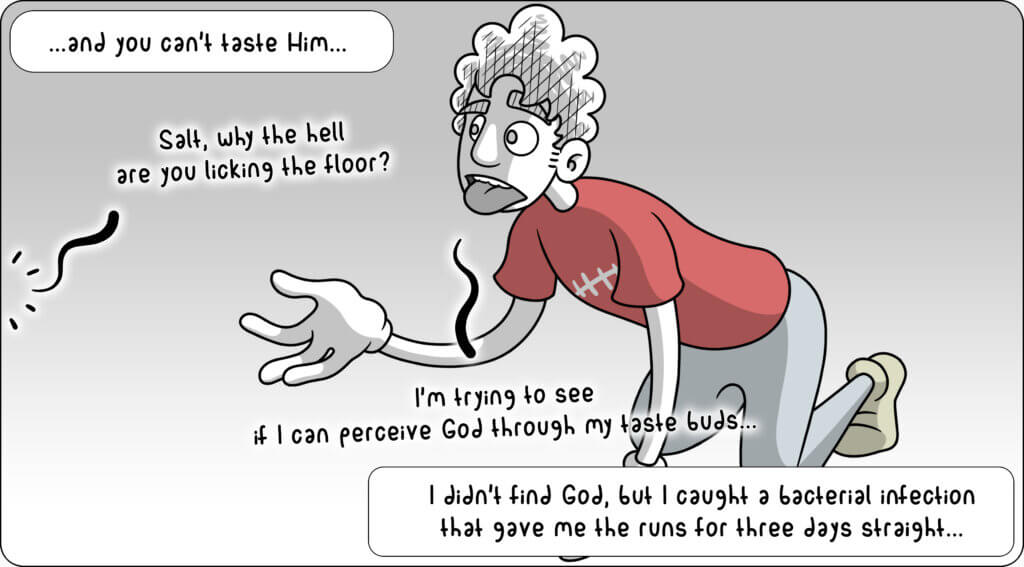
- Using the five senses, His existence is not immediately evident: God is not seen, not heard, not touched…
3 • If God exists, can He be accessible to man?
Many people, unable to perceive God with their five senses, give up on this inquiry; some say it’s an unanswerable question; others assert with unyielding certainty the non-existence of God (I have yet to meet a Christian who believes in God with the same confidence with which some atheists deny His existence).
But is it reasonable to stop this search?
To abandon ship?
To surrender to the: “I don’t see it / I don’t touch it / I don’t hear it“?
Forgive me for a very silly example…
A sailor, in the middle of the ocean, looking around 360°, does not see land. Yet, he orients himself using a series of means whose utility is not immediately evident:
- a compass;
- the position of the sun;
- the position of the stars.
In this way, indirectly, he manages to gather a series of very useful information.
What do I mean by this analogy?
That – presumably – perhaps – probably – presumably – IF God exists, although His existence is not evident, there may be situations, intuitions, experiences, things, facts that – indirectly – say something about Him.
For example… there is a psalm in the Bible that states:
The heavens declare the glory of God;
And the firmament shows His handiwork.
Day unto day utters speech,
And night unto night reveals knowledge.
There is no speech nor language
Where their voice is not heard.
Their line has gone out through all the earth,
And their words to the end of the world.
(Psalm 19:1-4)
What does this text mean? In what sense do “the heavens declare…”?

The psalm, of course, is a poetic text…
…but, paraphrasing its content, St. Paul wrote to the Romans that:
[…] because what may be known of God is manifest in them, for God has shown it to them. For since the creation of the world His invisible attributes are clearly seen, being understood by the things that are made, even His eternal power and Godhead, so that they are without excuse […].
(Romans 1:19-20)
(Paul made a similar speech also before the Areopagus in Athens; cf. Acts 17:22-29)
In other words:
[…] if we cannot know directly with immediate intuition the divine nature, something of it is accessible to our intelligence through the created world.
(JEAN DANIELOU, Dio e noi, Rizzoli, Milano 2009, kindle version, 22%, from Chapter II “Il Dio dei filosofi”)
In what sense is “something” of God accessible “through the created world“?
Hmm… let’s see…
- Have you ever hiked in the mountains?
- Gone on a sailing trip?
- Have you ever carefully observed the beauty of an animal?
- Have you lingered to contemplate the precision of a spider’s web? The symmetry of a beehive?
- Have you ever pondered the precision of the laws governing the universe?
- Have you seen the wonderful symmetry in the Maxwell’s equations?
- What incredible precision there is in the functioning of the sodium-potassium pump on the surface of cells?
- Have you ever seen a sunset from beginning to end?
- Have you ever lain on a meadow, with your significant other, contemplating the stars?
- Have you ever looked a child in the eyes, straight on, for more than 30 seconds?
I don’t know… I hope that, as you scroll through this list I’ve made, you may have found yourself in some situations… or similar examples may have come to your mind, experiences you have personally lived through…
Moments in which you perceived a hint of something more beautiful, bigger…
Far be it from me to say that these are overwhelming evidence of the existence of God…
…but I know many people — even non-believers — who in these examples I’ve given sense that in materialism, “something doesn’t add up“… they grasp something elusive, something that is hidden but seems to be there, just around the corner…
…something that cannot be reduced to a simple emotion or an electro-magnetic impulse in the brain that comes as feedback to an external stimulus…
4 • Approaching God with Reason
Many people, from the outside, have a fideistic idea of Christianity:
- “dogmas” to believe blindly;
- repetitious prayers recited like a parrot;
- candles lit in front of statues of saints.
Beyond many distortions (*) that I have witnessed myself (and in the face of which I wanted to wash my eyeballs with pure alchool), the Church is very serious — and leaves little room for incense or intimistic suggestions — when it comes to the possibility of knowing God on the part of man.
(*) (one day, God willing, we will talk on the blog about dogmas, devotional prayers, and the communion of saints — serious stuff beyond all trivialization)
Here is what is written in a document from the First Vatican Council (held in 1869-70):
The same Holy Mother Church professes and teaches that God, the beginning and end of all things, can be known with certainty by the natural light of human reason through the things created.
(Dogmatic Constitution Dei Filius, c. 2; DH 3004)
Well, so much for “fideism“…
Or for a supposed “blind faith,” unsupported by reason…

Not only does the Church affirm that God can be “known with certainty” by reason…
… but throughout history, it has repeatedly questioned (and continues to do so) everything related to the “problem of God” – and each time, it had to put on its thinking cap to give an account of its faith in God (cf. 1 Peter 3:15):
- What are the characteristics of God?
- Is it possible that God is “Someone,” and not simply “an energy“?
- Is it reasonable that God has revealed Himself?
- What does it mean that God is “Good“?
- To what extent can humans know the nature of God?
- Is it possible for humans to reject the revelation of God?
- If God has revealed Himself in Jesus Christ, how should we behave towards other religions?
- … and so on…
If you think that the Church has never asked these questions in two thousand years, you don’t know it well enough…
… if you believe that the answer to these questions can be found on Google by typing “what does the Church think about…“, you are overestimating the Mountain View search engine.
5 • Approaching God through a convergence of clues…
Attention: when the Church states that God “can be known with certainty by the natural light of human reason” (see the above quote), it obviously does not mean through a mathematical proof.
The answer to the question “Does God exist?” is not given by solving a system of partial differential equations.
So how can one know God through reason?
An intriguing answer was provided by John Henry Newman (1801-1890), an English cardinal, theologian, philosopher and since November 1st, 2025, Doctor of the Church.
Newman spoke of the “illative sense” of faith (*); by this term, he meant that it is possible to grasp the reasonableness of faith through a convergence of indications, each of which, taken individually, would not be able to provide the burden of proof… but when combined, they allow us to perceive the existence of God with certainty.
(*) (in his essay “Grammar of Assent,” published in 1870)
Let’s take an example: how can a husband be sure that his wife loves him? How can his wife be certain that her husband would die for her?
With a demonstration? With reasoning?

No, no demonstration…
… but in an illative way. That is – once again – through a convergence of clues.
Skeptical question: is it possible to arrive at certainty by adding partial clues?
The answer is: “Yes, certainly.”
An example?
My grandmother’s love for me. In the 24 years of life I spent with her, I have gathered such a large number of clues, such an exorbitant amount of evidence, that I would sooner cut off my hand than doubt this certainty.
I believe it is more likely for someone to come and tell me that the demonstration of Maxwell’s equations given to me at the engineering faculty was incorrect…
Or to prove to me that the Pythagorean theorem is a hoax…
Or to convince me that the Earth is flat…
… before my certainty of my grandmother’s love wavers.
Is it a reasonable certainty? Absolutely yes.
Is it stable? Absolutely yes.
Is it based on the scientific method? Absolutely no.
6 • Approaching God Gradually…
Another interesting observation comes from Severinus Boethius (circa 475 – 525), a Roman philosopher and senator.
At the end of the third book of “On the Consolation of Philosophy” (a dialogue in five books he wrote from prison, where he was confined until his death sentence after being accused of conspiring against the Emperor Theodoric), Boethius talks about the existence of God.
One of the arguments he puts forward in support of this thesis is that of the “degrees of perfection“:
Everything said to be imperfect is, by that very fact, said to be imperfect by a diminution of perfection. It follows that, if in any genus of things there appears to be something imperfect, there must of necessity be something perfect in that genus.
(SEVERINUS BOETHIUS, De consolatione philosophiae, III, 10, 8-12)
Translated into plain language:
- When we talk with people, we often say that something is “more perfect” or “less perfect” or “better” or “worse,” etc.;
- When we use these expressions, we are (explicitly or implicitly) referring to a hierarchy, based on which we place what we are evaluating at a specific point on a “reference scale”;
- Well, according to Boethius, God is what is at the “highest point” on that “perfection scale.”

A few paragraphs later, Boethius presents another clue to the existence of God: the fact that the world, despite being complex, diverse, and multifaceted, is inexplicably harmonious and ordered:
This world could not in any way have derived a unified form from such diverse and contrary parts if He who combined such different and contrary realities had not been One. The very diversity of the various natures, at variance with each other, once unified, would be disassociated and disordered if there were not One who kept together what He had joined. The order of nature would not be so stable, nor would it unfold in such harmonious movements according to places, times, effects, spaces, qualities, if there were not One who regulates this multiple variety of changes, remaining Himself immutable. This being, whatever it is, by whose work created realities endure and become, by a name universally used, I call God.
(SEVERINUS BOETHIUS, De consolatione philosophiae, III, 12, 10-20)
(For references to Boethius, I have drawn from BATTISTA MONDIN, Storia della filosofia medievale, Pontificia Università Urbaniana, Roma 1991, p.222 and following)
Conclusion
In the 4th century, Basil of Caesarea (circa 330–379) stated in one of his sermons:
If the world has a beginning and has been created, seek who created it, seek who gave it a beginning, that One who is its Creator.
(BASIL OF CAESAREA, Hom. in Hexaemeron, 1, 2, 6)
How is this search carried out?
Well, in a myriad of ways…
… one of them is suggested by the Book of Wisdom (one of the books of the Old Testament, likely composed in the mid-first century BC):
For from the greatness and beauty of created things
comes a corresponding perception of their Creator.
(Wisdom 13:5)
salt
(Summer 2021)
- LUIGI GIUSSANI, Il senso religioso, BUR Rizzoli, Milano 1997
- TOMÁS MELENDO, Un sapere a favore dell'uomo. Introduzione alla filosofia, Edusc, Roma 2008
- JEAN DANIELOU, Dio e noi, Rizzoli, Milano 2009
- JOSEPH RATZINGER, Il Dio di Gesù Cristo: meditazioni sul Dio uno e trino, Queriniana, Brescia 2011