1 • The Perpetually Dissatisfied
There are people who – whether the topic is a public figure, an influencer, an old high school teacher, a historical event, the parish priest, etc. – always manage to find something to get upset about.
No matter what.
The politician of the moment (take your pick) gives a speech?
There will always be someone annoyed that they didn’t spend enough time on a certain topic, skipped some other subject, didn’t say this, said that, etc.

Is it a John Paul II anniversary?
Someone on your feed is guaranteed to post a photo of the pope with Pinochet that day (*).
(*)(After all, everyone knows that visiting a country under a dictatorship to try to open a dialogue with its leader is the same as fully endorsing everything the dictator does…)
Do you like the Middle Ages?
Someone will be scandalized that you could possibly appreciate that dark age when the Inquisition courts used torture (**).
(**) (In reality, torture was in use even before the Holy Office was established, including in secular courts; many historians argue that the Inquisition was “extremely moderate” compared to civil courts; not to mention that the ancient Greeks, the Romans, and generations of highly educated judges well into the 1700s took it for granted that the accused would be tortured, and that this was the right – even sacred – way to get at the truth)
2 • Constructive or Destructive?
A few years ago, I came across a 1987 interview with Leonardo Sciascia.
At one point, the writer (one of the best-known Italian figures of the post-Enlightenment, secularist camp in the second half of the 20th century) said:
I have written in my books about the Catholic Inquisition. But I would not have revived its memory if there were not others, new ones, in the world today. There is, for example, the disturbing neo-inquisition of sociologists and psychoanalysts. The inquisition has passed into their hands, and they have wielded it exactly as it was wielded in the past. But there are others. During Moro’s imprisonment (*), the newspapers criticized me for my silence. I was astonished: at least the old Catholic Inquisition judged what people said, not their silence. Even Fascism was satisfied as long as you kept your mouth shut. Here, instead, they wanted to put me on trial for keeping quiet. It’s truly frightening.
(LEONARDO SCIASCIA, interview in VITTORIO MESSORI, Inchiesta sul cristianesimo: sei tu il Messia che deve venire?, Torino, Società editrice internazionale 1987, p. 23)
(*) (Aldo Moro was one of Italy’s most prominent statesmen and a leading figure of the Christian Democratic Party. In 1978, he was kidnapped in Rome by the far-left terrorist group known as the Red Brigades and held captive for 55 days before being murdered. His kidnapping and assassination remain among the most traumatic and defining events in modern Italian history)
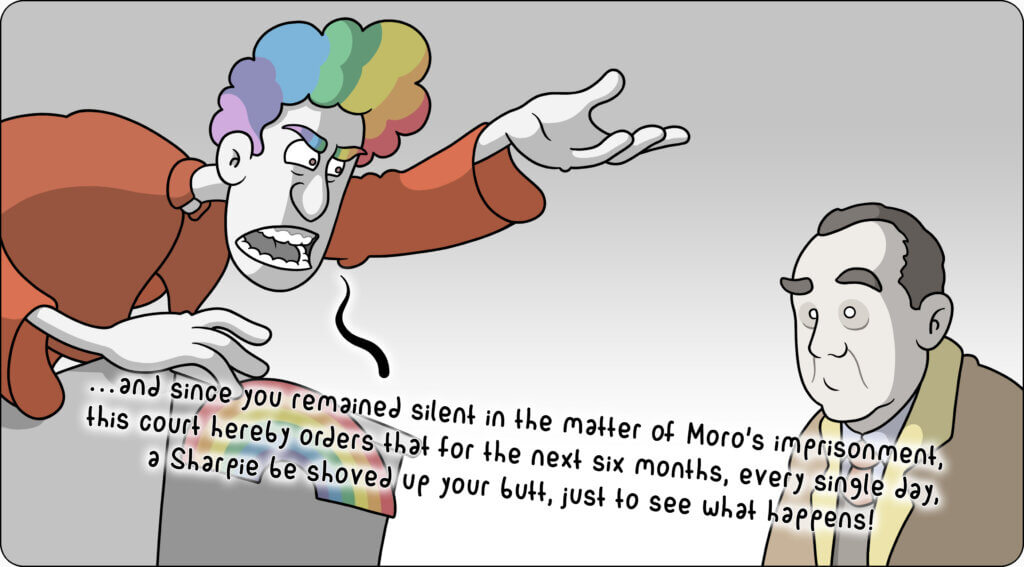
Sciascia describes a situation not all that different from the examples I mentioned in the previous section.
When we look at reality (myself included, of course), we never do it neutrally.
Implicitly, our gaze – even before it lands on people, current events, or history – is already colored by a certain feeling we have toward whatever we’re looking at.
So we end up judging people and situations in one of two ways, which (for lack of better words) I’d call:
- Constructive/Positive/Understanding;
- Destructive/Pessimistic/Indignant.
3 • Indignation… in the Gospels
The Gospels contain quite a few episodes that deal with indignation, more or less explicitly.
In some cases, the ones who feel it are the disciples themselves:
And when the ten heard it, they began to be indignant at James and John.
(Mark 10:41)
But when the disciples saw it, they were indignant, saying, “Why this waste?”
(Matthew 26:8)
At other times, it’s the crowd or the chief priests who feel it:
When they heard this, all in the synagogue were filled with wrath.
(Luke 4:28)
But when the chief priests and the scribes saw the wonderful things that he did, and the children crying out in the temple, “Hosanna to the Son of David!” they were indignant […].
(Matthew 21:15)
But the ruler of the synagogue, indignant because Jesus had healed on the sabbath […].
(Luke 13:14)
Finally, there’s the ending of the parable of the prodigal son, where it’s the elder brother who becomes indignant:
But he was angry and refused to go in. His father came out and entreated him.
(Luke 15:28)
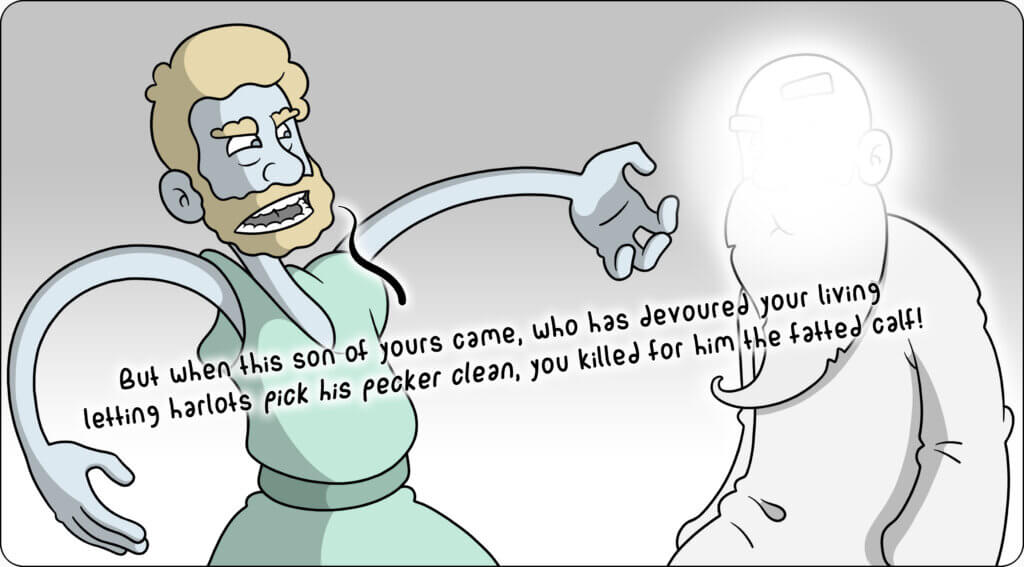
In all these cases – whether it’s the twelve apostles, the crowd, the scribes, or the priests – there’s a common denominator.
Several things often come together in indignation:
- A certain idea of ourselves in relation to others (often seeing others in a “speck in your eye, log in mine” kind of way, cf. Matthew 7:3–5; Luke 6:41–42).
- An ideological take on daily life, current events, the past, and history, which tends to sort everything into “white” or “black,” “good” or “bad,” “us” or “them.”
- The certainty of having figured everything out, or of knowing enough.
In other words, indignation is a mixture of pride and envy.
4 • Foremost Among the Indignant…
Now.
Let’s be real.
Why do I find it so easy to talk about indignation?
Well… because it’s an attitude I fall into anywhere from 7 to 36 times a day:
- When someone doesn’t live up to the expectations I have of them.
- When a public figure says something that gets on my nerves.
- When someone judges the past through a 21st-century lens.
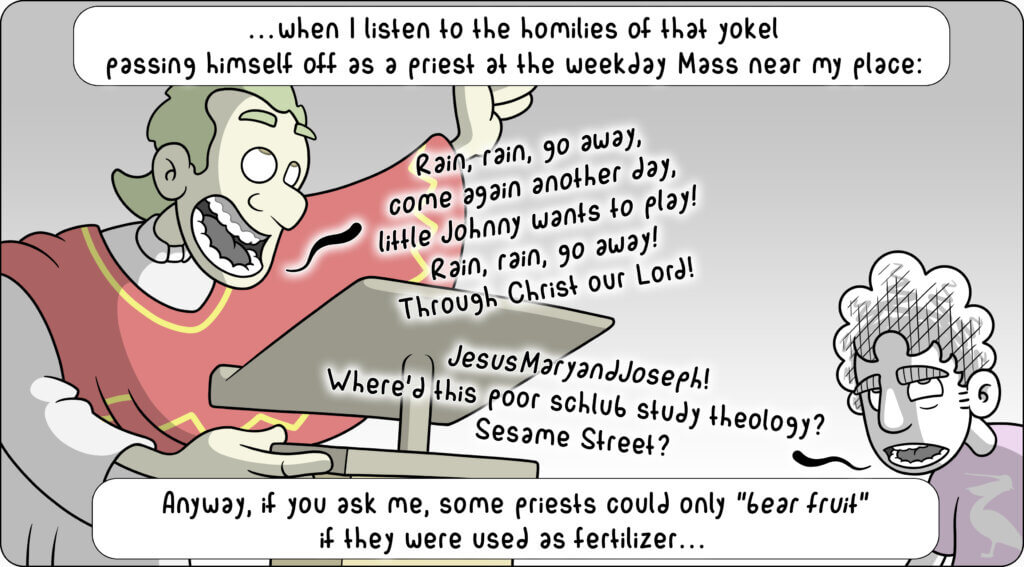
- When a priest changes the words or gestures of the liturgy, thinking he’s being original, when all he’s really doing is pulling me away from the grace of God.
- When a bishop espouses an obvious heresy.
In short.
We’re all in the same boat.
And when it comes to indignation, I’m the “captain of the ship.”
5 • When Does God Get Angry?
In the Gospels, there are a few cases where indignation isn’t presented in a negative light.
Episodes where indignation is, if you will, legitimate.
Which ones?
They’re very easy to spot: the subject of the sentence is God.
In some parables, Jesus attributes this feeling to God, using the figure of a “lord” or a “king” to stand for the Father:
And in anger his lord delivered him to the jailers, till he should pay all his debt.
(Matthew 18:34)
The king was angry, and he sent his troops and destroyed those murderers and burned their city.
(Matthew 22:7)
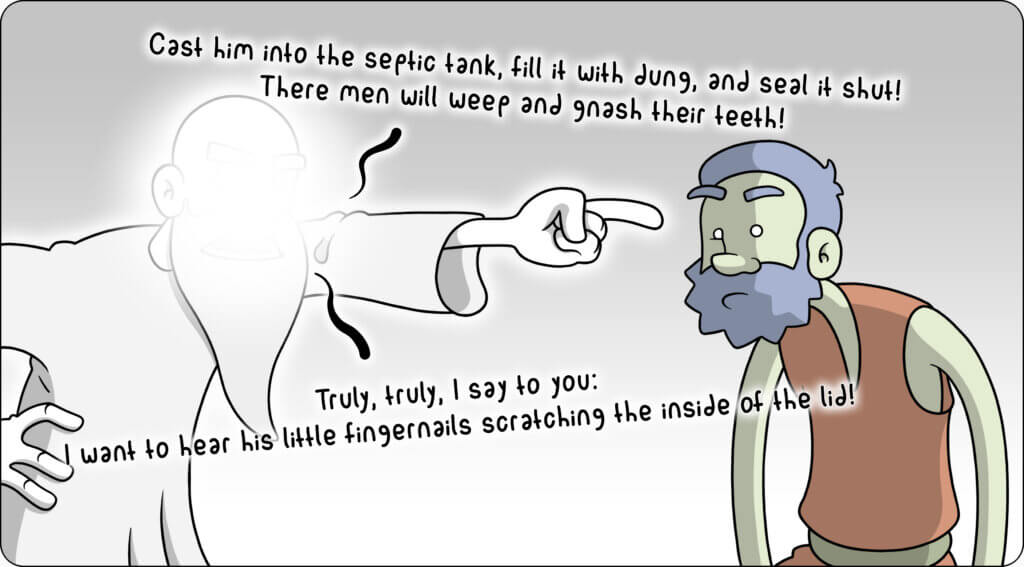
At other times, it’s Jesus himself who feels it:
And he looked around at them with anger, grieved at their hardness of heart, and said to the man, “Stretch out your hand.” He stretched it out, and his hand was restored.
(Mark 3:5)
But when Jesus saw it he was indignant, and said to them, “Let the children come to me, do not hinder them; for to such belongs the kingdom of God.”
(Mark 10:14)
How can God get angry?
Isn’t God supposed to be “the good guy“?
In what situations does God (whether the Father in the parables or Jesus himself) become indignant?
God becomes indignant when He forgives a servant a massive debt, and that servant then turns around and treats someone who owes him ruthlessly, without the slightest compassion (cf. Matthew 18:21–35).
(In other words, outside the parables) God becomes indignant whenever someone receives His free, boundless, overwhelming love… and then hardens their heart.
God becomes indignant when religion becomes an obstacle to the working of His grace (disclaimer: religion, Church structures, hierarchy, precepts, rules, etc., are good things; but they have no life in themselves. They are means, tools, settings in which – if God is at work – it becomes possible to experience new life in Christ, who, by contrast, is “the end”).
Conclusion – “Render to God the Things That Are God’s”
So, what does the Gospel say?
It says that – if anyone gets to be indignant – it’s God (the One who reads hearts and never judges sloppily)…
As for poor clueless souls like me, I think Paul of Tarsus‘s exhortation is more useful:
Let all bitterness and wrath and anger and clamor and slander be put away from you, with all malice.
(Ephesians 4:31)
And that’s it. That’s a wrap.
salt
(Fall 2021)
- GIOVANNI SCIFONI, Senza offendere nessuno : chi non si schiera è perduto, Mondadori, Milano 2021
- MARK MANSON, La sottile arte di fare quello che c***o ti pare, Newton Compton Editori, Roma 2017
- MAURO MOSCONI, SIMONE RICCARDI, Fallaciae - Le prime, uniche e originali carte delle fallacie a fumetti, PSYCOMIX S.r.l