1 • “He who follows frivolity is devoid of understanding” (Proverbs 12:11)
Is faith reasonable?
Does it oppose reason?
Is everything that is not the result of deduction or analytical ability irrational?
Is an act of faith reasonable?
Are Christians credulous without reason?
…
I ask myself each of these questions 17 times a day…

But let’s not be misled…
… appearances (sometimes) deceive!
2 • “To know”… in the third millennium
Nowadays, we are all more or less convinced that a statement is only considered true if what is intended to be communicated is (in some way) rationally demonstrable: through logical-deductive reasoning, the scientific method, mathematics, …
For this reason, faith is not included in the scope of “human knowledge“…
…or, at most (if you want to be generous), it is considered a knowledge of a lower category.
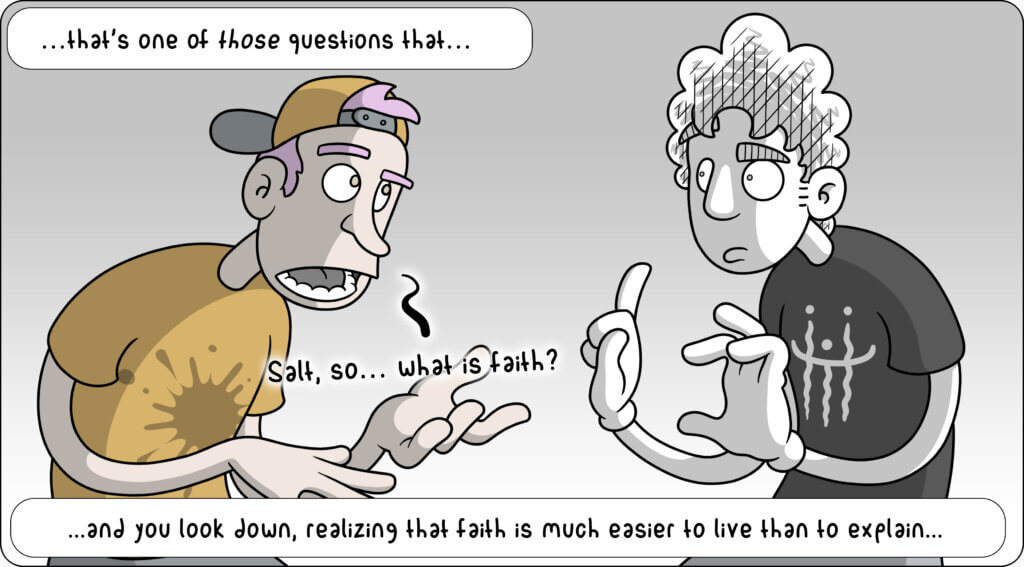
Before determining whether faith can be considered a form of “knowledge” or not, it would be necessary to establish what we mean by “faith”…
3 • “Acts of faith” that we perform in everyday life
Pope John Paul I (1912-1978), during one of the audiences of his very short pontificate (he was pope for 33 days), spoke these words:
My mother used to tell me when I was younger: when you were small, you were very sick; I had to take you to one doctor after another and stay awake all night. Do you believe me? How could I say, “Mom, I don’t believe you?” Of course, I believe, I believe what you tell me, but I believe especially in you.
(JOHN PAUL I, General Audience, September 13, 1978)
Often, we don’t realize it, but in reality, we accept as truth many things that are communicated to us NOT through demonstration or reasoning but based on the value of the testimony of others.
Examples abound:
- The news in the media that we receive daily (I wasn’t there, but I am sure, for example, that Donald Trump met Kim Jong-un);
- Historical events that we have learned about in school books (I have never been to Germany, but I have no doubts that less than 100 years ago the Holocaust occurred);
- Geographical knowledge (I have never been to Kentucky, but I once met a person who claimed to be from there, and – I swear on Nyarlathotep – I believe him!);
- Scientific knowledge that is not accessible to everyone unless they have undergone specific studies (I have no idea how this discovery was made, but I would bet my hand that DNA is composed of adenine, thymine, guanine, and cytosine).
In fact:
Systematically distrusting everything we’re told to believe means drastically limiting our baggage of knowledge and making our life in society impossible.
(ALEJANDRO LLANO, Filosofia della conoscenza, EDUSC, Roma 2011, p. 73)

In all the examples I have presented above, (whether it’s news in the media, historical events, medical and scientific knowledge, etc.), whether we like it or not, an “act of faith” is required.
We acquire knowledge – considered “true” – based on an act of trust in someone (whether it be a person or a constituted authority).
Many of the things we consider “true” – often those that have a fundamental influence on the direction of our lives – do not come from deductive reasoning or demonstration, but we learn them from others.
From birth, therefore, they [men] are immersed in traditions which give them not only a language and a cultural formation but also a range of truths in which they believe almost instinctively. Yet personal growth and maturity imply that these same truths can be cast into doubt and evaluated through a process of critical enquiry. It may be that, after this time of transition, these truths are “recovered” as a result of the experience of life or by dint of further reasoning. Nonetheless, there are in the life of a human being many more truths which are simply believed than truths which are acquired by way of personal verification.
(JOHN PAUL II, Encyclical Letter Fides et Ratio, 31)
4 • “Natural” Faith
Many people have a negative bias towards the word “faith” because they immediately associate it with God, religion, the Church…
…but in reality, the word faith – in itself – does not necessarily have a religious connotation (that is to say — for insiders — faith is not only a theological virtue).
There is indeed what we could call “natural” faith (the definition of which can be found in a very dusty and yellowed encyclopedia):
Faith: it is the assent of the intellect motivated by the value of a testimony. In everyday life, much of our knowledge is based on this form, and it is not absent in the scientific field. It includes elements of intelligence, as no one wants to have faith in someone who does not deserve it; it includes volitional elements, because there is no authority that can compel the intellect as a mathematical or philosophical demonstration does; and it includes feelings, as they can influence the acceptance of one doctrine over another.
(M. CORDOVESE, Faith, in Enciclopedia Italiana Treccani, ed. Istituto dell’Enciclopedia Italiana, Roma 1949, vol. XIV, p. 931)
Let me provide an example (*).
(*) (Note: This will not be an example of “faith” in the strict sense, but please follow my reasoning: I promise to connect it back to this definition later)
…A boy says to a girl, “I love you!“.
From that moment on, the girl will come to know something she didn’t know before…
… but based on what information will she deem what the boy told her to be true?
- A logical-deductive reasoning written on the blackboard?
- A three-page demonstration?
- The boy’s blood test results?
- His electroencephalogram?
- The specialized medical report from a psychiatrist?

In the definition of “faith” that I retrieved from the italian Encyclopedia, I emphasized four words…
…it’s interesting that we find those same four concepts in the example I just gave about the declaration of love:
- testimony: the “truth” that the girl accepts (the boy’s love for her) is not the result of reasoning she does alone, focused on her reflections, but is based on a relationship;
- intelligence: the “truth” that the boy verbally expresses (love) is examined by the girl’s reason;
- volition: the “truth” doesn’t fall on the girl’s head in a sterile manner as if it were a dictionary definition but responds to desires she has in her heart;
- feelings: the testimony of the boy not only touches the girl’s mind, presenting itself as “true“… but also touches her heart, presenting itself as “beautiful” and “good.”
These four words, if we think of them in relation to “faith” and “God,” might seem a bit “silly“:
- testimony
- intelligence
- volition
- feelings
…however, they are the four pillars on which the relationship between a man and a woman is based.
The love between a man and a woman is not based on logical-deductive reasoning or demonstration…
…but (as it seems to me) it is one of the most beautiful, true, good and reasonable things there are.
5 • Believing a Witness vs Believing a Believer
From what we have discussed, it would seem that humans make acts of faith much more often than they realize when acquiring information about…
- news events
- scientific notions
- historical knowledge
- …
- the expiration date of packaged products
- the weather forecasts they read on the weather app
- the dashboard lights in the car indicating whether everything is okay or if they need to go to the mechanic
- the maximum capacity of the elevator (although I confess that every time an overweight person enters an elevator, I try to mentally calculate the weight of everyone present to understand if the cable will break, and we will plummet to our deaths into the void)
- …
- (and, of course) the knowledge of God, as expressed in various religious traditions
However, there is a huge difference depending on whether faith is based on the testimony of:
- a witness: someone who was present at an event, who can precisely explain the reason behind a scientific notion, who has actually been to Kentucky, or Wirral, ect.
- a believer: in this case, we are, in turn, believing someone who has made an act of faith in someone else; therefore, to be sure of what is being testified to us, we should trace the “original witness” to verify the reasons for their credibility.
In short, in the second case, the risk of the “Chinese whispers” or distortion of information is much higher…

6 • Knowing in a Relationship
Indeed, the knowledge gained through a relationship (with an individual or a chain of witnesses) might seem incomplete, defective, and lacking to us “modern” individuals who prefer knowledge obtained through MY reasoning, MY deduction, MY efforts…
Certainly, the more evidence there is for something, the better; hence, welcome scientific research, logic, deduction, “as was to be demonstrated,” etc.
Man is indeed the only animal…
- … rational (cf. Gen 1:27): meaning endowed with reason/ intellect/will, capable of reflecting, meditating, and pondering;
- … capable of dominion over Creation (cf. Gen 1:28): not in the sense of domineering, but in cultivating, guarding, testing, subjecting it to one’s investigation, examining it, creating a mathematical model, etc.
However, man is not ONLY this.
Modern thought, which has isolated only these two aspects of man, runs the risk of creating a society in which:
- people turn into individuals (meaning human beings with utilitarian relationships, very weak or entirely absent);
- dialogue transforms into simple communication (i.e., an “aseptic” exchange of information);
- all knowledge not derived from a narrow group of human knowledge – scientific/rationalist/materialist – is considered insignificant.
The consequences of this reductionism are many, and examples abound…

This narrow view, widespread in our society, often loses sight of a fundamental characteristic of man.
It’s true that man is a rational being…
…but he is also a relational being:
So God created man in His own image; in the image of God He created him; male and female He created them.
(Genesis 1:27)
(If any non-believer is reading this statement, they can comfortably interpret it in a secular manner) Man is an image of God only when engaged in a relationship; the image of God is not the “individual man” but the “male and female,” that is, the relational man.
Detached from his relationships, man is not truly human.
Let’s connect this back to the discussion above, regarding:
- rational/solipsistic/logical/deductive knowledge
vs
- knowledge obtained in a relationship
Pope John Paul II observed that:
In believing, we entrust ourselves to the knowledge acquired by other people. This suggests an important tension. On the one hand, the knowledge acquired through belief can seem an imperfect form of knowledge, to be perfected gradually through personal accumulation of evidence; on the other hand, belief is often humanly richer than mere evidence, because it involves an interpersonal relationship and brings into play not only a person’s capacity to know but also the deeper capacity to entrust oneself to others, to enter into a relationship with them which is intimate and enduring.
(JOHN PAUL II, Encyclical Letter Fides et Ratio, 32)
And further:
Human perfection, then, consists not simply in acquiring an abstract knowledge of the truth, but in a dynamic relationship of faithful self-giving with others. It is in this faithful self-giving that a person finds a fullness of certainty and security. At the same time, however, knowledge through belief, grounded as it is on trust between persons, is linked to truth: in the act of believing, men and women entrust themselves to the truth which the other declares to them.
(JOHN PAUL II, Encyclical Letter Fides et Ratio, 32)
In the search for truth (whether they are partial truths, like scientific ones, or “higher” truths, such as the meaning of life), a man who limits himself to rationalism as the ONLY method of inquiry is a man mutilated…
…especially if what is sought is the Truth with a capital “T”:
Such a truth — vital and necessary as it is for life — is attained not only by way of reason but also through trusting acquiescence to other persons who can guarantee the authenticity and certainty of the truth itself. There is no doubt that the capacity to entrust oneself and one’s life to another person and the decision to do so are among the most significant and expressive human acts.
It must not be forgotten that reason too needs to be sustained in all its searching by trusting dialogue and sincere friendship. A climate of suspicion and distrust, which can beset speculative research, ignores the teaching of the ancient philosophers who proposed friendship as one of the most appropriate contexts for sound philosophical enquiry.
(JOHN PAUL II, Encyclical Letter Fides et Ratio, 33)
Conclusion
In short, summarizing…
…a happy synthesis of all the rambling I’ve written so far can be found in the Catechism of the Catholic Church:
[…] Believing is an authentically human act. Trusting in God and cleaving to the truths he has revealed is contrary neither to human freedom nor to human reason. Even in human relations it is not contrary to our dignity to believe what other persons tell us about themselves and their intentions, or to trust their promises (for example, when a man and a woman marry) to share a communion of life with one another.
(Catechism of the Catholic Church, No. 154)
This sentiment is echoed by something written a few years ago by Marko Ivan Rupnik (born in 1954), a Slovenian priest and theologian:
Faith is not irrational, much less antirational. Love is not irrational either. Both have their own intelligence and are, therefore, open to rationality, although not to rationalistic reductionism.
(MARKO IVAN RUPNIK, Dire l’uomo – Volume 1: Persona, cultura della Pasqua, Lipa, Roma 2011, p. 206)
salt
(Spring 2021)
- GIOVANNI PAOLO II, Fides et ratio (enciclica circa i rapporti tra fede e ragione)
- ALEJANDRO LLANO, Filosofia della conoscenza, EDUSC, Roma 2011
- JOSÉ MARIA GALVÁN, Scelti in Cristo per essere santi – II. Morale Teologale, EDUSC, Roma 2018