1 • “Inconsistency, thy name is Church!”
Is the Church inconsistent?
“Preaches well and practices poorly”?
Has it betrayed the original intentions of Jesus?
Has it deviated from the teachings of the master?
Was the “Church of the origins” better?
Have we lost the “good old-fashioned values” (those mentioned in the Family Guy theme song)?
Are Christians today less authentic than in the past?
Less attentive to the words of the Pope?

2 • The marvelous, unsurpassable, lofty, pure (and imaginary) “Church of the origins”
All individuals – both Christian and nonChristian – who are dissatisfied with the Church of our days, almost always compare it to the “Church of the origins.”
With this expression, they refer to an imaginary “golden age” of the Church, in which the Christian community lived authentically, frugally, genuinely, where everyone adhered faithfully to the words of Jesus, showing mercy to one another, attentive to the needs of others, pure of heart, and so on and so forth.
But… did this Church ever truly exist?
From what I recall, in his three years of public life, there were several instances when Jesus reproached the apostles or others who followed him:
But when He had turned around and looked at His disciples, He rebuked Peter, saying, “Get behind Me, Satan! For you are not mindful of the things of God, but the things of men.”
(Mark 8:33)
Then Jesus answered and said, “O faithless and perverse generation, how long shall I be with you and bear with you?”
(Luke 9:41)
And when His disciples James and John saw this, they said, “Lord, do You want us to command fire to come down from heaven and consume them, just as Elijah did?” But He turned and rebuked them.
(Luke 9:54-55)

Even Paul of Tarsus, in various letters to the Corinthians, Galatians, Timothy, and others, did not hesitate to complain about the serious shortcomings of the Christian communities he founded (at one point, Paul even confronts Peter):
And I, brethren, could not speak to you as to spiritual people but as to carnal, as to babes in Christ. I fed you with milk and not with solid food; for until now you were not able to receive it, and even now you are still not able; for you are still carnal. For where there are envy, strife, and divisions among you, are you not carnal and behaving like mere men?
(1 Corinthians 3:1-3)
I marvel that you are turning away so soon from Him who called you in the grace of Christ, to a different gospel,
(Galatians 1:6)
But shun profane and idle babblings, for they will increase to more ungodliness. And their message will spread like cancer. Hymenaeus and Philetus are of this sort, who have strayed concerning the truth, saying that the resurrection is already past; and they overthrow the faith of some.
(2 Timothy 2:16-18)
Now when Peter had come to Antioch, I withstood him to his face, because he was to be blamed.
(Galatians 2:11)
In summary, despite many idealizations, a quick glance at the New Testament (including the Gospels, Acts of the Apostles, and Paul’s letters) provides a much more down-to-earth perspective…
3 • Does “Primitive” mean “better”?
John Ronald Reuel Tolkien (1892-1973), the renowned British writer, wrote these words in a letter to his son Michael in 1967:
The “protestants” look back for “simplicity” and directness – which, of course, though it has a value or at least a negative merit, is a mistake in the present state of knowledge.
Because “primitive Christianity” is and must be, in the nature of things, largely unknown; because “primitiveness” is no guarantee of value, and was and is mostly a reflection of ignorance. Serious abuses were as much a part of the conduct of the Christian “cult” in the beginning as now. (St. Paul’s strictures on the Eucharist show that!). Furthermore, “my Church” was not conceived by Our Lord to remain static or in a state of eternal youth; rather, it was intended to be a living organism (like a plant) that develops and changes externally through the interaction between the divine life passed down to it and history — the specific circumstances of the world in which it finds itself.
There is no resemblance between the mustard seed and the fully grown tree. For those living in the time of its full growth, it is the tree that matters because the history of a living thing is part of life, and the history of a divine thing is sacred.
The wise understand that everything began from the seed, but it is futile to try to bring it back to light by digging, for it no longer exists, and its virtues and powers have now passed on to the tree.
[…] They will certainly cause harm if they are obsessed with the desire to go back to the seed or even to the early youth of the plant when it was (as they think) beautiful and uncontaminated by evil.
(JOHN RONALD REUEL TOLKIEN, from a letter to his son Michael, August 25, 1967, in J.R.R. TOLKIEN, The Letters of J.R.R. Tolkien, ed. Humphrey Carpenter, Houghton Mifflin, 1981)
In paraphrase: it is easy to idealize the past, demonize the present, and yearn for nonexistent “golden ages“…

The myth of the “Church of the origins” is the archetype of every ideology.
Apparently, it refers to the past, but in reality, it negates it, as it erases the entire Tradition to immediately (i.e. without mediation) revert to an unrealistic, abstract, and mythologized idea of the past.
Then again, one might wonder…
Could there ever have been a historical period when the Church was free from sins?
St. Augustine of Hippo (354-430) was somewhat skeptical about it:
But where has the Enemy not sown weeds? What species, what field of wheat has he found and not sown weeds in it? Has he sown them perhaps among the laity and not among the clergy or bishops? Or has he sown them among the married and not among those who profess chastity? Or has he sown them among the married women and not among those consecrated to God? Or has he sown them in the houses of the laity and not in the monastic convents?
He has spread them everywhere, sown them in every place. What has he not left mixed with the weeds? But let us thank God, for the One who deigns to separate cannot make a mistake.
[…]
Why are you surprised to find evil in holy environments? Do you not know that the first sin in paradise was disobedience, and because of it, even the angels fell? Did they contaminate heaven, perhaps? Adam fell: did he contaminate the [earthly] paradise? One of Noah’s sons fell: did he defile the house of that righteous man? Judas fell: did he dishonor the assembly of the Apostles?
[…]
Because of these, the Apostle says: Judge nothing before the appointed time; wait until the Lord comes. He will bring to light what is hidden in darkness and will expose the motives of the heart; so each will receive praise from God. Human praise passes; sometimes one praises a wicked person without knowing them; at times, another accuses a faithful servant of God without knowing them. May God forgive those who do not know; may He come to the aid of those who suffer.
(AUGUSTINE OF HIPPO, from Discourse 73)
4 • Preach well and practice poorly
I know many people who, for one reason or another, have been fascinated by Jesus or his teachings…
…but have been burned by the bad example of many Christians (men of the Church, religious, laity, that grumpy nun with a mustache who taught in first grade class) who, despite preaching the Gospel and claiming to be part of the “Body of Christ,” often scandalize those who observe them, providing with their words or actions a counter-witness to Jesus.
Undoubtedly, a certain coherence of life between words and deeds, between desires and actions, between “saying” and “doing” – for myself first and foremost – would not hurt at all…
…the problem with coherence, however, is that people often pursue it in an idolatrous manner; as if it were something to be “possessed” at all costs, something that – once conquered – can be flaunted in front of others.
I don’t know if you’re aware, but from the first community in Jerusalem to the Church of our days, “coherence” has never been included in the list of Christian virtues.

In reality (catechism in hand), there is something much more important than coherence: humility.
I had already mentioned this passage by Madeleine Delbrêl (1904-1964), a French mystic and social worker… but repetita iuvant (repetition helps):
[…] regarding the example, one must know that we will not always give it. Even in moments when we struggle most firmly against ourselves, we will remain inferior to the example that should be given.
[…] The day we are convinced of being small, a fraternity of little people, treating each other as such, without being surprised at being what we are, many things in our life will harmonize, minimally but truly, with the simplicity of God.
(MADELEINE DELBRÊL, Note scritte secondo l’intenzione dei suoi gruppi, 1956)
Humility – much more than coherence – is a school of virtues; through this narrow gate pass all the beautiful things one can desire… for oneself and for others.
One of these, for example, is gratitude:
We remain individuals on whom criticisms and complaints about the Church do not make an impression because we are grateful. Because without the Church, God would not be our good, and we would not be His good. Because the Church is our mother, and one does not reproach the giver of life for living badly.
(MADELEINE DELBRÊL, from a personal note in 1956, in MADELEINE DELBRÊL, La gioia di credere, Gribaudi, Torino 2012, p. 177)
5 • Looking at the (dirty) finger pointing at the moon… or the moon?
Let’s clarify…
…I believe that someone who distances themselves from the Church because they have been burned by the bad witness of Christians they have encountered – 9 times out of 10 – demonstrates great mental health.
A tree is known by its fruits (cf. Matthew 7:16-20).
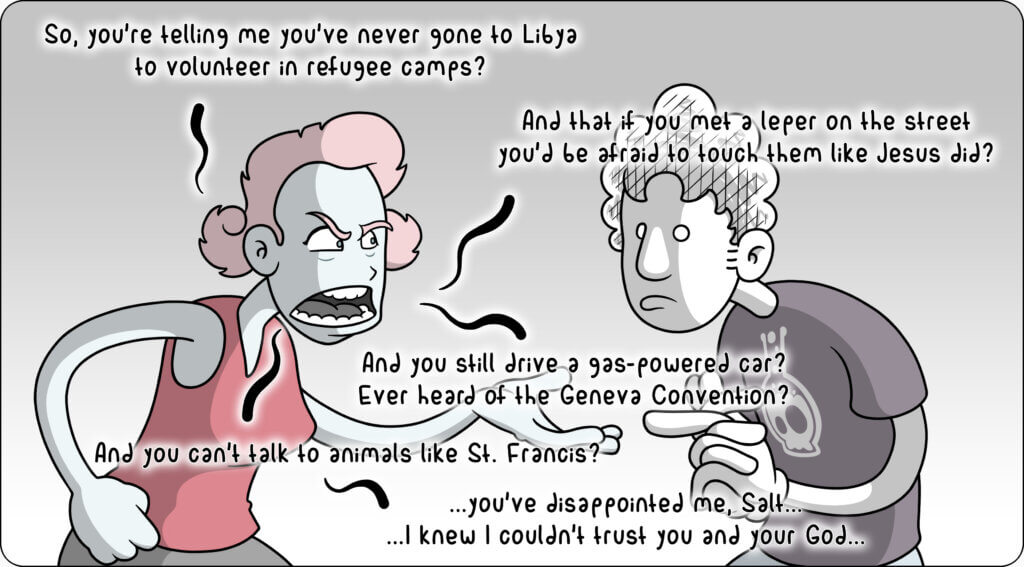
Sometimes, however, the discussion about the “bad witness of Christians” has led to somewhat excessive positions. Such as:
- “In theory, I [person outside the Church] know that, like you [Christian], I am a fragile person with weaknesses, flaws, and sometimes a bit inconsistent.”
- “Despite this, I [person outside the Church] expect from you [Christian] an exemplary coherence between what you profess and how you behave.”
- “And since there is an objective discrepancy between these two things, I [person outside the Church] consider the Church not credible.”
Father Luigi Giussani (1922-2005) wrote:
Jesus said: “And blessed is he who is not offended because of Me” (Luke 7:23); that is, by what he said and did, however paradoxical it might appear.
Similarly, we can say: blessed is the person who does not reject the value because of the possible imperfection of the one who carries it.
(LUIGI GIUSSANI, Perché la Chiesa?, Rizzoli, Milano 2003, p. 180)
Anyone who seeks in the Church, that is, in the community of Christians, a particular “moral perfection” or any other virtuosity is forgetting <em>a small detail… that the Church is made up of human beings!
(If the words of Jesus are true), however, God uses these very men to try to reach everyone…
…as also remembered by Francesco di Assisi, in this episode recounted in the Franciscan Sources:
I have heard that, as the blessed Francis passed through Lombardy and entered a church to pray, a Patarine or Manichean, aware of the saint’s reputation for holiness among the people, approached him. Wanting to attract the people to himself through Francis and thus distort the faith and make the priestly office contemptible, since the parish priest of that parish was scandalous, as he lived with a concubine, he asked the said saint: “Look, should we believe the words of this man and give reverent credit to the life of one who keeps a concubine and has defiled hands, having touched the flesh of a harlot?” The saint, sensing the malice of that heretic, approached that priest in front of the parishioners and, bending his knees before him, said: “I do not know if this man’s hands are as he describes them, but even if they were, I know that they cannot defile the power and efficacy of the divine sacraments. Indeed, through these hands, many heavenly benefits and charisms are poured onto the people of God. For this reason, I kiss them in reverence for what they administer and for the authority of Him for whom they administer it.” And uttering these words on his knees in front of that priest, he kissed his hands, confusing the heretics and their followers who were present.
(from the testimony of Stephen of Bourbon, Franciscan Sources, n. 2253)
6 • Who am I? The scandalized or the scandalizer?
In another letter (from 1963), Tolkien wrote to his son Michael:
The temptation to “not believe” (which actually means the rejection of Our Lord and His demands) is always within us. A part of us longs to find an excuse outside of us to give up. The stronger this inner temptation, the more easily and severely we will be scandalized by others. I think I am as sensitive as you (or any other Christian) to scandals, whether they come from the clergy or the laity. I have suffered painfully in my life because of stupid, tired, ignorant, or even evil priests; but now I know myself well enough to know that I will not leave the Church (which for me would mean breaking the covenant with Our Lord).
[…]
If He is a cheat, and if the Gospels are also: distorted tales of a demented megalomaniac (which is the only alternative), then of course, the show staged by the Church (in the sense of the priests) in the past and today is simply proof of a gigantic fraud.
[…]
We should grieve for the sake of Our Lord, associating ourselves with the scandalizers and not with the saints, without shouting that we cannot accept Judas Iscariot, or the absurd and cowardly Simon Peter, or the foolish women like the mother of James who tries to push her son.
(JOHN RONALD REUEL TOLKIEN, from a letter to his son Michael, November 1, 1963, in J.R.R. TOLKIEN, La realtà in trasparenza: lettere 1914-1973, Bompiani, Milano 2001, p. 380)
Mutatis mutandis, I think the same applies to the reading of The Lord of the Rings…
…we are all (myself included) very good at identifying with Frodo, Samwise Gamgee, Faramir…
…but the truth (at least for me, if I dig into my heart) is different…
…I am a champion of Pharisaism… I have a demanding and pretentious super-ego… and I even have a slight disdain for humanity…
…I would be a perfect cosplay of Boromir…
…then I have a disordered sense of priorities, combined with a pathological attachment to trifles and foolishness…

Gilbert Keith Chesterton (1874-1936), the British writer and journalist, wrote these lines in an essay in 1905:
When Christ, in a symbolic moment, founded His great society, He chose not the brilliant Paul nor the mystic John but a brawler, a snob, a coward, in a word: a man. And on this rock, He built His Church, against which the gates of hell could not prevail. All empires and kingdoms have failed because of this perennial inherent weakness, that they were founded by strong men and on strong men. But this one thing, the historic Christian Church, was founded on a weak man and for that reason is indestructible. Because no chain is stronger than its weakest link.
(GILBERT KEITH CHESTERTON, Eretici, Lindau, Turin 2010, p. 50)
This passage from an interview that Vittorio Messori conducted with Oscar Luigi Scalfaro in 1987 (a few years before he was elected President of the Italian Republic) also struck me:
Every now and then, a priest friend opens a usually closed church for me, in Via di Monserrato, in the center of Rome. I enter and kneel to pray in front of an ancient tomb: that of Alexander VI, Pope Borgia. That wretched pope is dear to me because it is above all in him – even more than in the saintly popes – that the power of God shines. God is God because He sheds light with burnt-out light bulbs; if He used the good ones, what kind of God would He be?
(OSCAR LUIGI SCALFARO, interviewed in VITTORIO MESSORI, Inchiesta sul cristianesimo: sei tu il Messia che deve venire?, Torino, Società editrice internazionale 1987, p. 221)
Conclusion
For those who still have a few minutes to spare – and would like to have a free laugh – I suggest you go read the second tale of the first day of Giovanni Boccaccio‘s Decameron (it’s a 7-minute read).
It’s the story of Abraam the Jew, a Jew who, after a trip to Rome where he witnessed the “malvagitá de’ cherici” (the wickedness of the clergy)… well, I won’t spoil it for you, read it 😉
As for the rest, I return the stage to the director with a quote from Joseph Ratzinger, from one of his books in 1968:
By virtue of the Lord’s gift, never retracted, the church continues to be what he has sanctified, in which the holiness of the Lord becomes present among men. But it is always truly the holiness of the Lord that is made present here and that continually chooses itself as the vessel of his presence, with paradoxical love, even and precisely the dirty hands of men. It is holiness that shines like the holiness of Christ in the midst of the sin of the church. This is the paradoxical figure of the church, in which the divine so often presents itself in unworthy hands, in which the divine is always present only in the form of “nevertheless,” for the faithful a sign of the “nevertheless” of God’s love, ever greater.
(JOSEPH RATZINGER, Introduzione al cristianesimo, Queriniana, Brescia 2005, p.331)
salt
(Spring 2021)
- LUIGI GIUSSANI, Perché la Chiesa?, BUR Rizzoli, Milano 2003
- VITTORIO MESSORI, Inchiesta sul cristianesimo: Sei tu il Messia che deve venire?, SEI, Torino 1987