1 • Charity: The “beauty farm” of the soul?
99.999999% of the people I know engage in “charity” (in many quotation marks) for the following reasons:
- 80% out of pride (those who post on Instagram photos showing “how good they are”);
- 15% out of guilt (to ease their conscience);
- 4.999999% because they are forced to.
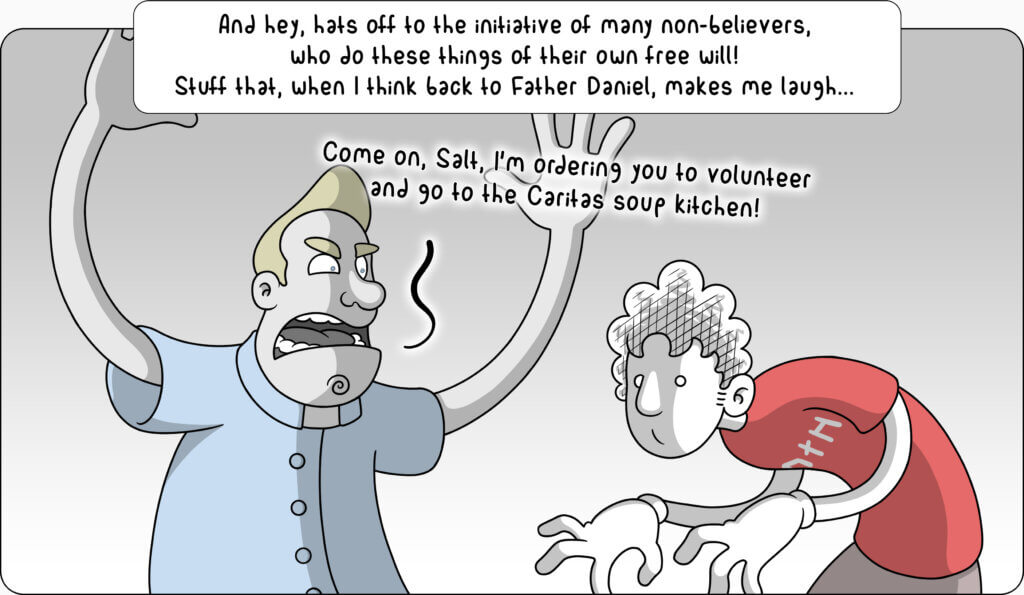
I fell into the third group, all those times when – as a kid – volunteer work at the Caritas soup kitchen was organized in the parish.

And then, between us, the annoyance wasn’t even so much the smell, but the “sharing” that took place in the parish after our “pious and selfless” work:

(INTERLUDE 1) • Folk Wisdom
May God save you from lightning and thunder
and from the sad ones who pretend to be good.
(Italian Proverb)
2 • Charity: An Outdated Concept?
I’ve noticed that in many parishes, the word “charity” doesn’t enjoy a good reputation.
It has a somewhat “outdated” feel to it.
It’s a bit too “churchy“; it carries that slightly musty flavor of incense, old ladies with rosaries, and spikenard oil.
Instead of using this word, people often prefer to say “volunteer work.”
This way, it’s also easier to relate to those who are not Christian and use other terms like “altruism,” “philanthropy,” or “humanitarianism.”
However, there’s something that leaves me perplexed.
In the ‘dialogue’ between parish realities dedicated to the poor and secular ‘socio assistance’ associations, the following message often comes across (more or less in these words):
To ‘do good,’ in the end, all you need is:
- Roll up your sleeves;
- Have a bit of goodwill.
Yes, okay, Jesus is also quite likable, of course!
But come on, we’re in the third millennium; by now, we’ve figured out how we should behave.
At most, we might need a ‘life coach’ to give us the right ‘mental attitude.’
(INTERLUDE 2) • But first… let me take a #selfie!

Take heed that you do not your alms before men, to be seen of them: otherwise you have no reward of your Father which is in heaven. Therefore when you do your alms, do not sound a trumpet before yourself, as the hypocrites do in the synagogues and in the streets, that they may have glory of men. Verily I say unto you, They have their reward.
But when you do alms, let not your left hand know what your right hand does: that your alms may be in secret: and your Father which sees in secret himself shall reward you openly.
(Matthew 6:1-4)
3 • What is Charity?
Here is what the good Father Luigi Maria Epicoco, an Italian priest and theologian (born in 1980), wrote:
When we talk about Faith, Hope, and Charity, we say that we are facing the theological virtues.
The obscure word ‘theological’ next to ‘virtues’ means something very simple: these virtues are given by God and are not part of the characteristic arsenal of our human nature.
Yet, in the normal course of our lives, it happens that sometimes we enter into a circuit of guilt produced precisely by Faith, Hope, and Charity.
All this is activated because we think, without realizing it, that Faith, Hope, and Charity are our own, human efforts; and since most of the time, we cannot fully live the dynamics of these three gifts, we feel guilty, we feel lacking.
(LUIGI MARIA EPICOCO, Sale non miele, San Paolo, Cinisello Balsamo 2017, p. 49)

Don Luigi continues:
No one is actually capable alone of Faith, or Hope, or Charity.
At most, humanly, we are capable of trust, which is a different matter from Faith; we are capable of optimism, which is different from Hope, and we are capable of doing good, which is a different matter from Charity.
Now, it is obvious that human attitudes must correspond to the theological gift of Faith, Hope, and Charity, but human attitudes alone are not enough.
(LUIGI MARIA EPICOCO, Sale non miele, San Paolo, Cinisello Balsamo 2017, p. 49)
(INTERLUDE 3) • A (spiritual) hernia of goodness!
And though I bestow all my goods to feed the poor, and though I give my body to be burned, and have not charity, it profites me nothing.
(1 Corinthians 13:3)
This was at the very heart of Paul’s debate with the Pharisees: the issue of whether salvation is attained by faith or by the works of the law. Paul rejects the attitude of those who would consider themselves justified before God on the basis of their own works. Such people, even when they obey the commandments and do good works, are centred on themselves; they fail to realize that goodness comes from God.
Those who live this way, who want to be the source of their own righteousness, find that the latter is soon depleted and that they are unable even to keep the law.
(POPE FRANCIS, Encyclical Letter Lumen Fidei, 19)

4 • “… and the second is like unto it, you shall love your neighbour as yoursel” (Matthew 22:39)
A few years ago, Benedict XVI wrote these lines:
It is time to reaffirm the importance of prayer in the face of the activism and the growing secularism of many Christians engaged in charitable work.
(BENEDICT XVI, Encyclical Letter Deus Caritas Est, 37)
Perhaps this statement may have raised eyebrows among some Christians who are “a little too active and not contemplative enough,” like:
- “Come on, enough with these clericalisms! Less prayer, more action!”
- “But then, what credibility can Ratzinger have, writing these things from the four walls of his lace and doily room! At least Francis has gotten his hands a bit dirty!”
Mmmm… fair enough!
Let’s then take the word away from the German pastor and give it to Madeleine Delbrêl.
Madeleine Delbrêl (1904-1964) was a French social worker; she spent her entire life in the working-class outskirts of Paris, where she worked tirelessly for the poor.
Madeleine was also a mystic and a spiritual director; she left us a large number of writings, which are imbued with holiness, orthodoxy, and love for the Church (here I say it, and here I deny it, in my opinion, Madeleine Delbrêl will be proclaimed ‘Doctor of the Church’ within the next 100 years).
Now.
There is a very famous passage in the Gospel where the Pharisees (that is, the ‘Hermione Granger‘ of 1st-century Judea) pose ‘trap questions‘ to Jesus to put him in a difficult position:
But when the Pharisees had heard that he had put the Sadducees to silence, they were gathered together. Then one of them, which was a lawyer, asked him a question, tempting him, and saying, “Master, which is the great commandment in the law?” Jesus said unto him, “You shall love the Lord your God with all your heart, and with all your soul, and with all your mind. This is the first and great commandment. And the second is like unto it, You shalt love your neighbour as yourself. On these two commandments hang all the law and the prophets.”
(Matthew 22:34-40)
This is how Madeleine commented on this passage in 1950:
The love of God is the first commandment. But the second is like it: only through others can we render love for love to God.
The danger is that the second commandment becomes the first.
[…]
Faith and hope are the prayer that gives them to us. Without praying, we cannot love.
[…]
It will be faith and hope, expanded by prayer, that will clear the path of our love from its most cumbersome obstacle: the concern for ourselves.
The third danger is to love not ‘as Jesus loved us’ but in a human way. And it is perhaps the most serious of dangers. Because human love, participating in Love, is something beautiful and great. Non-believers can love others with magnificent love. But we have not been called to this love. It is not our love that we must give: it is the love of God.
(MADELEINE DELBREL, note from 1950, from La gioia di credere, Gribaudi, Torino 2012, p. 74)
5 • Charity: simmering in the love of God
In another note, Delbrêl wrote:
Charity, we do not ‘do’ it, even though it is ours.
God, and God alone, can ‘do’ charity. We must ask Him for it, we must receive it.
[…]
We should neither be the agitated nor the activists of charity.
We should be passive, patient, those who support the passion of charity: through this, and only through this, God’s loving action can pass into the world.
(MADELEINE DELBREL, note from 1950, from La gioia di credere, Gribaudi, Torino 2012, p. 82)
Against the danger of activism, against the illusion of becoming better with an extra effort, against the risk of slipping into pride (which is always around the corner in these contexts), Madeleine suggests the path that many saints before her have taken: prayer, silence, patience, poverty of spirit.
Her docility and gentleness reminded me of those of Mother Teresa of Calcutta…

(In your spare time, look up on Google how much time Mother Teresa spent every day in Eucharistic adoration before bringing to others what she had first received from God)
Charity is a gift.
And the only way to obtain it is to be in the company of the Person who can give us this gift:
[…] when we realize that we do not have these three gifts [Faith, Hope, and Charity], instead of feeling bad and guilty, we should do the simplest thing in the world: ask for them.
[…]
We do not realize that the vast majority of important things in our spiritual life are a gift, and the gift is received only with the logic of a child who goes to the mother and says, “I need…”
What is the worst illness that can strike us in our spiritual life? Self-sufficiency, thinking that we don’t need anyone. Thinking that we must grow to the point of getting rid of the help of everyone, including God. Spiritual maturity is exactly the opposite: it is understanding that we are dependent on God.
(LUIGI MARIA EPICOCO, Sale non miele, San Paolo, Cinisello Balsamo 2017, p. 49)
Conclusion
Madeleine Delbrêl wrote again:
We do not learn charity; we come to know it little by little by getting to know Christ.
It is faith in Christ that makes us capable of charity.
[…]
It is the spirit of Christ that makes us live in charity, active through charity, fruitful in charity.
(MADELEINE DELBREL, written for a group departing for Ivory Coast, 1961, from La gioia di credere, Gribaudi, Torino 2012)
…anyway…
Not to take ourselves too seriously, let’s say goodbye with a thought from Douglas Adams:
Not only, so to speak, did their left hand not always know what their right hand was doing: very often, their right hand didn’t know well what it was doing either.
(DOUGLAS ADAMS, from So Long, and Thanks for All the Fish, the fifth book in the Hitchhiker’s Guide to the Galaxy series)
salt
(Summer 2020)
- MADELEINE DELBRÊL, La gioia di credere, Gribaudi, Torino 2012
- LUIGI MARIA EPICOCO, Sale non miele. Per una fede che brucia, San Paolo, Cinisello Balsamo (MI) 2017
- BENEDETTO XVI, Deus Caritas Est (enciclica sull’amore cristiano)
- FERNANDO OCÁRIZ, Carità senza Dio? Il cammino cristiano dell'amore, Ares, Milano 2016