Ah, the notorious apocryphal Gospels.
The hidden Gospels.
Secret.
Controversial.
Narrating scandalous things about Jesus and Mary Magdalene.
They tell of Nicodemus engaging in catcalling with the Samaritan woman…
…of Judas, who perhaps was good, but it was necessary for him to betray Jesus as it was written in God’s plans.
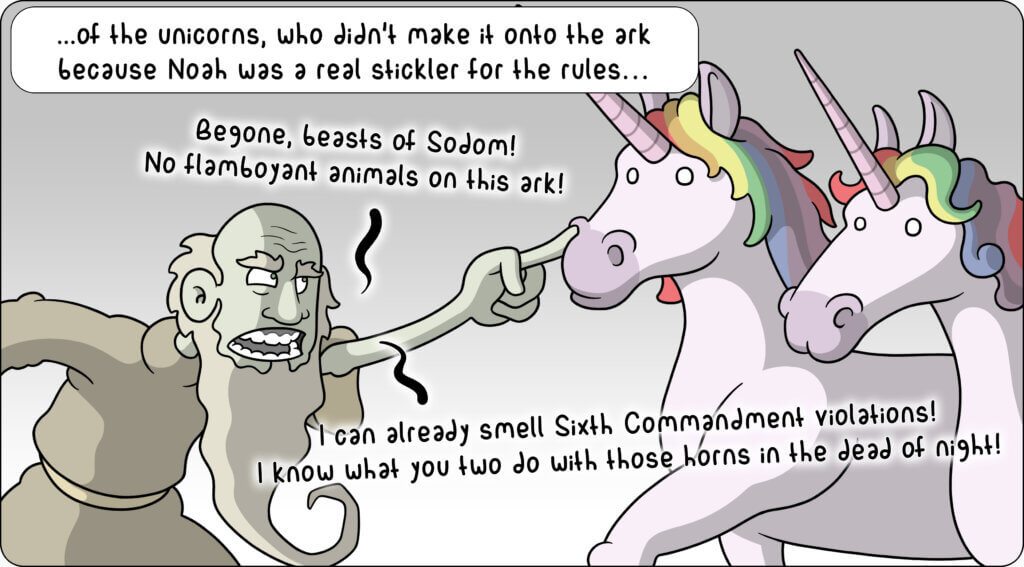
Yes, exactly, the nonsense is quite significant…
…but let’s try to make sense of it and bring some order:
- What are the apocryphal Gospels?
- Who wrote them?
- When were they written?
- Above all… why?
1 • What does apocryphal mean?
The word “apocryphal” comes from the Greek adjective apòkryfos (ἀπόκρυϕος, composed of apo “from” and kryptein “to hide”), which means “hidden, concealed, secret” (etymology kindly provided by Merriam-Webster).
But “hidden” in what sense?
Who hid the apocryphal texts?
The Church? The Vatican?
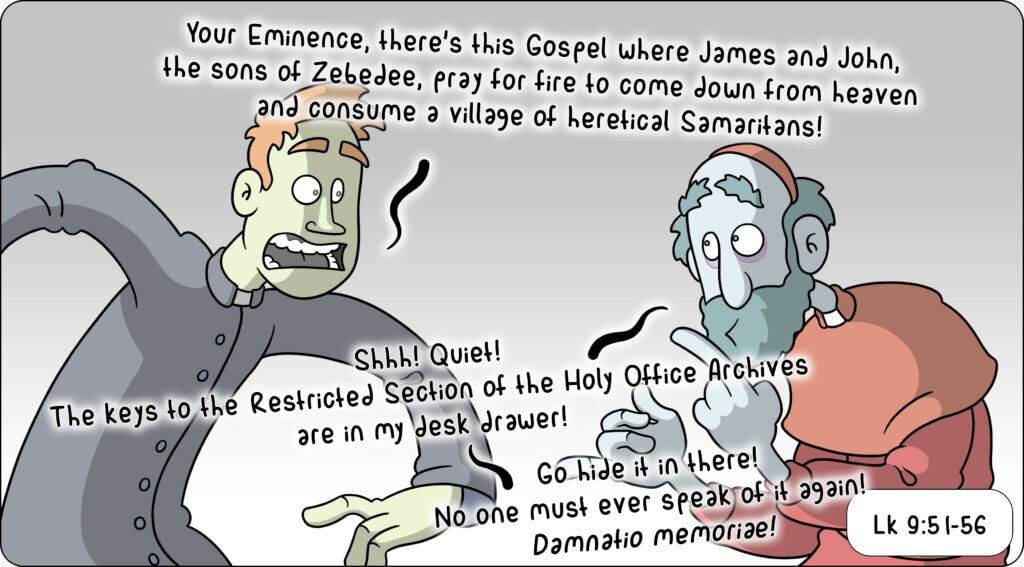
In fact, it’s precisely the apocryphal Gospels that use the term “secret” (i.e., “apòkryfos”) in their openings:
These are the secret sayings which Jesus the living one spoke, and which Didymos Judas Thomas inscribed.
(Opening of the Coptic Gospel of Thomas, circa 140 AD)
These are the secret words which the Savior spoke to Judas Thomas, and which I, Matthew, recorded in writing.
( (Opening of the apocryphal Gospel of Judas, circa 130-170 AD)
These are the hidden mysteries he [the Savior] revealed in silence […] and taught to John, who paid attention to them.
(Opening of the Apocryphon of John, circa 120-180 AD)
The reason the term “hidden” is used is straightforward: to pretend there is no chronological gap between these texts and the other New Testament writings.
In what sense?
Imagine living in the year 150 AD.
The letters of Paul and the other canonical Gospels have been circulating for 50-100 years (the first letter to the Thessalonians, the earliest in Paul’s letters, dates back to 50-52 AD; the Gospels were written between 65 and 100 AD).
Now, you come across an apocryphal Gospel that speaks of Jesus, narrating different episodes than those transmitted by Paul or the evangelists… the spontaneous question arises:
“Why does this text, which says different things about Jesus, only surface now? Why has no one talked about it in the last 50-100 years?”
The answer is straightforward (and if you don’t want to invoke philology, textual criticism, and archaeology, you can arrive at the same conclusion using Occam’s razor):
“No one has talked about this text in the last century because it hadn’t been written yet!”
The answer that the authors of the apocryphal texts seek to evoke, using the term “hidden,” is rather:
“This text was written a long time ago, but it has always circulated in secret!
Year after year, we passed down these top-secret secrets about Jesus by whispering them in each other’s ears!
If you’ve never heard of it, it’s not because it didn’t exist… but because it was super-hidden!”
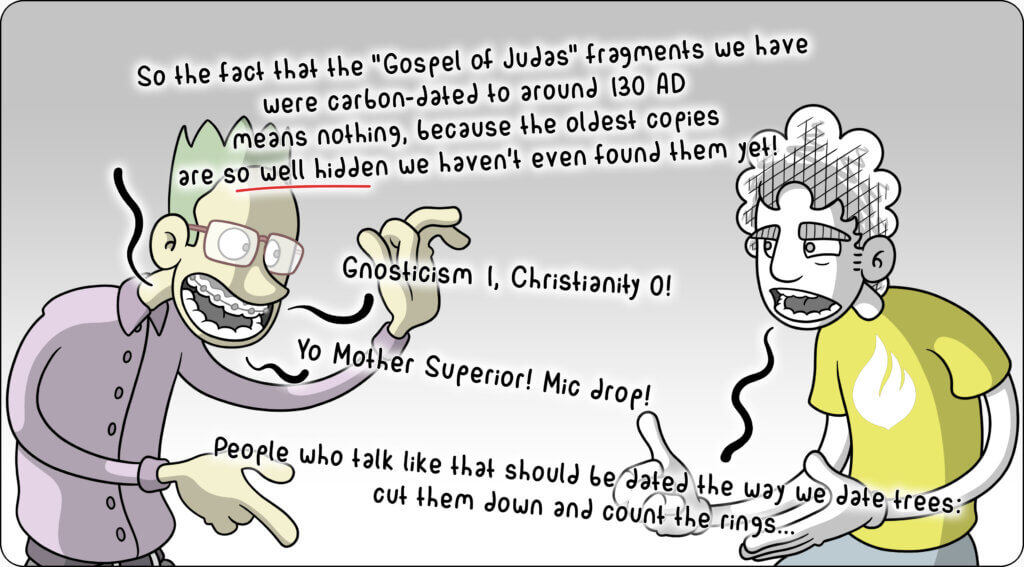
The device of “secrecy” is a literary genre through which one simulates that a text was composed “in the past” and that it circulated “in secret,” even though its actual composition is much more recent.
2 • What are the apocryphal Gospels?
This term refers to a literary production of texts that (for the most part) were written between the 2nd and 6th centuries AD and, in content and form, are similar to the canonical Gospels.
Some of these texts contain a collection of sayings attributed to Jesus (like the Gospel of Thomas)…
…while others (the majority) narrate episodes written to satisfy curiosity about certain aspects of Jesus’s life: his infancy (Protoevangelium of James, Infancy Gospel of Thomas, etc.), his passion and resurrection (Gospel of Peter, Acts of Pilate, Gospel of Nicodemus, etc.).
After all, even in our days, if a brand is successful, it gets squeezed like a citrus fruit…

(For the information I have reported in this and the next paragraph, see PIERRE DEBERGÉ, “Et si les évangiles apocryphes disaient vrai?”, in ALAIN MARCHADOUR (ed.), Que sait-on de Jésus de Nazareth?, Bayard, Paris 2001, 9-33, cited in PIERRE DEBERGÉ and JACQUES NIEUVIARTS, Guida di lettura del Nuovo Testamento, EDB, Bologna 2006, p.78)
3 • What’s “wrong” with the apocryphal Gospels?
The two main “oddities” within the apocryphal Gospels are these:
- the presence of Gnostic doctrines;
- the pursuit of a “sensationalistic narrative.”
3.1 • Gnostic Teachings
The term “apocryphal” (secret) initially alluded to a revelation transmitted only to some (not to all Christians) and that could be communicated only to selected individuals. […] Many of them contain Gnostic doctrines.
(JERÓNIMO LEAL, Avvio alla Patrologia, EDUSC, Roma 2015, p. 89)
The fact that the teachings in the apocryphal Gospels are addressed to only a few people is due to the fact that many of these texts originated in a Gnostic environment (for those unaware – Wikipedia in hand – Gnosticism was a philosophical, religious, and esoteric movement, with an initiatory character, widespread between the 2nd and 4th centuries, according to which the salvation of the soul depended on a form of higher and enlightened knowledge).
However, this secrecy and exclusivity are quite distant from Jesus’s style, who repeatedly emphasized that the announcement of the Kingdom of God is for everyone:
Jesus answered him, “I spoke openly to the world. I always taught in synagogues and in the temple, where [a]the Jews always meet, and in secret I have said nothing. Why do you ask Me? Ask those who have heard Me what I said to them. Indeed they know what I said.”
(John 18:20-21)
Therefore do not fear them. For there is nothing covered that will not be revealed, and hidden that will not be known. Whatever I tell you in the dark, speak in the light; and what you hear in the ear, preach on the housetops.
(Matthew 10:26-27)
“No one, when he has lit a lamp, covers it with a vessel or puts it under a bed, but sets it on a lampstand, that those who enter may see the light.
(Luke 8:16)
3.2 • The “Wonder” of the Apocrypha and the Evangelical Impassibility
In the apocryphal texts, there are many passages that emphasize the miraculous aspect of Jesus’s actions…
…many of these episodes are placed during his infancy (of which the canonical Gospels provide very few details); the funny thing is that often Jesus is portrayed as a violent and capricious child:
- at the age of four, Jesus is playing with mud near the Jordan River; another child plays a trick on him; Jesus curses him, and the child dies instantly (in the Gospel of PseudoMatthew, see M. ERBETTA (ed.), Gli apocrifi del Nuovo Testamento. Vangeli. Infanzia. Passione. Assunzione di Maria, vol. I/2, Marietti, Casale Monferrato (AL) 1981, p.57);
- on the same occasion, he creates twelve little birds from mud and, with a clap of his hands, gives them life, and they fly away (in the Gospel of Pseudo-Matthew, see M. ERBETTA (ed.), Gli apocrifi del Nuovo Testamento. Vangeli. Infanzia. Passione. Assunzione di Maria, vol. I/2, Marietti, Casale Monferrato (AL) 1981, p.57);
- on another occasion, a boy running along the road accidentally bumps into Jesus, and He – striking him on the spot – makes him fall to the ground dead; then, when the witnesses of the event go to tattle to Joseph, Jesus makes them lose their sight (in the apocryphal Ta paidika tou Kyriou (“The Marvels of the Lord”), see M. ERBETTA (ed.), Gli apocrifi del Nuovo Testamento. Vangeli. Infanzia. Passione. Assunzione di Maria, vol. I/2, Marietti, Casale Monferrato (AL) 1981, p.84-85).
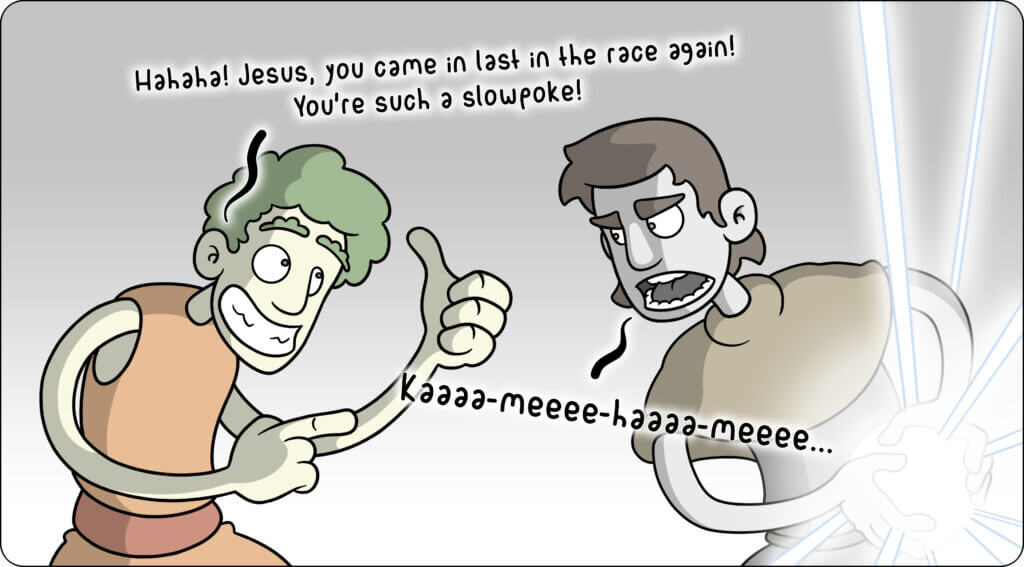
(For a rundown of other examples of apocryphal texts, you can read this article by Father Andrea Lonardo, which features many other entertaining passages.)
In short, the style of the apocrypha:
- is sensationalistic;
- is baroque;
- is rich in anecdotes that “wink” at the reader;
- is clickbait;
- s in line with the religious mythology of that historical period.
On the contrary, the four canonical Gospels:
- are very sober (critics speak of “evangelical impassivity“);
- report information with the detachment of a chronicler;
- narrate all the “happy events” of Jesus’ life in a neutral manner, without any personal commentary from the editor (no jubilation for the birth of the Messiah, and no phantasmagorical description when Jesus performs miracles);
- even moments that could be charged with greater drama are described impassively: do you remember the scene of the flagellation in the movie “The Passion of the Christ” (2004, by Mel Gibson)? Well, those 20-30 minutes full of tension in the Gospel are summarized with a simple: “So then Pilate took Jesus and scourged Him” (John 19:1). No feelings, no pathos, no emotions;
- even after the Resurrection, Jesus is described quite mundanely eating roasted fish (cf. Luke 24:36-43).
4 • Who decided which Gospels are “acceptable” and which are not?
But who decided that the four Gospels are correct and the apocryphal ones are not?
The Vatican?
The Congregation of the Index of Forbidden Books?
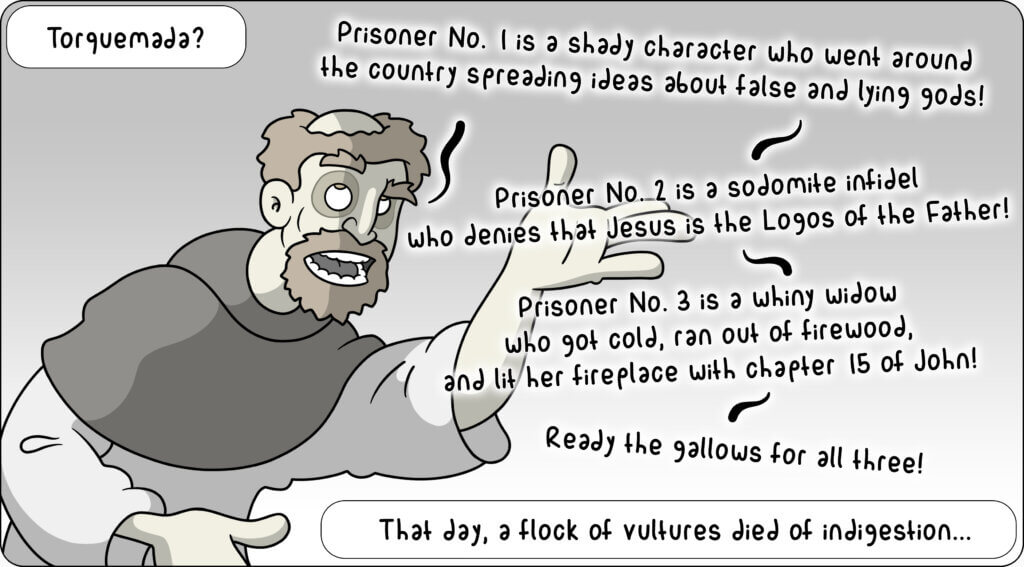
No.
It was the Christian community itself – the one “at the origins” – that from the beginning distinguished “the originals” from the “fakes“.
How?
Primarily through two criteria (*).
The four canonical Gospels, in fact:
- are linked to apostolic preaching: that is, these texts originated within communities founded by the apostles: one centered around John, one around Matthew, one around Peter (for the Gospel of Mark), and one around Paul (for the Gospel of Luke); the testimony contained in these Gospels could be compared with the apostolic preaching that the members of the communities had heard live;
- were used in liturgical contexts: the texts of Mark, Matthew, Luke, and John (as well as those of Paul’s letters) were read during prayer and during the assemblies of the very earliest Christian communities.
Many of the apocryphal texts were attributed to famous figures (the apostles, Judas, Mary Magdalene, Nicodemus, etc.)… but this is a literary device known as Pseudepigrapha (the attribution of a work to a famous figure who did not actually write it to enhance the text’s authority).
Already in 170, Irenaeus of Lyons (ca. 130 – ca. 202), a Roman bishop and theologian, wrote about the Gnostics:
[They] insinuate an indescribable mass of apocryphal and spurious writings, which they themselves have forged.
(IRENAEUS OF LYONS, Against Heresies 1.20.1)
(*) (End of paragraph note: what I have described in this paragraph is a kind of “rule of nine” that the Christian community has used over the centuries; however, the formation of the canon of the Bible – which defines which books are considered “inspired by God” – was a gradual process that lasted several centuries; there are two summary tables on Wikipedia that outline the stages of this process for the Old and the New Testament.)
Conclusion
Unfortunately, the apocryphal texts do not contain any particularly spicy or scandalous information.
Indeed, in reality, Christian iconography borrowed many anecdotes from the apocryphal texts, which were later absorbed into popular tradition… for example:
- the fact that Jesus’ maternal grandparents were named Joachim and Anne (information contained in the Protoevangelium of James);
- the fact that in the stable with the child Jesus there were a donkey and an ox (an episode recounted in the apocryphal PseudoMatthew).
It’s a bit disappointing for fans of Dan Brown, but beyond a few amusing episodes featuring the young Jesus (like the ones I mentioned above) or some overly intellectualized Gnostic doctrines, the apocryphal texts are quite dull.
salt
(Summer 2021)
- PIERRE DEBERGÉ, JACQUES NIEUVIARTS, Guida di lettura del Nuovo Testamento, EDB, Bologna 2006
- JERÓNIMO LEAL, Avvio alla Patrologia, EDUSC, Roma 2015
- ANDREA LONARDO, Chi ha nascosto gli apocrifi?, articolo sul sito de «Gli Scritti»
- ANDREA LONARDO, Il Gesù totalmente Figlio di Dio e non vero uomo degli apocrifi, articolo sul sito de «Gli Scritti»
- ANDREA LONARDO, Gli apocrifi alle origini della rappresentazione iconografica dell’infanzia della vita di Maria in età paleocristiana (Santa Maria Maggiore) e medioevale (Cappella degli Scrovegni), articolo sul sito de «Gli Scritti»
- PAOLO CURTAZ, Gesù zero. Per dissetare l'intelligenza, San Paolo, Cinisello Balsamo (MI) 2017
- VITTORIO MESSORI, Ipotesi su Gesù, Ares, Milano 2019