1 • Is Jesus… a marshmallow?
Well, let’s see…
…I received my “heavy metal baptism” with System of a Down at the age of thirteen; it was the year of our Lord 2004.
A few months later, I was already transitioning to Korn.
I’ll spare you the escalation with the various other groups that a typical teenager listens to: a nihilistic-cynical mix so intense that even Nietzsche would be like: “Whoa, move over…”.
You understand well, therefore, that when the priest, during the homily, came out with exhortations like:

Here, the more I heard these “euphoric” and “flowery” speeches (stuff even Pollyanna wouldn’t buy into), the more I felt nauseous.
And I wondered: am I the only idiot who is actually sad, or is there someone else to whom this sermon doesn’t really mean anything?
Does Christianity boil down to this? Struggling to be happy?
2 • Is Jesus… a moralizer?
Then there were other priests, whose sermon (in a nutshell) consisted of:
- «Strive to be more generous!»
- «I urge you: be kinder!»
- «Be less selfish!»
- «Be more welcoming!»
- «Be more affectionate!»
- «Don’t be mean!»
Now, it happens that I am also a deeply proud person.
And if someone (be it the priest during the homily, the Instagram influencer, or the current politician) comes out with similar phrases, only one thing comes to my mind:

Even the sermon from the pulpit would drive me crazy.
And I wondered: perhaps Christianity boils down to this? Struggling to be better?
Is it a competition to see who is more consistent? More of a moralizer?
3 • Is Jesus… a copycat?
A few years later, someone else told me that Jesus came to “give us teachings”.
To provide us with the “instruction manual for life” to live happily and in peace with others.

What didn’t add up?
Many people believe that Jesus’s “mission” consisted of transmitting “precepts” on love for others, mercy towards the distant, compassion for the least…
…all well summarized in:
You shall love your neighbor as yourself. (Mark 12:31)
Now, let’s be clear.
Certainly, teachings on charity, piety, and benevolence were very dear to Jesus… it’s enough to see how often he talks about them in the Gospels (e.g., Matthew 5:1-48; Mark 12:28-34), often resorting to parables (e.g., Luke 10:25-37; Luke 16:19-31); not to mention that Jesus makes charity the “criterion” for judgment at the end of times (Matthew 25:31-46).
However, many of these teachings are not “innovations” brought by Jesus; for example, “you shall love your neighbor as yourself” is a phrase found in Leviticus (Lev 19:18) (one of the early books of the Old Testament, written centuries before the birth of the Galilean carpenter).
The same can be said of many other invitations to “open up to others”.
Just to mention one, we read again in Leviticus:
When an alien resides with you in your land, you shall not oppress the alien. The alien who resides with you shall be to you as the citizen among you; you shall love the alien as yourself, for you were aliens in the land of Egypt: I am the Lord your God.
(Lev 19:33-34)
In short, many of the “innovations” taught by Jesus are not new: they were already contained (more or less explicitly) in the Old Testament (*).
But not only there…
(*) (For all the “Hermione Grangers”: I know well that at this point, someone will want to point out that Jesus actually came to give a “new interpretation” of the Law, to “fulfill,” etc… okay, well done: “10 points to Gryffindor!” Can I continue now?)
4 • Is Jesus… a super-copycat?
In 1943, Clive Staples Lewis authored an exceptional book titled The Abolition of Man (refer to the bibliography at the end for details).
Apart from its literary merit, the booklet (spanning fewer than 100 pages) includes an “appendix” where Lewis compiles a collection of precepts from diverse historical cultures (Indian, Chinese, Norwegian, Egyptian, Roman, etc.).
A few examples follow:
“In Nástrond (Hell) I saw… the murderers.” Old Norse (Voluspá 38, 39)
“Do not utter a word by which another may be wounded.” Hinduism (Janet, Histoire de la science politique vol. I, p. 7)
“Do not do to others what you would not want done to yourself.” Ancient Chinese (Analects of Confucius, tr. A. Waley XV. 23)
“Men were created that they might do good to one another.” Roman culture (Cicero, De Officiis, I. VII)
“In the tribe of the Dalebura, a woman, crippled from birth, was taken in turn by members of the tribe until her death at the age ofsixty-six […] They never abandon the sick.” Australian Aborigines (Le Jeune, Encyclopedia of Religion and Ethics, p. 443)
“You will see them taking care of their relatives [and] the children of friends without ever reproaching them in the slightest.” Native
Americans (Le Jeune, Encyclopedia of Religion and Ethics, vol. V, p. 437)
«Children, old people, the poor, and the sick are to be considered the lords of the atmosphere». Hinduism (Janet, Histoire de la science politique vol. I, p. 8)
“Do not choose to gain dishonorably rather than lose.” Greek (Chilon, fragment 10. Diels.)
“Respect him whom you know as well as him whom you do not know.” Ancient Egyptian (Le Jeune, Encyclopedia of Religion and Ethics, p. 482)
“The tongue of one who is full of lies is not worth much in your presence.” Babylonian (Hymn to Shamash, Encyclopedia of Religion and Ethics, p. 478)
“There is nothing better than loyalty.” Old Norse (Hávamál 124)
Do these sound familiar? Do they remind you of something?
Let’s return to the question about Jesus: who is he?
A master of the art of plagiarism? A copycat from other past cultures?

5 • The Natural Moral Law
Let’s try to shift our perspective.
In the letter he wrote to the Romans (between 55 and 58 A.D.), the Apostle Paul says:
When Gentiles, who do not possess the law, do instinctively what the law requires, these, though not having the law, are a law to themselves. They show that what the law requires is written on their hearts, to which their own conscience also bears witness; and their conflicting thoughts will accuse or perhaps excuse them.
(Romans2:14-15)
Augustine of Hippo (between the 4th and 5th centuries) also wrote something similar:
[God] has written on the tablets of the Law what men were not able to read in their hearts.
(Saint Augustine, Enarratio in Psalmum 57, 1: CCL 39, 708 – PL 36, 673)
From the early centuries, the Church has consistently spoken of the existence of a natural moral law, written by God in the heart of every person and supported by reason (incidentally, throughout history, the Church has not been the only one to assert this: ever heard of natural law in high school?).
Something “internal,” therefore, and not “external.”
It is by virtue of this law that every person, throughout history, has always considered stealing, killing, lying, betraying, etc., as evils, irrespective of latitude, longitude, culture, and historical period (as demonstrated by the phrases from various cultures of the past that I mentioned above).
So…
…according to what we have seen (and what is written in the Catechism of the Catholic Church: see points 1954-1960), Jesus did not come to bring the “natural moral law.”
Then what did he come to do?
6 • Jesus: A Too Bulky Carpenter
In his book on “Jesus of Nazareth,” Joseph Ratzinger at one point quotes Jacob Neusner, a renowned American rabbi (who is a distinguished scholar as well as an observant Jew).
In 1993, Neusner published a book titled A Rabbi Talks with Jesus, in which he envisions being in the Galilean crowd listening to Jesus teach.

Neusner compares what Jesus says with the teachings of the Hebrew Bible and Rabbinic tradition (contained in the Mishnah and the Talmud).
Despite being fascinated by Jesus’ speeches, in the end, he decides not to follow Him, remaining faithful to the Covenant of Israel (to the “Eternal Israel,” as he calls it).
Why?
Neusner admits that Jesus did not neglect anything from the Law… but he made a mistake: he added himself.
A single, seemingly insignificant detail, yet the linchpin of Christianity: the centrality of the person of Jesus; this burdensome “I” that he repeatedly emphasizes:
- “I am the way” (John 14:6)
- “I am with you always” (Matthew 28:20)
- “I have come in my Father’s name” (John 5:43)
- “I am the bread of life” (John 6:48)
- “I am the true vine” (John 15:1)
- “On that day you will know that I am in my Father” (John 14:20)
- “I have come that they may have life, and have it in abundance” (John 10:10)
- “Neither do I condemn you” (John 8:11)
- “Whoever has seen me has seen the Father” (John 14:9)
Jesus is “bulky” because in Him, God desires to ake Himself known (*).
Jesus is “bulky” because in Him, God reveals His own face (*).
(*) (As usual, this is true if Jesus is who He claimed to be and not a mythomaniac)
7 • Hooray for the “God Spel”… but what is it?
Believers and non-believers alike, there’s something that “everyone knows.”

“Jesus came to bring the Gospel,” meaning “the good news.”
But what does it mean?
Everyone uses the word “Gospel,” but – for goodness’ sake – what is this blessed “good news”?
Jesus went throughout Galilee, teaching in their synagogues and proclaiming the good news of the kingdom and curing every disease and every sickness among the people. (Matthew 4:23)
Soon afterwards he went on through cities and villages, proclaiming and bringing the good news of the kingdom of God. (Luke 8:1)
And he sent them out to proclaim the kingdom of God and to heal. (Luke 9:2)
He [Paul] lived there two whole years at his own expense[a] and welcomed all who came to him, proclaiming the kingdom of God. (Acts 28:30)
The good news, the only good news, is the kingdom of God, His reign.
The possibility that Jesus reigns in my life.
In what way?
Jesus said to him, “I am the way, and the truth, and the life. No one comes to the Father except through me. (John 14:6)
Then Jesus told them a parable about their need to pray always and not to lose heart. (Luke 18:1)
So I say to you, Ask, and it will be given you; search, and you will find; knock, and the door will be opened for you. […] If you then, who are evil, know how to give good gifts to your children, how much more will the heavenly Father give the Holy Spirit to those who ask him! (Luke 11:9, 13)
But you will receive power when the Holy Spirit has come upon you; and you will be my witnesses in Jerusalem, in all Judea and Samaria, and to the ends of the earth. (Acts 1:8)
I am the vine, you are the branches. Those who abide in me and I in them bear much fruit, because apart from me you can do nothing. (John 15:5)
Then he took a loaf of bread, and when he had given thanks, he broke it and gave it to them, saying, “This is my body, which is given for you. Do this in remembrance of me.” (Luke 22:19)
Use the synonym that resonates: “receive His grace”; “convert”; “accept His forgiveness”; “let the old self die”; “be saved”; “surrender to Him”…
There’s no beating around the bush: for Christ, the good news is to “depend on Him.”
“Praying” is depending on Him.
“Asking for the gift of the Holy Spirit” is vital dependence on Him.
“Receiving the grace of the Sacraments” is visceral dependence on Him.
“Without me, you can do nothing,” meaning without me, you cannot follow the “natural moral law,” without me, you cannot truly love, without me, you cannot be fully happy.
Happiness, according to Jesus, is realizing the Kingdom of God in my life.
Happiness, according to His words, is depending on Him…
…throwing oneself into His arms…
…letting Him take the reins…
8 • Conclusion – Performance Anxiety?
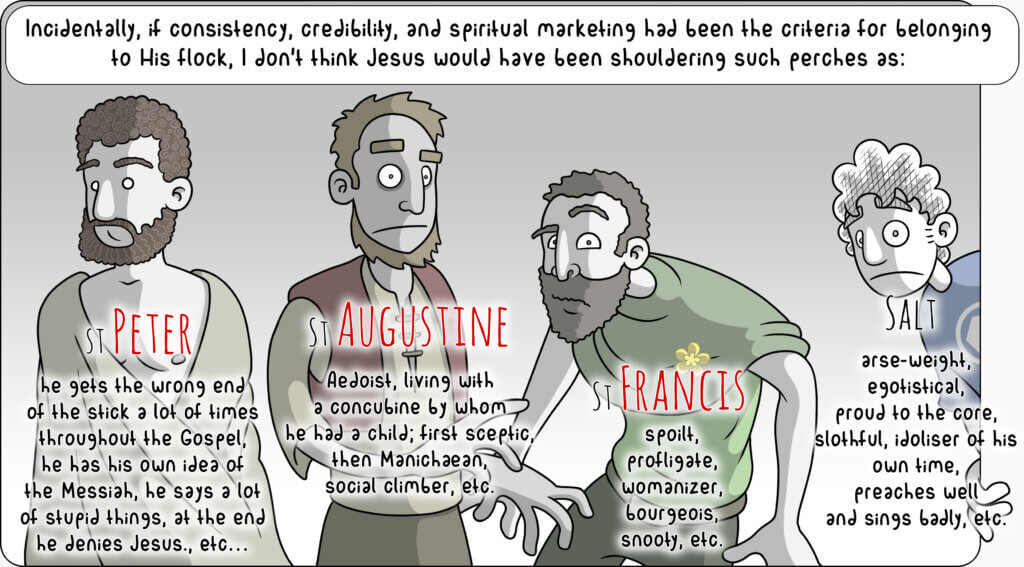
In our times, there are plenty of people in the parishes who (despite having the best intentions and believing in conscientiously doing good) set aside this visceral dependence on Jesus and live their faith relying solely on their own strength: striving to be credible, exhausting themselves to be consistent, developing a spiritual hernia by planning, organizing, and strategizing relentlessly.
Unfortunately, this approach has nothing to do with Christianity.
It’s called “Pelagianism” (and it’s a fifthcentury heresy; feel free to look it up on Wikipedia).
Oh, let’s be clear.
Putting our all into “setting a good example” is not a wrong thing… not at all!
And avoiding (as much as possible) “scandalizing” has its value.
But the center is not there…
As Madeleine Delbrêl, a French mystic and social worker (someone who “broke her back” for others, in the streets, out of love for Jesus), used to say:
[…] regarding the example, we must know that we will not always give it. Even in moments when we fight most firmly against ourselves, we will remain below the example we should give.
[…] The day we are convinced of being small, a fraternity of little people, treating each other as such, without being surprised at what we are, many things in our lives will harmonize, minimally but truly, with the simplicity of God.
(MADELEINE DELBRÊL, Note scritte secondo l’intenzione dei suoi gruppi, 1956)
As I mentioned earlier, the center of Christian action is another (indeed, Another).
In 1984, Cardinal Giacomo Biffi of Bologna wrote these lines:
“Should the Church become credible?” As it sounds, the concept is poorly formulated and unacceptable because it makes the demands and persuasions of men the measure for judging the action and reality of Christians, while the only measure remains the Lord Jesus and His truth.
The Church must strive to be increasingly faithful; in this way, it will become increasingly credible in the eyes of non-believers who are open-minded, seeking the truth, and increasingly incredible in the eyes of non believers who have no desire to believe.
(GIACOMO BIFFI, La bella, la bestia e il cavaliere. Saggio di teologia inattuale, Milan, Jaca Book, 1984, pp. 40-41)
Simulating Christian behavior without the vital relationship with Jesus in prayer, in the sacraments, in silence, in seeking His Spirit, His gaze on others (and so on)… I think it leads little far.
Pope Francis also reminded us of this a few years ago at the World Youth Day in Rio de Janeiro:
It is not creativity, as pastoral as it may be, nor encounters or planning that guarantee the fruit, although they help a lot… but what guarantees the fruit is being faithful to Jesus, who insists: “Abide in me, and I in you.”
(POPE FRANCIS, homily at the Cathedral of Saint Sebastian, on the occasion of the XXVIII World Youth Day, Rio de Janeiro, July 27, 2013)
9 • Bonus (or malus?)
If you’ve grown tired of reading, theoretically, the spiel should be over.
However, after reading this passage that Clive Staples Lewis wrote in 1943 for “The Sunday Times,” my heart ached not to share it with you:
In the world, there are three categories of people.
The first is composed of those who live only for themselves and consider Man and Nature as raw material to be manipulated for their own satisfaction.
In the second, there are those who recognize above them certain obligations – the will of God, the categorical imperative, or good society– and honestly try to pursue their interests within those constraints. They seek to surrender to the higher demand to the extent that it requires, like those who, in paying a tax, hope (…) that the remainder is at least sufficient to survive. Their life is divided, like the life of a soldier or a student, into times of “parade” and “rest,” “school” and “recreation.”
But the third category consists of those who can affirm together with St. Paul, that “it is Christ who lives in them” (Philippians 1:22). Such people have freed themselves from any anxious care arising from adjusting the demands of their self to those of God by the simple expedient of wholly rejecting that self. The old selfish will has been bypassed, converted, and transformed into something new. The will of Christ is no longer a limit to theirs; it is theirs. All their time, belonging to Him, also belongs to them since they are His.
And since there are three categories, a mere dualistic division of the world into good and evil would be disastrous. It would not consider the fact that members of the second category (to which the majority belongs) are always and necessarily unhappy. The tax that moral conscience levies on our desires doesn’t leave us much to live on, in fact. As long as we’re in this category, we’ll end up feeling guilty for not paying that tax or, having paid it, we’ll suffer from scarcity.
The Christian doctrine that there is no salvation through works done according to the moral law is a matter of daily experience. Forward or backward, we must move. But it makes no sense to proceed only with our efforts. If the new Self, the new Will, does not arise in us spontaneously (N.B. with the grace of God), we certainly cannot produce it synthetically.
(CLIVE STAPLES LEWIS, Three Kinds of Men, “The Sunday Times,” March 21, 1943)
(If anyone is wondering, I belong to the second category. The only reason I started the blog is to understand if the “Galilean carpenter” is worthy of trust and therefore the third category exists, or if Christians are nothing more than poor deluded individuals)
salt
(Fall 2019)
- CLIVE STAPLES LEWIS, L'abolizione dell'uomo, Jaca Book, Milano 2016
- VITTORIO MESSORI, Rapporto sulla fede. Vittorio Messori a colloquio con Joseph Ratzinger, San Paolo Edizioni, Cinisello Balsamo (MI) 2005
- JOSEPH RATZINGER, Gesù di Nazaret. Dal Battesimo alla Trasfigurazione, BUR, Milano 2011
- FËDOR DOSTOEVSKIJ, Memorie dal sottosuolo, Biblioteca Economica Newton, Roma 2005
- CARLO MARIA MARTINI, Cosa è il Regno di Dio annunziato da Gesù? (da una meditazione tenuta ai preti del settore Sud di Roma nella Quaresima 2005, il 24 febbraio)
- PADRE MAURIZIO BOTTA, Qual è la "buona notizia"? (catechesi del "MonasteroWifi 2019")