Why was Jesus condemned to death?
What was the charge?
- Was he a subversive?
- A revolutionary?
- The first of the communists?
When someone gives me these answers, I have
to count to a very, very high number, otherwise…
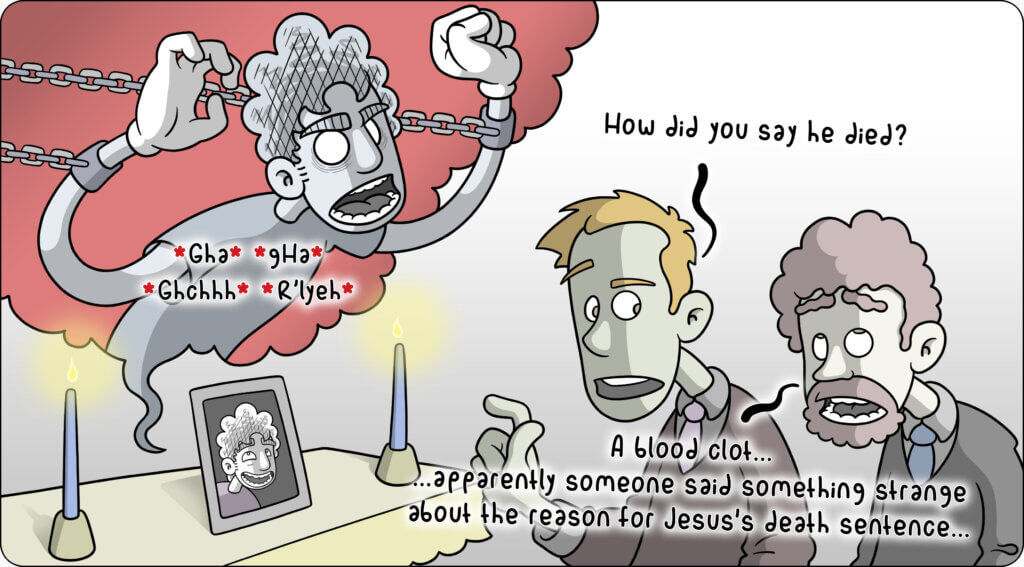
…anyway… after a nice chamomile drip… back to us…
Where is the answer to the question of why Jesus was sentenced to death?
Obviously, in the Gospels.
1 • Jesus, the blasphemer
In the Gospel of John, seven miraculous signs performed by Jesus are recounted; the third of them is the healing of a paralytic at the pool of Bethesda.
After the event, the Gospel reports that:
The man departed and told the Jews that it was Jesus who had made him well. For this reason the Jews persecuted Jesus, and sought to kill Him, because He had done these things on the Sabbath.
(Jn 5:15-16)
The Jews were scandalized by the fact that Jesus performed miracles on the Sabbath (Matthew recounts a similar episode where Jesus heals a man with a paralyzed hand “on the Sabbath,” cf. Mt 12:9-14).
The Gospel then continues:
But Jesus answered them, “My Father has been working until now, and I have been working.” Therefore the Jews sought all the more to kill Him, because He not only broke the Sabbath, but also said that God was His Father, making Himself equal with God.
(John 5:17-18)
John adds to this:
- If the signs performed by Jesus on the Sabbath made the Jews grind their teeth…
- …what really made them see red was His filial relationship with YHWH.
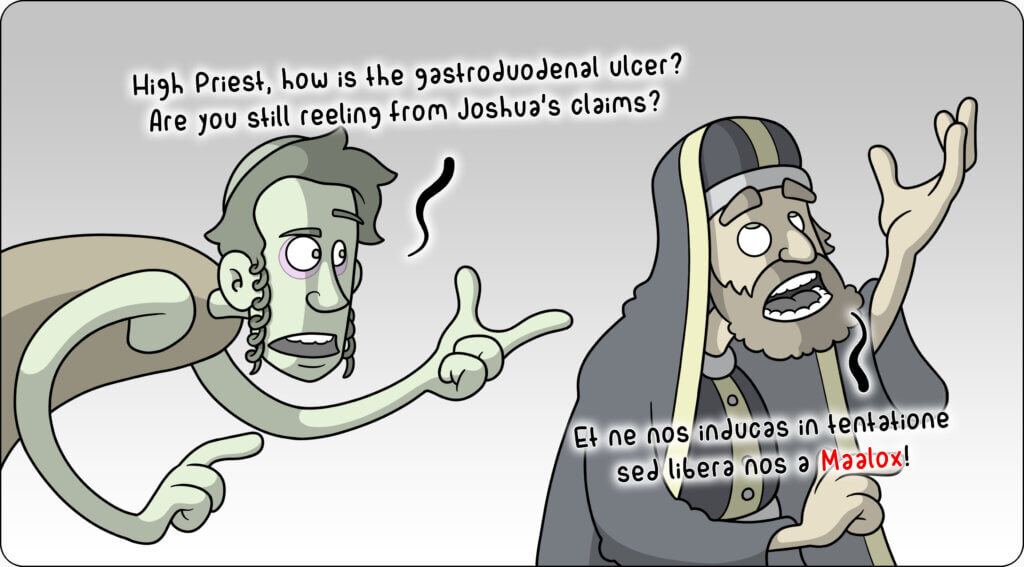
A few chapters later, the evangelist reports another encounter/clash between Jesus and the Jews:
Jesus answered them, “[…] The works that I do in My Father’s name, they bear witness of Me. But you do not believe, because you are not of My sheep, as I said to you.
My sheep hear My voice, and I know them, and they follow Me. And I give them eternal life, and they shall never perish; neither shall anyone snatch them out of My hand. My Father, who has given them to Me, is greater than all; and no one is able to snatch them out of My Father’s hand. I and My Father are one.”
Then the Jews took up stones again to stone Him. Jesus answered them, “Many good works I have shown you from My Father. For which of those works do you stone Me?”
The Jews answered Him, saying, “For a good work we do not stone You, but for blasphemy, and because You, being a Man, make Yourself God.”
(John 10:25-33)
Here, too, the reason for the conflict is blasphemy. Jesus uses expressions that provoke the indignation of his listeners:
- He speaks of “works that he does in His Father’s name” (cf. John 10:25).
- He claims to “give eternal life” (cf. John 10:28).
- He goes so far as to say that “He and the Father are one” (cf. John 10:30).
In the following chapter, after Jesus resurrects Lazarus (cf. John 11:38-44), the Pharisees want to kill him because of the miracles he performs.
Then the chief priests and the Pharisees gathered a council and said, “What shall we do? For this Man works many signs. If we let Him alone like this, everyone will believe in Him, and the Romans will come and take away both our place and nation.” […] Then, from that day on, they plotted to put Him to death.
(John 11:47-48, 53)
Finally, when the chief priests and the crowd bring Jesus to Pontius Pilate to condemn him to death, the theme of blasphemy emerges once again:
Therefore, when the chief priests and officers saw Him, they cried out, saying, “Crucify Him, crucify Him!”Pilate said to them, “You take Him and crucify Him, for I find no fault in Him.” The Jews answered him, “We have a law, and according to our law He ought to die, because He made Himself the Son of God.”
(John 19:6-7)
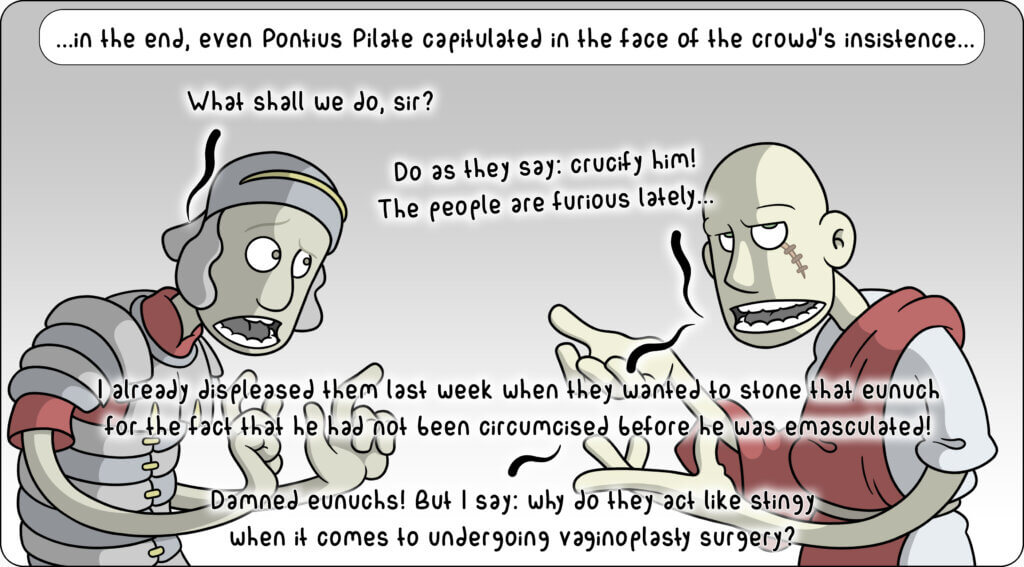
Also in the Gospel of Mark, in the exchange between the high priest and Jesus shortly after his arrest, the reason for the hatred against him is clear:
But He kept silent and answered nothing. Again the high priest asked Him, saying to Him, “Are You the Christ, the Son of the Blessed?”
Jesus said, “I am.
And you will see the Son of Man
sitting at the right hand of the Power,
and coming with the clouds of heaven.”
Then the high priest tore his clothes and said, “What further need do we have of witnesses? You have heard the blasphemy! What do you think?”
And they all condemned Him to be deserving of death.
Then some began to spit on Him, and to blindfold Him, and to beat Him, and to say to Him, “Prophesy!” And the officers struck Him with the palms of their hands.
(Mark 14:61-65)
2 • Jesus, the rejected Messiah
The reason for Jesus’ condemnation is his identity.
The cause of his crucifixion is inherent in every word and action: Jesus presents himself as the Son of God, someone who acts “in a sovereign manner,” manifesting both the power and authority of YHWH.
Jesus claims for himself the status and characteristics of God.
This is why both the Jews and the priestly class are scandalized by him:
Appealing to Lv 24:16 (“And whoever blasphemes the name of the Lord shall surely be put to death“), the entire Sanhedrin agrees that Jesus is deserving of death. The Gospel emphasizes: they all pronounced judgment.
(MARKO IVAN RUPNIK, Dire l’uomo – Volume 1: Persona, cultura della Pasqua, Lipa, Roma 2011, p. 293-294)
It is very interesting that, in response to Jesus’ words, Caiaphas, the High Priest, makes a highly significant gesture:
The high priest cannot tolerate that Christ manifests his identity in the midst of the Sanhedrin, and, overwhelmed by fury, he tears his clothes – a custom among the Jews but forbidden to him (cf. Lv 21:10). With this gesture, the high priest practically expresses the capitulation of the high priesthood. It is a gesture that conveys a profound truth because, in the presence of the high priest of the old covenant, now stands the new high priest according to the order of Melchizedek (Psalm 110:4).
(MARKO IVAN RUPNIK, Dire l’uomo – Volume 1: Persona, cultura della Pasqua, Lipa, Roma 2011, p. 292)
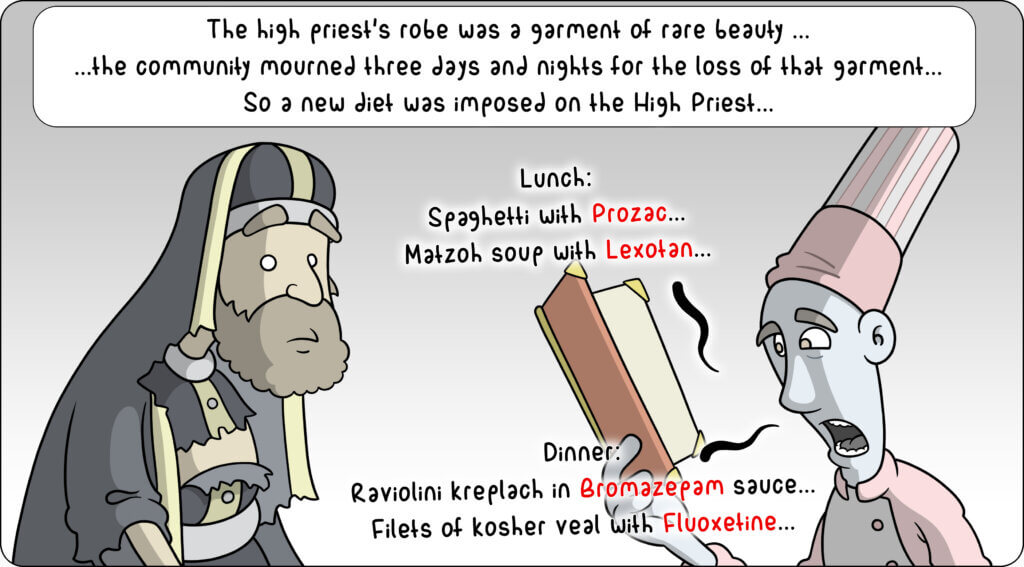
Jesus’ claim fills the measure.
His identity, the self-awareness he has as the Son of God, is denied and deemed blasphemous.
Therefore, he is condemned to death.
And shortly after…
As soon as the unanimous death sentence is proclaimed, they begin to humiliate him with spitting and beatings. Perhaps the most dramatic sentence in the passion is the last one concerning the Sanhedrin: “And the officers struck Him with the palms of their hands” (Mark 14:65). Christ, the obedient servant, surrenders in his kénosis so deeply that even the servants find in him someone smaller than themselves to unleash their accumulated resentment, thirst for revenge, and thirst for justice upon.
(MARKO IVAN RUPNIK, Dire l’uomo – Volume 1: Persona, cultura della Pasqua, Lipa, Roma 2011, p. 294)
Why all this hatred?
Why was Jesus rejected so violently?
The Son of God was not welcomed because he disappointed. The story of Christ’s passion in Jerusalem is the story of humanity’s disappointment in the face of God. Even that of the disciples. However, this still wouldn’t explain everything. Jesus was also crucified: not just rejected but hated to death by the religious authorities of the time. They rejoiced in committing the crime, as when one frees oneself from a burdensome weight. Why? Because Jesus exposed the hypocrisy of a faith closed in on itself and full of pious excuses: “If you were blind, you would have no sin; but now you say, ‘We see.’ Therefore your sin remains” (John 9:41). Man, a prisoner of ignorance – especially when he believes he has God on his side – becomes a murderer.
(GIUSEPPE FORLAI, Vestirsi di luce: introduzione pratica alla vita nello Spirito, Paoline, Milano 2018, p. 86-87)
3 • “Jesus was the first of the communists”… and other crap…
But if Jesus was condemned for blasphemy, why is there “King of the Jews” written on the cross?
“King of the Jews” seems much more like a political accusation rather than a religious one…
At this point, someone might insist again:
- “See, the reason for the condemnation was the class struggle!“
- “Jesus was a revolutionary!“
- “Jesus was the first of the communists!!!“
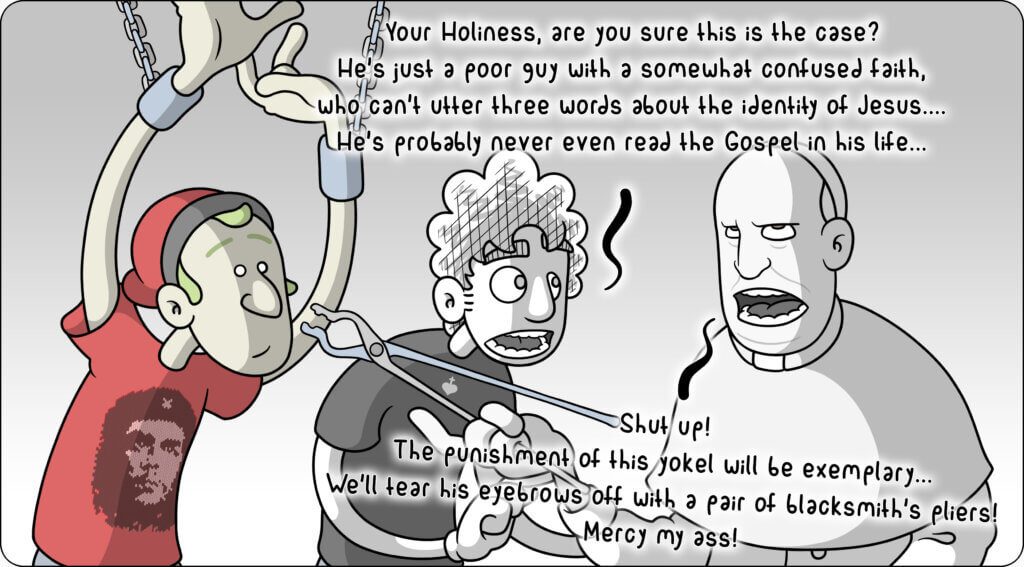
Calm down.
In order.
In the hours before his crucifixion, Jesus is brought:
- first before the high priest and the Sanhedrin – that is, the religious authorities of the people of Israel;
- then he is brought before the political authority, i.e. the Praetorium – the seat of the prefect of the Roman province of Judea, who between 26 and 36 was Pontius Pilate.
The Jews, in fact, at that time, did not have political autonomy as Palestine was part of the Roman Empire.
Therefore, any accusation or condemnation of Jesus had to go through b.
To present Jesus in chains at the praetorium, the Sanhedrin had to answer the question:
- With what charge are you presenting this hypothetical criminal before the Roman court?
In the council, as mentioned by [the evangelist] Mark, it was certainly decided not to go to Pilate accusing Jesus of proclaiming himself the Son of God, because Pilate would have little interest in that. The Romans did not intervene in Jewish religious matters, as they did not pose a threat to them. To involve Pilate and obtain his approval for this execution, they had to move accusations against Christ that would be of interest to the Romans. Hence, the fundamental accusation they bring against him is proclaiming himself the King of the Jews. This political act immediately makes him an enemy of Caesar. Christ responds to this accusation in a surprising way for Pilate. The Roman procurator probably never thought that Christ was the King of the Jews: Christ’s response reveals a certain weakness in Pilate, in the sense that he is reporting what others are saying. Indeed, one gets the sense that Pilate has little to say on the matter, and that it is rather the chief priests, representatives of the religious branch of the Sanhedrin, who put forward arguments against Jesus. This is another confirmation that the fundamental issue remains a religious one.
And the chief priests accused Him of many things, but He answered nothing. Then Pilate asked Him again, saying, “Do You answer nothing? See how many things they testify against You!” But Jesus still answered nothing, so that Pilate marveled. (Mark 15:3-5)
Pilate has nothing more to ask Jesus. The initial response he received and the numerous accusations from the chief priests are enough for a Roman military man to understand that the reason they handed Jesus over to him was not due to his kingship. He understood that there was another motive:
For he knew that the chief priests had handed Him over because of envy. (Mark 15:10)
(MARKO IVAN RUPNIK, Dire l’uomo – Volume 1: Persona, cultura della Pasqua, Lipa, Roma 2011, p. 298-299)
Conclusion
In a 2007 encyclical, Benedict XVI recalled that:
Christianity did not bring a message of social revolution like that of the ill-fated Spartacus, whose struggle led to so much bloodshed.
Jesus was not Spartacus, he was not engaged in a fight for political liberation like Barabbas or Bar- Kochba.
Jesus, who himself died on the Cross, brought something totally different: an encounter with the Lord of all lords, an encounter with the living God and thus an encounter with a hope stronger than the sufferings of slavery, a hope which therefore transformed life and the world from within.
(BENEDICT XVI, Encyclical Letter Spe Salvi, 4)
The scandal of Jesus’ claim traverses all of history.
The blasphemous hypothesis of a God who incarnates, participates in human suffering, and transfigures it, has been questioning everyone for over 2000 years, consciously or unconsciously, without exceptions.
In 1968, when he was a professor in Tübingen, Joseph Ratzinger wrote the following lines.
Fifty (and some) years later, they seem to me even more relevant than before:
We contemporary men remain almost silent in the face of this Christian “revelation,” and we wonder – especially when comparing it with the religiosity of Asia – whether ultimately it would not have been much easier for us to believe in the Eternal wrapped in mystery, thinking of Him, longing for Him, and trusting in Him. We wonder if it would not have been almost better for God to have left us at an infinite distance; if it indeed would not have been much more straightforward, transcending every worldly reality, to try to grasp through tranquil contemplation the eternally elusive mystery, instead of surrendering to the positivism of faith in a single figure, thus placing the salvation of man and the world as on the needlepoint of this unique point of incidence.
(JOSEPH RATZINGER, Introduzione al cristianesimo, Queriniana, Brescia 2005, p. 48)
salt
(Summer 2021)
- JOSEPH RATZINGER, Gesù di Nazaret. Dall'ingresso in Gerusalemme fino alla Risurrezione, Libreria Editrice Vaticana, Città del Vaticano 2011
- JOSEPH RATZINGER, Introduzione al cristianesimo: lezioni sul simbolo apostolico, Queriniana, Brescia 2018
- MARKO IVAN RUPNIK, Dire l'uomo - Volume 1: Persona, cultura della Pasqua, Lipa, Roma 2011