Who wrote the Gospels?
Who is behind the four names that tradition has associated with these texts since the 2nd century?
Who are Mark, Matthew, Luke, and John?
Were the Gospels really written by them?
Over the last 100 years, many exegetes (*) have questioned this…
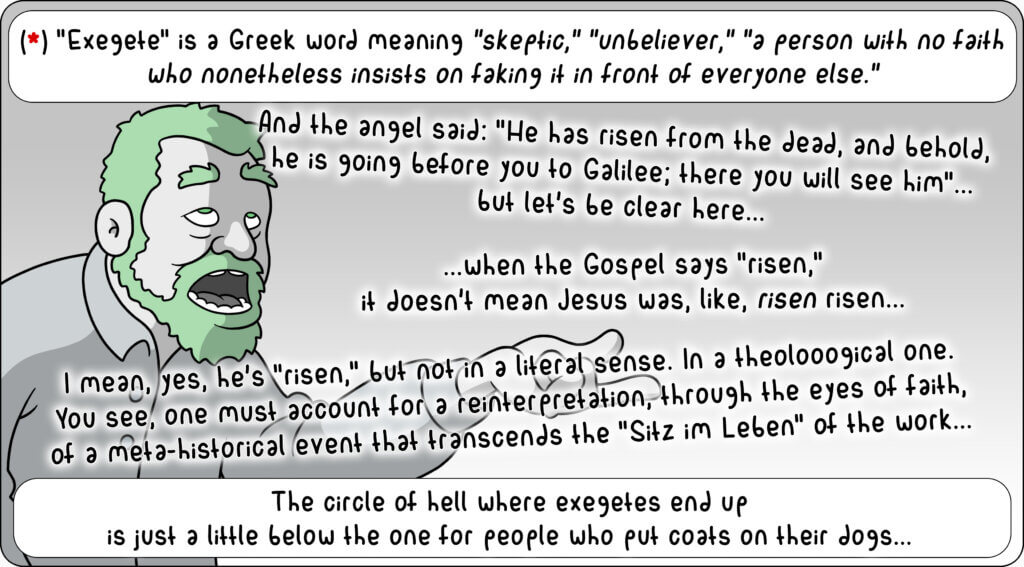
To be fair, many of the observations made by recent biblical scholarship (backed by archaeological and/or philological evidence) are interesting and worth a closer look…
Today I’d like to try to sort out a few questions that have been rattling around in my head:
- Who are the four Gospels attributed to?
- Who is behind the traditions preserved in them?
- Is the testimony they contain authentic?
1 • Who wrote the Gospel “According to Mark”?
This Gospel (the oldest of the four) has been linked to the name “Mark” since the 2nd century (a very common Roman name at the time).
Tradition identifies the author as the “John whose other name was Mark” mentioned several times in the Acts of the Apostles (cf. Acts 12:12, 12:25, 15:39) (*).
(*) (According to Acts, Mark was the son of a woman who opened her home to Christians for their meetings and prayers, cf. Acts 12:12. During Paul’s first journey, Mark apparently quit the trip early, cf. Acts 13:13… which left Paul pretty salty, cf. Acts 15:37-39. Mark also shows up in Paul’s letters to Philemon, cf. Philemon 24; to Timothy, cf. 2 Timothy 4:11; and to the Colossians, cf. Colossians 4:10; as well as in Peter’s first letter, cf. 1 Peter 5:13.)
According to Eusebius of Caesarea, Mark was the “interpreter of Peter” (*). In Eusebius’s account, Mark never knew Jesus personally but got his information from Peter.
(*) (EUSEBIUS OF CAESAREA, Ecclesiastical History III.39.15. Eusebius’s source is Papias, bishop of Hierapolis in Phrygia around AD 125, who in turn was reportedly passing on the testimony of a certain “John the Presbyter,” a first-generation Christian who had known the apostles.)
In short, hats off to Eusebius for trying to trace the chain of testimony from Papias of Hierapolis all the way back to Jesus…
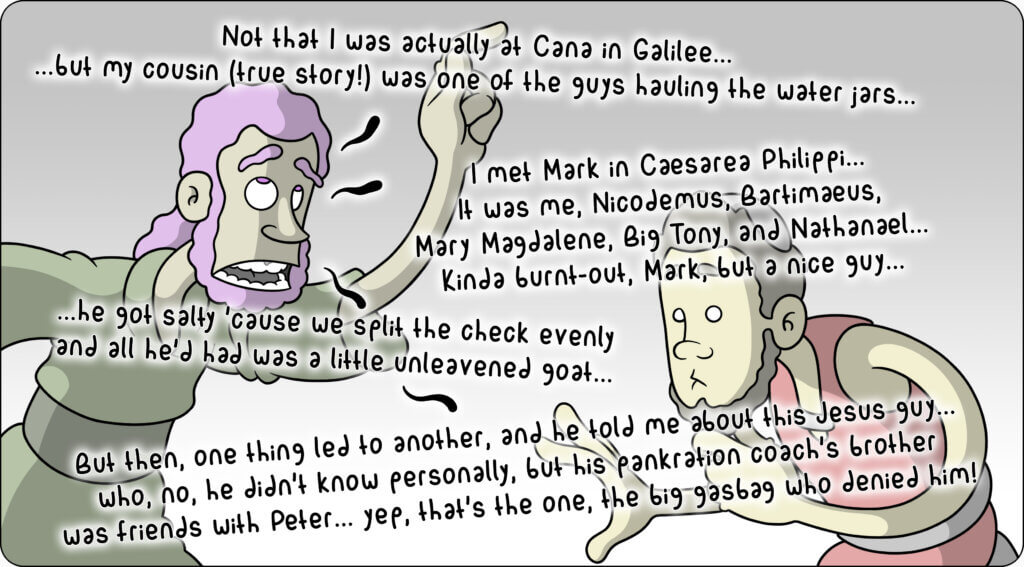
That said, there are several reasons why it is unlikely that this Mark, the “interpreter of Peter”—that is, a Jew from Jerusalem—wrote one of the four Gospels:
Based on the way this Gospel presents Peter, on the many geographical inaccuracies it contains (for example, 7:31), and on other features, many authors today consider it unlikely that John Mark—a Jew from Jerusalem who most likely spoke Aramaic and became a Christian very early on—could have written this work, which, moreover, depends on Peter.
They prefer to attribute this Gospel to a second-generation Jewish Christian who spoke Greek and was open to the universal mission.
Perhaps his name was Mark, which would explain the later confusion with the John Mark of the Acts of the Apostles.
(PIERRE DEBERGÉ, JACQUES NIEUVIARTS, Guida di lettura del Nuovo Testamento, EDB, Bologna 2006, p. 39, n.)
2 • Who wrote the Gospel “According to Matthew”?
As with Mark, the association with “Matthew” goes back to the second half of the 2nd century.
Here too, Eusebius of Caesarea cites Papias as his source:
Matthew put together the oracles (logia, λόγια) [of the Lord] in the Hebrew [Aramaic?] language, and each one interpreted them as best he could.
(EUSEBIUS OF CAESAREA, Ecclesiastical History III.39.16)
So what does Papias mean here?
- Is he referring to a Hebrew original that Matthew later translated into Greek? (Some scholars hold this view. Back in 2016 I mentioned Jean Carmignac, who, in his book The Birth of the Synoptics, did a monumental job of back-translating the Greek text to reconstruct the original Semitic text.)
- Or is he talking about the Gospel according to the Hebrews, cited by many Church Fathers between the 2nd and 5th centuries and used by Christians in Palestine and by Jewish Christians around Aleppo, in Syria?
Critics are divided on the question…

…what’s certain is that today no philologist attributes this Gospel to “Matthew the tax collector,” one of the Twelve (Mt 10:3; cf. also 9:9; Mk 3:18; Lk 6:15; Acts 1:13). Here’s why:
- The author of this Gospel uses the Gospel of Mark (dated 67-68) as one of his sources… which is rather odd for someone who was supposedly an eyewitness to Jesus’ life;
- The Judaism reflected in this Gospel is a Judaism unified around the Pharisees, which points to a time after the fall of Jerusalem in 70;
- The frequent use of the phrase “their synagogues” (4:23; 9:35; 10:17; 12:9; 13:54; 23:34) suggests that the split between this Gospel’s community and the Jews, if not already complete, was well underway.
(PIERRE DEBERGÉ, JACQUES NIEUVIARTS, Guida di lettura del Nuovo Testamento, EDB, Bologna 2006, p. 45)
Not to mention that the Gospel refers more than once to persecution (especially in Mt 10:16-33).
The text was most likely composed in the 70s by a Christian of Jewish origin, in a community where the apostle Matthew may have played an important role.
3 • Who wrote the Gospel “According to Luke”?
Early Christian tradition recognizes “Luke” as the author of both this Gospel and the Acts of the Apostles.
We already find this in Irenaeus of Lyons (130-202):
Luke also, the companion of Paul, recorded in a book the Gospel preached by him.
(IRENAEUS OF LYONS, Against Heresies III.1.1)
Similar testimony is found in the Muratorian Canon (an ancient list of New Testament books) and in Clement of Alexandria, Origen, and Tertullian.
This Gospel and Acts have been attributed to Luke for two reasons:
- In his letters, Paul mentions Luke several times as his coworker/companion (cf. Philemon 24; Colossians 4:14; 2 Timothy 4:11);
- Several passages in Acts are narrated in the first-person plural, as if the evangelist had been present for those events (cf. Acts 16:10-17; 20:5-15; 21:1-18; 27:1–28:16).

Starting in the late 19th century, however, many critics began to doubt this testimony, both because the Greek name “Luke” (Loukás, Λουκάς) was quite common at the time, and because an author’s use of “we” was a common literary device in antiquity. Not to mention that in the Gospel’s prologue (cf. Lk 1:1-4), Luke places his own work at the end of a line of eyewitnesses and of the “many” who had already written accounts of Jesus’ life, death, and resurrection before him.
In short, here too exegetes have questioned whether “Luke the companion of Paul” is really the author of this Gospel:
Reading this work, one senses that the man called Luke was most likely neither a Palestinian (as shown by the way he describes Nazareth (Lk 4:29), the clumsy information in 4:44 and 17:11, and what he says about houses with tiled roofs (5:19), river floods (6:48-49), sowing techniques (8:5-7), and even the Lake of Tiberias (the Sea of Galilee), which he refuses to call a sea (5:1-11; 8:22-23, 33)) nor a Jew (his knowledge of the Old Testament might suggest otherwise. But his mistake about the purification in 2:22 (“their” purification wrongly implies that the father was purified too) seems to rule out his having been raised in a Jewish family. Moreover, what he says about the Old Testament law—that it is an unbearable yoke (Acts 15:10)—is unlikely coming from a circumcised man. So it is better to place the evangelist among the Gentiles who had become “God-fearers” (cf. Lk 7:5; Acts 10:2), or among the proselytes. We can assume that before converting to Christianity, he had been drawn to Judaism).
An educated man and a gifted writer, he is able to play with the various styles of Greek, even giving each of his characters the language and style that suit them: at Pentecost, for example, Peter speaks a Greek full of Semitisms (Acts 2:14-36), while Paul, at the Areopagus in Athens, gives a speech in polished Greek (Acts 17). Elsewhere, Luke can even imitate the Greek of the Septuagint (Lk 1).
(PIERRE DEBERGÉ, JACQUES NIEUVIARTS, Guida di lettura del Nuovo Testamento, EDB, Bologna 2006, p. 51)
On the other hand, nearly all critics agree that this Gospel and Acts were written by the same author (even though no manuscript has the two texts side by side), for linguistic, literary, and theological reasons.
4 • Who wrote the Gospel “According to John”?
The fourth Gospel repeatedly mentions a mysterious figure: “the disciple whom Jesus loved” (Jn 13:23-26; 19:26-27; 20:2-10; 21:7, 20-23).
Irenaeus of Lyons was the first to identify him with John, the son of Zebedee, and to name him as the author of the fourth Gospel (*):
Afterwards, John, the disciple of the Lord, who also had leaned upon His breast, did himself publish a Gospel during his residence at Ephesus in Asia.
(IRENAEUS OF LYONS, Against Heresies III.1.1)
(*) (Irenaeus’s source is his teacher Polycarp, who in turn was a disciple of the apostle John)
In his letter to Florinus (quoted by Eusebius of Caesarea), Irenaeus also shares some interesting details:
[…] I can speak even of the place in which the blessed Polycarp sat and disputed, how he came in and went out, the character of his life, the appearance of his body, the discourses which he made to people, how he reported his intercourse [i.e., dealings] with John and with the others who had seen the Lord, how he remembered their words, and what were the things concerning the Lord which he had heard from them, and about their miracles, and about their teaching, and how Polycarp had received them from the eyewitnesses of the word of life, and reported all things in agreement with the Scriptures. I listened eagerly even then to these things through the mercy of God which was given me, and made notes of them, not on paper but in my heart, and ever by the grace of God do I truly ruminate on them.
(EUSEBIUS OF CAESAREA, Ecclesiastical History V.20.6-7, trans. Kirsopp Lake)
Many critics consider it unlikely that the author of this Gospel was an apostle, both because of its late date (as I mentioned before, the Gospel of John is thought to have been written between 90 and 100) and because “the disciple whom Jesus loved” portrayed here is very different from the John, son of Zebedee, of the Synoptic Gospels (cf., e.g., Lk 9:54-55; Mk 10:35-40):
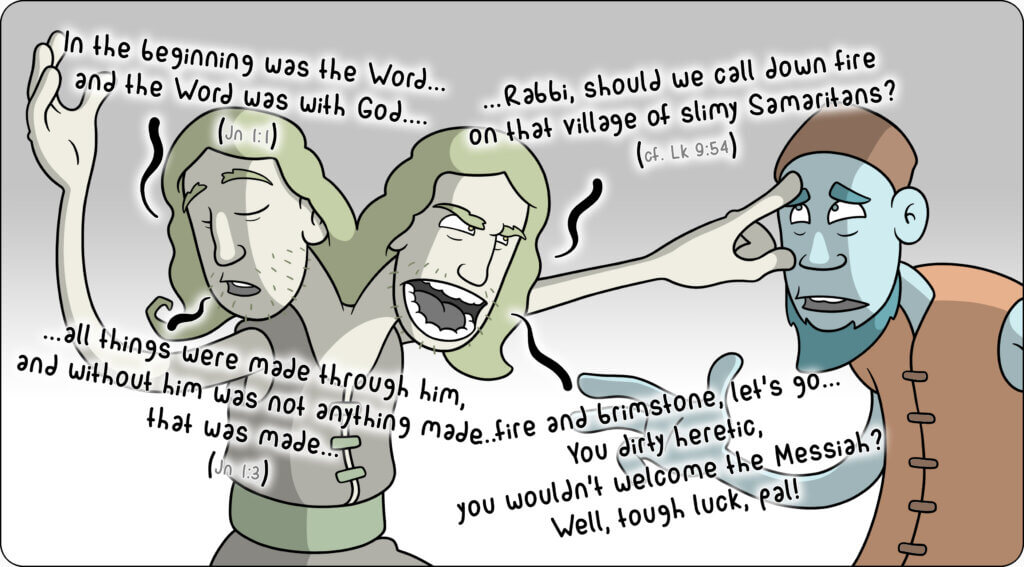
What’s more, near the end of the Gospel we find this verse:
This is the disciple who is bearing witness to these things, and who has written these things; and we know that his testimony is true.
(Jn 21:24)
“We know“… “we” who? The speaker seems to be not so much the eyewitness himself as the members of the community in which the Gospel was written.
On the other hand, a close look at the text turns up some very interesting details:
Since the Greek of this Gospel contains Semitic constructions, since its background is strongly shaped by Judaism and the Old Testament (1:17, 45; 3:14; 6:31; 7:38, etc.), and since its “author” shows an excellent knowledge of Judea and Jerusalem (details about the Pool of Bethesda (5:2-3), the Pool of Siloam (9:7), the portico of Solomon (10:22-23), the stone pavement of the Praetorium (19:13), etc.), it is fair to say that these various elements, while not settling the question of who the “author” of the fourth Gospel was, point to a Jew who knew Palestine well and had been with Jesus from the beginning of his ministry.
(ALAIN MARCHADOUR, L’évangile de Jean [Commentaire pastoral], Centurion, Paris 1992, p. 14; quoted in PIERRE DEBERGÉ, JACQUES NIEUVIARTS, Guida di lettura del Nuovo Testamento, EDB, Bologna 2006, p. 64)
Even granting that the fourth Gospel was not written by the apostle John, there’s no denying its very strong connection to one of the Twelve, through the role he played in the community where it was written:
There is no doubt that behind the Johannine traditions stands a prestigious apostolic figure, a disciple, an eyewitness. He is the one who gathered traditions about Jesus unknown to the Synoptics. Only he could have imposed a tradition that was otherwise marginal. He is the one who left his stamp and his style on it, and who was able to impose a Christological current very different from that of the other Gospels. Who is he really? Tradition has identified him with one of the sons of Zebedee. Nothing stands in the way of this identification.
(ALAIN MARCHADOUR, L’évangile de Jean [Commentaire pastoral], Centurion, Paris 1992, p. 14; quoted in PIERRE DEBERGÉ, JACQUES NIEUVIARTS, Guida di lettura del Nuovo Testamento, EDB, Bologna 2006, p. 64)
Conclusion
So, bottom line: who wrote the Gospels?
Some critics (the majority) consider it unlikely that they were written by the evangelists whose names they bear.
Others (a minority) critique the critics.
The Church’s Magisterium hasn’t been too concerned with untangling this knot…
…but on one point it has been very clear: we know (no matter who actually wrote the last word) that all four canonical Gospels are of apostolic origin (cf. Dogmatic Constitution Dei Verbum, no. 18).
What does “apostolic origin” mean?
It means that the Gospels originated within communities that gathered around the apostles (unlike the apocryphal gospels).
Communities that grew up around people who knew Him: people who lived with Him, walked with Him, ate with Him, listened to Him…
…people who “smelled like Jesus.”
salt
(Fall 2021)
- PIERRE DEBERGÉ, JACQUES NIEUVIARTS, Guida di lettura del Nuovo Testamento, EDB, Bologna 2006
- ADRIANO VIRGILI, Sulle tracce del Nazareno: Introduzione al Gesù storico, Phronesis Editore, Palermo 2022