“Praying is pointless!”
Or at least, that’s what a lot of people think—people who don’t pray (or who’ve stopped) for all sorts of reasons…
- …because they don’t believe in God;
- …because, even though they believe in Him, they think prayer is a bit naive;
- …because they’ve been let down by a prayer God didn’t answer;
- …because they’re weirded out by the way people rattle off prayers on autopilot every Sunday at Mass, as if they were reading the ingredients on a medicine label.
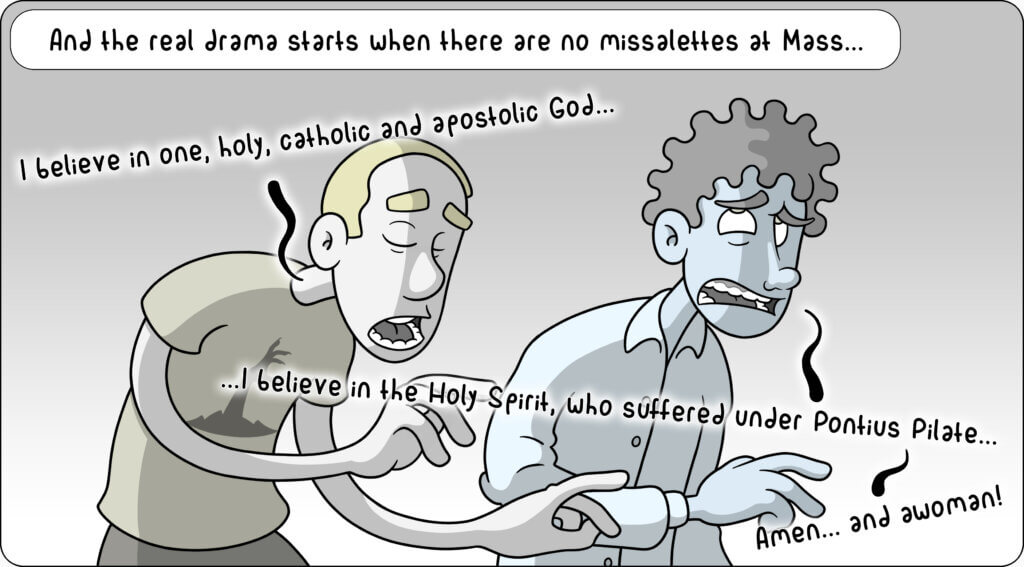
Prayer is a sore spot, even for Christians.
It’s no coincidence that a few months ago, Pope Francis needled the faithful like this:
The question that we Christians need to ask ourselves is: Do I pray? Do we pray? How do I pray? Like parrots or do I pray with my heart? How do I pray? Do I pray, certain that I am in the Church and that I pray with the Church? Or do I pray a bit according to my ideas and then make my ideas become prayer? This is a pagan prayer, not Christian.
(POPE FRANCIS, General Audience, Wednesday, April 14, 2021)
1 • Praying to “convince God”
Many people believe prayer is meant to inform God of our needs… just in case He wasn’t paying attention! (isn’t God supposed to be omniscient?)
Others, though, believe prayer is meant to convince God.
To move Him from a state of “non-benevolence” to one of “benevolence.”
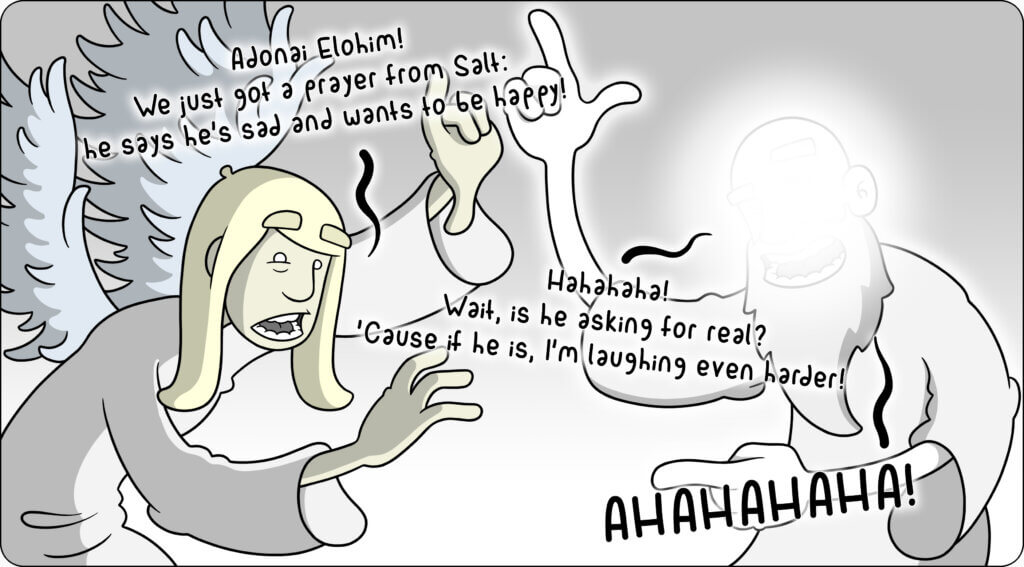
Still others think of God as a merchant.
They believe prayer means piling as many words as possible onto the scale.
If the weight is enough, God will do my will (but in the Lord’s Prayer, don’t we pray for His will to be done?).
Isaac of Nineveh (613–700), a Syriac Christian bishop, said:
Pray a little at a time, and often, for if your prayers are long, the Enemy comes to tempt you.
(Isaac to Cassian in the Sayings of the Desert Fathers)
…and before him, a certain Galilean Carpenter said something similar:
And in praying do not heap up empty phrases as the Gentiles do; for they think that they will be heard for their many words.
(Matthew 6:7)
In college, every time I had an oral exam, I’d talk the professor’s ear off, drowning him in words to show him how much I’d studied (*)…
(*) (this strategy always let me snag grades way higher than I actually deserved… being long-winded has its perks sometimes)
Well… with God, that tactic isn’t necessary.
2 • Praying to “feel something in my little heart”
In recent decades, anything with an Eastern vibe has become more and more trendy…
…a trend that has spilled over into the spiritual realm too: meditation, breathing techniques, āsanas, Reiki.
In the West, “Eastern spirituality” often just means “a spa for the soul.”
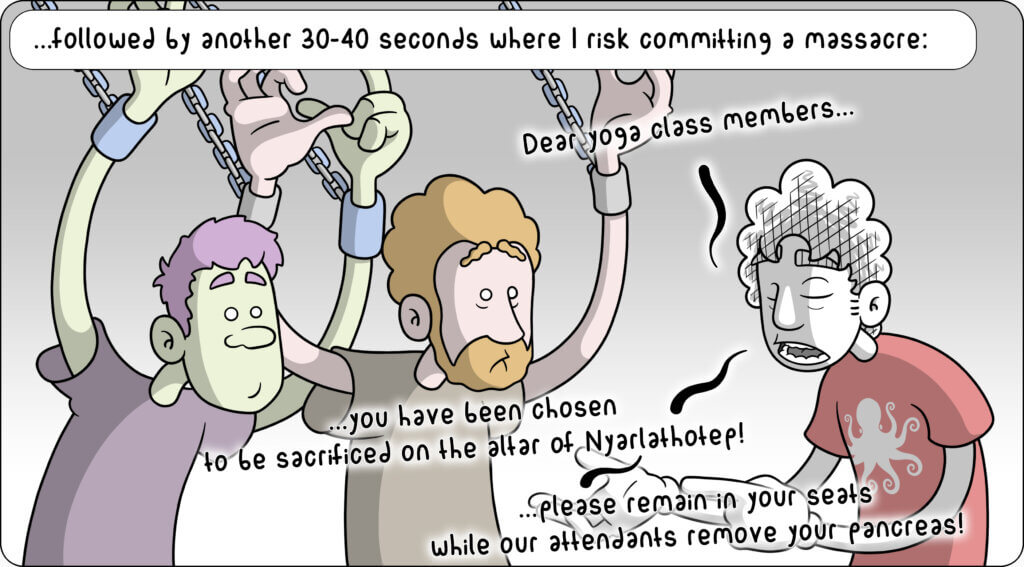
When I find out the parish is running yoga classes, I’ll admit there are a good 10–15 seconds where I risk having a stroke…
Fr. Luigi Maria Epicoco (b. 1980) writes:
In my pastoral experience, I notice that most people, when they start out in a life of prayer, confuse it with their emotional state. For example, they come to pray because they feel something.
That’s not bad; sometimes it’s how things begin, and it feels good. But it’s a problem when someone thinks they’ve lost their faith and don’t know how to pray anymore because they no longer feel anything.
They’ve confused faith with an emotional state.
(LUIGI MARIA EPICOCO, Sale non miele: per una fede che brucia, San Paolo, Cinisello Balsamo (MI) 2017, p. 80)
Prayer isn’t about tickling your emotions.
It’s not about chasing a particular mood or feeling.
It has nothing to do with mind-body wellness.
You don’t pray to “feel something.”
3 • What does it mean to “pray”?
So:
- if prayer isn’t meant to “convince God“
- and it isn’t meant to “reach some kind of emotional well-being,”
…what’s the point of praying?
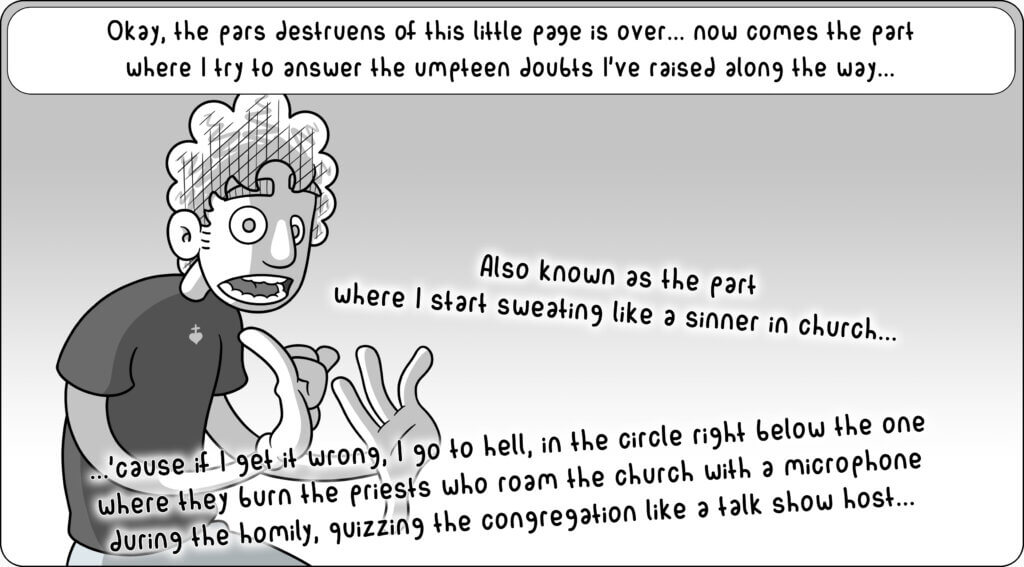
Let’s take a step back: what does it mean to pray?
André Louf (1929–2010), a Belgian Trappist monk, wrote:
Praying means perceiving our deepest reality, that precise point in our being where—unconsciously, imperceptibly, without ever having seen it—we reach God, flow into God, touch God; or rather, that point where, at every moment, while never ceasing to create us, God touches us.
Byzantine writers sometimes call this point the tópos toû theoû, the place where God is present in us.
The only difference among mystics is the name they give to this place: noûs, mens, cor, the ground of being, the innermost self, the core, the abyss of the soul, the summit of the soul, the apex of the spirit.
(ANDRÉ LOUF, Sotto la guida dello spirito, Qiqajon, Magnano (BI) 2005, pp. 153–154)
…and further:
God touches us as He creates us, as Michelangelo depicted it in his famous Creation of Adam: the Father’s finger barely brushes Adam’s, never to let go again. So we might ask ourselves: is it possible for human consciousness to pick up on this creative contact between God and man?
[…]
This prayer […] deep within us: can it be perceived? Can it become conscious? If so, how?
(ANDRÉ LOUF, Sotto la guida dello spirito, Qiqajon, Magnano (BI) 2005, p. 154)
Praying means seeking Someone.
Or rather: it means entering that secret place and staying under the Father’s gaze.
When we say “Our Father, who art in heaven…,” it’s a bit like saying “Our Father, who dwells in the depths of my heart…“:
[…] when you pray, go into your room and shut the door and pray to your Father who is in secret; and your Father who sees in secret will reward you.
(Matthew 6:6)
4 • Praying, or rather “letting God do His thing”
We’re way too used to thinking of prayer as a performance.
A show.
Something I do.
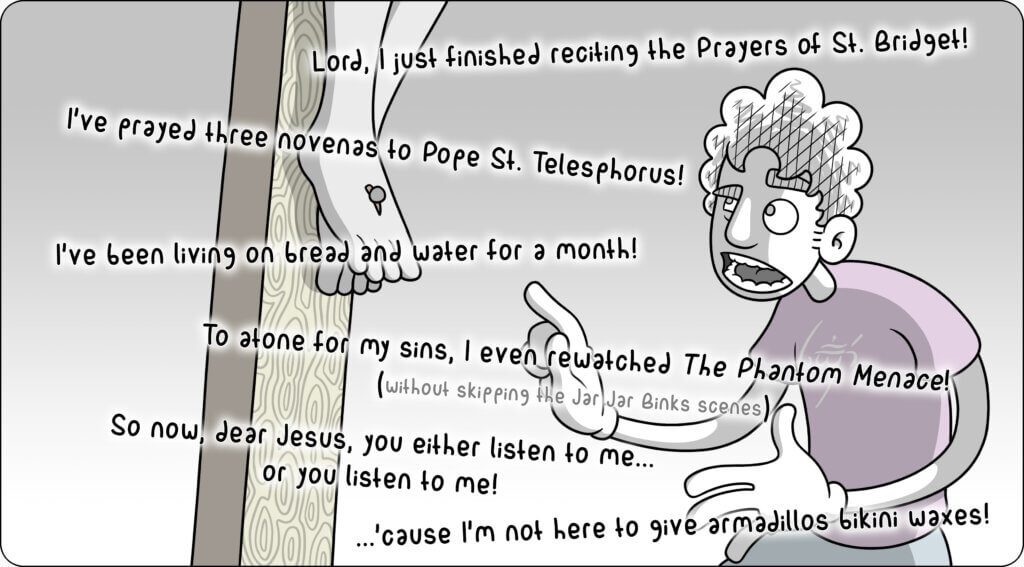
Prayer is something much more passive:
[…] it is up to God to take the initiative, and for us to let Him act and surrender to His action within us.
(ANDRÉ LOUF, Sotto la guida dello spirito, Qiqajon, Magnano (BI) 2005, pp. 157–158)
The fruitfulness of prayer doesn’t depend on my abilities, my efforts, or my attempts to look good during the time I carve out for prayer…
…quite the opposite:
My grace is sufficient for you, for my power is made perfect in weakness. […] For when I am weak, then I am strong.
(2 Corinthians 12:9–10)
Whether it’s resting silently under His gaze, going to Eucharistic adoration, praying the Rosary, reading the Word of God, asking a saint’s intercession, etc…
…prayer has a theurgic efficacy (pardon my French), meaning it works in my heart and in my life even if I don’t notice it, even if I’m not up to it, even if I don’t understand it, even if I can’t perceive it, even when it seems like nothing is changing.
And this has been happening since the day of our baptism:
Our heart is already in a state of prayer.
We received prayer, along with grace, at the moment of our baptism.
The state of grace, as it is called, means, at the level of the heart, a state of prayer.
There, in the deepest recesses of ourselves, we have been in continuous contact with God ever since.
The Holy Spirit of God has seized us, has taken complete possession of us: He has become the breath of our breath, the Spirit of our spirit.
He takes our heart in tow, so to speak, and turns it toward God.
[…]
We continually carry this state of prayer with us, like a hidden treasure we are only dimly aware of, if at all.
Somewhere, our heart breathes to the full, without our even realizing it.
(ANDRÉ LOUF, Lo Spirito prega in noi, Qiqajon, Magnano (BI) 1995, p. 19)
So this is what prayer is for:
The sole aim of any prayer technique is to make us aware of what we have already received, to teach us to sense, to discern, in the full and tranquil certainty of the Spirit, the prayer that has taken root in our innermost being and never ceases to work.
(ANDRÉ LOUF, Lo Spirito prega in noi, Qiqajon, Magnano (BI) 1995, p. 20)
5 • Jesus and prayer
Some modern, enlightened theologians argue that prayer is a thing of the past…
…useless…
…vaguely pagan…
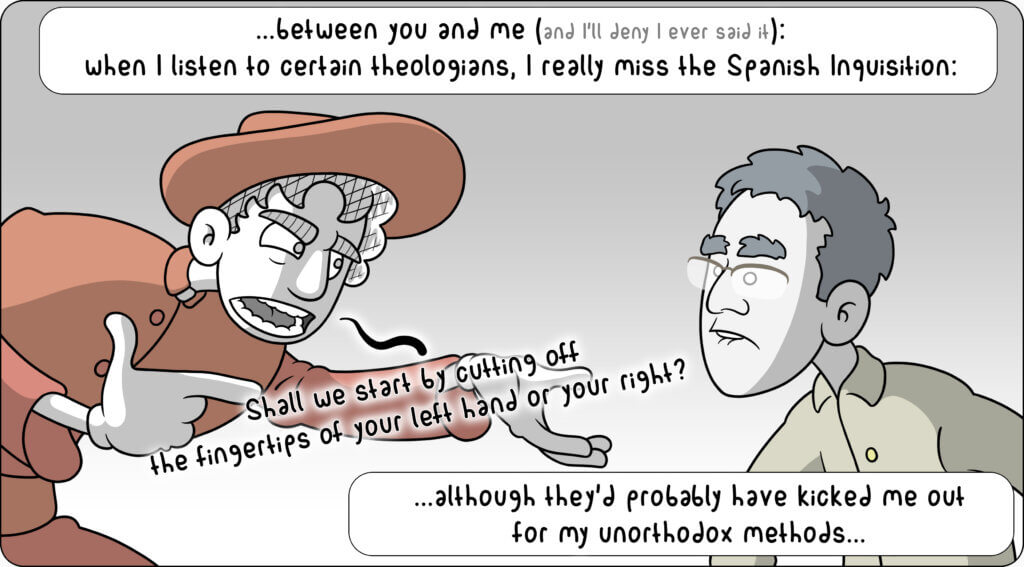
…which is strange, because in the Gospels, Jesus is the one who prays more than anyone:
In these days he went out into the hills to pray; and all night he continued in prayer to God.
(Luke 6:12)
Jesus prays a lot.
He spends whole nights alone in prayer.
He prays before every major event in His life.
And He tells His disciples to do the same:
And he came out, and went, as was his custom, to the Mount of Olives; and the disciples followed him. And when he came to the place he said to them, “Pray that you may not enter into temptation.”
(Luke 22:39–40)
Watch and pray that you may not enter into temptation.
(Matthew 26:41)
And he told them a parable, to the effect that they ought always to pray and not lose heart.
(Luke 18:1)
Ask, and it will be given you; seek, and you will find; knock, and it will be opened to you.
(Matthew 7:7)
Hitherto you have asked nothing in my name; ask, and you will receive, that your joy may be full.
(John 16:24)
The desire to pray sprang up in the hearts of His disciples precisely because they saw that Jesus was constantly seeking a dialogue with the Father. That’s why they asked Him, “Lord, teach us to pray” (Luke 11:1).
St. Paul, too, keeps stressing the importance of prayer in his letters:
Pray at all times in the Spirit, with all prayer and supplication. To that end keep alert with all perseverance, making supplication for all the saints.
(Ephesians 6:18)
Pray constantly.
(1 Thessalonians 5:17)
Conclusion
Prayer makes the Christian.
There is no Christian without prayer.
You can’t be a child without a relationship with the Father.
Prayer is essential.
Necessary.
Indispensable.
Prayer is a matter of life or death, happiness or despair, authenticity or counterfeit. We pray in order to keep hoping, especially when the dawn seems slow in coming.
(GIUSEPPE FORLAI, Vestirsi di luce: introduzione pratica alla vita nello Spirito, Paoline, Milan 2018, p. 94)
salt
(Fall 2021)
- ANDRÉ LOUF, Lo Spirito prega in noi, Qiqajon, Magnano (BI) 1995
- ANDRÉ LOUF, Sotto la guida dello Spirito, Qiqajon, Magnano (BI) 2005
- GIUSEPPE FORLAI, Vestirsi di luce : introduzione pratica alla vita nello Spirito, Paoline, Milano 2018