1 • Purify the Heart?
The title of this little page is, admittedly, a bit unfortunate.
The phrase “purify the heart” does sound a bit saccharine. Sappy. Diabetes-inducing.
It sounds like something a Victorian boarding-school girl would say.
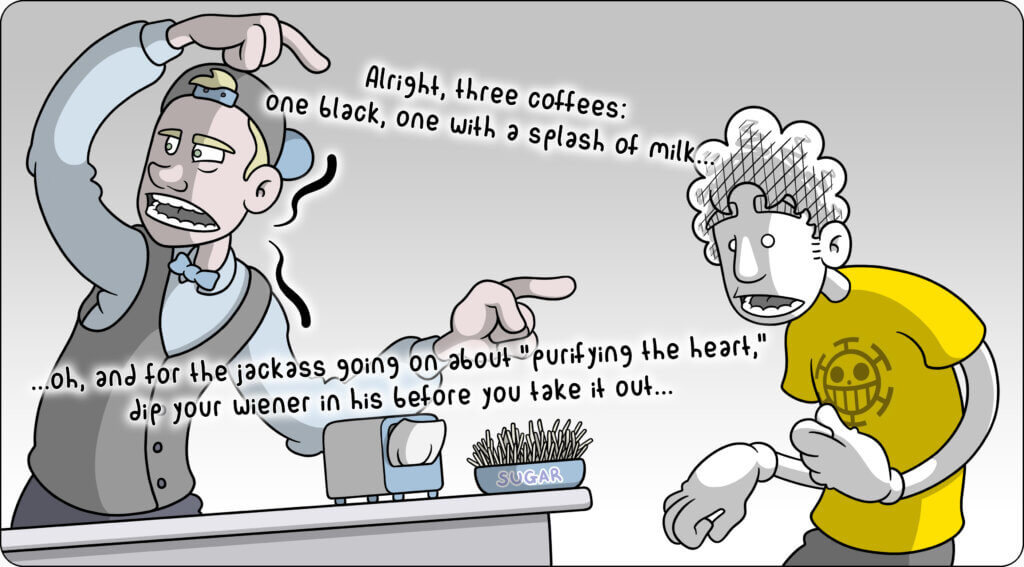
Say it out loud at a coffee shop and you’ll come across as naive. A chump. A nun…
2 • Outdated Words?
But let’s be honest: it’s not just nonbelievers who feel uncomfortable with the phrase “purify the heart.”
Even Christians squirm a little when they hear it.
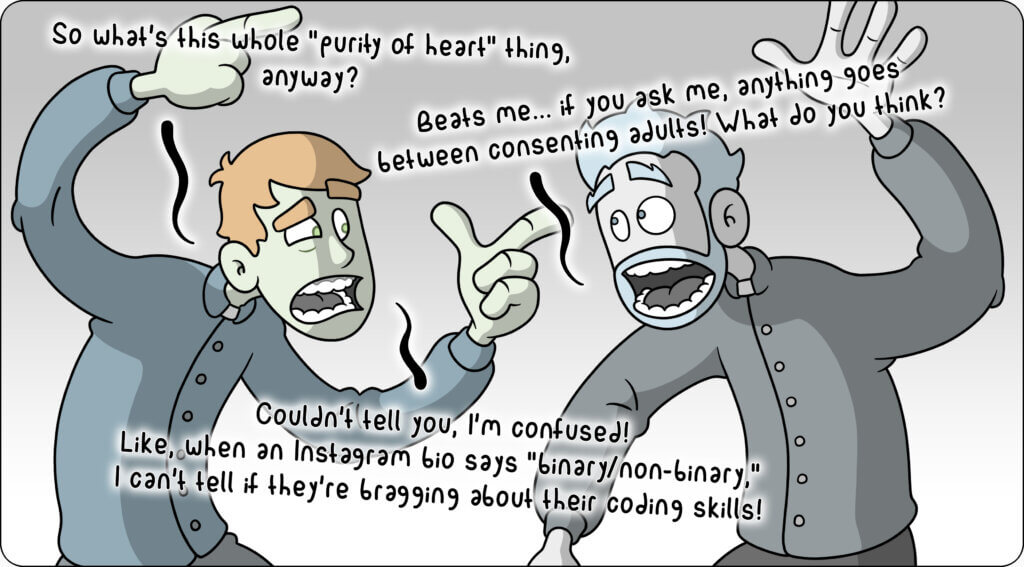
Plenty of words that once belonged to the Christian vocabulary are misunderstood or completely unknown today (even in parishes and sacristies): purity of heart, virginity, modesty, chastity, obedience, humility…
…words that are “out of step with the times.”
…words that “we’d better not use” if we want to stay relevant and keep young people from leaving the Church.
In a book from about ten years ago, Fabrice Hadjadj (born in 1971) imagined that if many people today were to pray Mary’s Magnificat (cf. Luke 1:46–55), it would come out something like this:
My soul magnifies itself,
and my spirit rejoices in me, my own savior,
for I have raised myself up to be my own master;
henceforth all generations will call me sovereign.
(FABRICE HADJADJ, La fede dei demoni: ovvero il superamento dell’ateismo, Marietti, Genoa 2010, p. 182)
…or, along the same lines, a modern version of the Beatitudes Jesus proclaimed on the mount (cf. Matthew 5) would go something like this:
Blessed are the rich in their own spirit, for theirs are the kingdoms of this world;
Blessed are the hard of heart, for they shall possess the land they have conquered;
Blessed are those who mourn, as long as they insist it’s always the other guy who’s wicked;
Blessed are those who hunger and thirst for their own brand of justice, for they shall always take revenge;
Blessed are the merciful, for they shall practice euthanasia;
Blessed are the pure in heart, for they shall see the devil;
Blessed are the pacifists, who will sign more Munich Agreements;
Blessed are those who are persecuted for justice’s sake and claim the right to persecute in turn, for theirs are the principalities of this world.
(FABRICE HADJADJ, La fede dei demoni: ovvero il superamento dell’ateismo, Marietti, Genoa 2010, pp. 180–181)
3 • Purity of Heart… But What Is It?
In the Sermon on the Mount, Jesus says:
Blessed are the pure in heart,
for they shall see God.
(Matthew 5:8)
But… what does that mean?
Who counts as “pure in heart“?
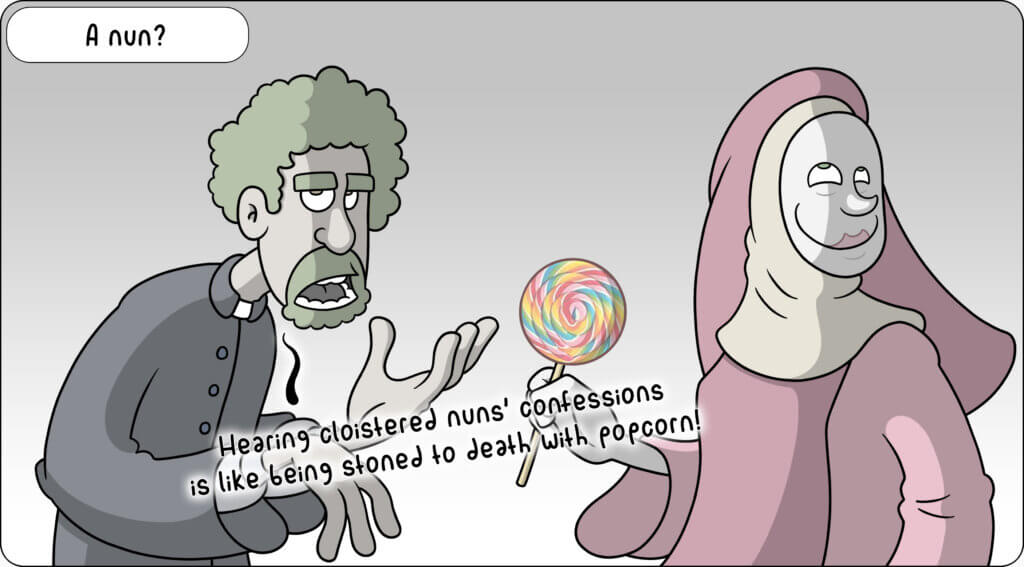
A goody-two-shoes? Someone out of touch with the real world? A sweet little virgin?
The “infamous” Catechism of the Catholic Church offers a hint of an answer:
The sixth beatitude proclaims, “Blessed are the pure in heart, for they shall see God” (Matthew 5:8). “Pure in heart” refers to those who have attuned their intellects and wills to the demands of God’s holiness […].
(Catechism of the Catholic Church, n. 2518)
The “pure in heart” are promised that they will see God face to face and be like him (cf. 1 Corinthians 13:12; 1 John 3:2). Purity of heart […] enables us to see according to God, to accept others as “neighbors”; it lets us perceive the human body – ours and our neighbor’s – as a temple of the Holy Spirit, a manifestation of divine beauty.
(Catechism of the Catholic Church, n. 2519)
4 • A “Case Study” in Purifying the Heart: Peter
Still, the Catechism’s definition might come across as a bit generic…
…indefinite…
…vague…
…so let’s look at an example: what happened to Peter during the three years he followed Jesus.
Peter perhaps slowly begins to understand that Christ is good, and therefore that his way is the way of goodness. So he tries to reason like a good person, but without being one.
Peter thinks that changing his mindset is enough, that learning a few nice phrases already means belonging to the Lord.
[…]
Peter and the disciples are sure they are friends of Christ, that they love him, that they will not betray him because they know him; they have heard from him that to love means to give one’s life. In fact, Peter swears that he will give his life. In other words, he is the image of a man who has built himself an idea of the good and is convinced that thinking rightly already means being good.
(MARKO IVAN RUPNIK, Dire l’uomo – Volume 1: Persona, cultura della Pasqua, Lipa, Rome 2011, p. 322)
After three years of living side by side with Jesus, Peter still hasn’t understood a thing.
Well, maybe he’s had a few flashes of insight (cf. Mark 8:29)… but they were just thoughts, ideas, concepts. His relationship with Jesus has remained something external, something that hasn’t yet cracked the shell around his heart to make it new.
So much so that during Jesus’ trial before the Sanhedrin, once Peter is cornered, he can no longer hide the truth: he denies his Friend:
Next, we come to the passage […] in the courtyard of the high priest.
A servant girl says to Peter, “You also were with the Nazarene, Jesus.” But he denied it, saying, “I neither know nor understand what you mean.” Peter’s answer to the woman is very curious: he denies having been with Jesus, but he adds that he doesn’t even know what this means.
In fact, it becomes obvious that Peter doesn’t know what it means to “be with the Nazarene, Jesus.”
Peter has lived with the Lord for several years and learned many phrases from him, but in reality he doesn’t know what it means to be with Christ.
The one walking with the Lord was still the old self.
(MARKO IVAN RUPNIK, Dire l’uomo – Volume 1: Persona, cultura della Pasqua, Lipa, Rome 2011, p. 323)
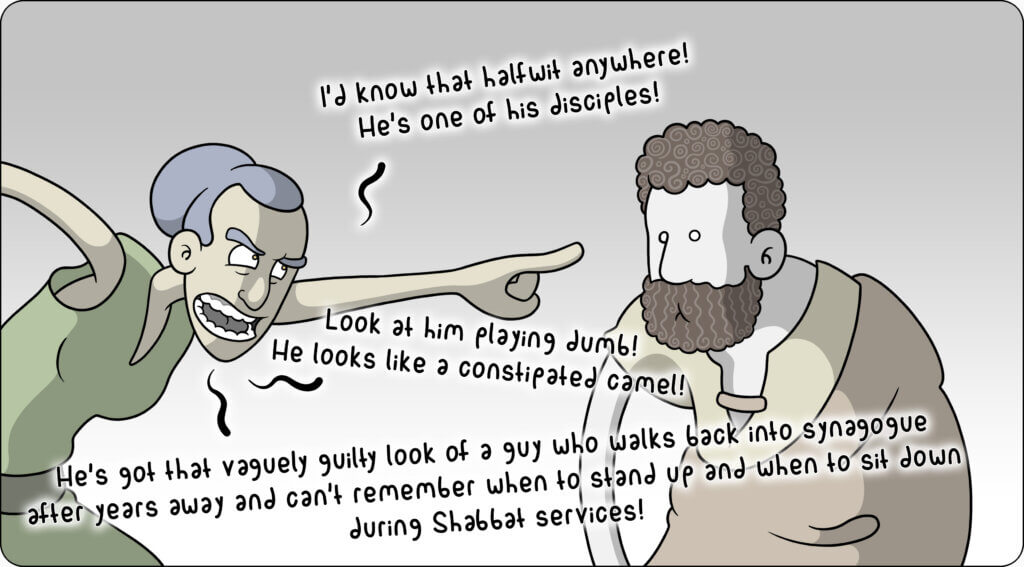
After denying Jesus, Peter denies the Church:
They said to him, “Are not you also one of his disciples?” He denied it and said, “I am not.”
(John 18:25)
…and finally denies himself:
And after a little while again the bystanders said to Peter, “Certainly you are one of them; for you are a Galilean.” But he began to invoke a curse on himself and to swear, “I do not know this man of whom you speak.” (Mark 14:70–71)
Which man are the bystanders talking about?
Clearly, they are talking about Peter, since they say, “Certainly you are one of them; for you are a Galilean.”
The main subject of this sentence is Peter, betrayed even by his accent.
He replies that he doesn’t know this man of whom you speak.
This is the third degree of denial: Peter denies himself.
(MARKO IVAN RUPNIK, Dire l’uomo – Volume 1: Persona, cultura della Pasqua, Lipa, Rome 2011, p. 326)
At that moment, with every mask shattered, Peter’s eyes meet the eyes of Jesus, and…
And the Lord turned and looked at Peter. And Peter remembered… (Luke 22:61)
When Peter can no longer even say who he is in front of the servants, he rediscovers himself in that gaze, in the gaze of the one he denied first.
In forgiveness, man discovers for the first time who he is.
(MARKO IVAN RUPNIK, Dire l’uomo – Volume 1: Persona, cultura della Pasqua, Lipa, Rome 2011, p. 327)
We arrive at love when we find no space within ourselves that does not need love. As long as we think we are capable of loving and doing good, we are walking toward betrayal and denial. Only when we have unmasked every space where Adam’s sin has inflated the ego so that it can fulfill itself even as goodness, even as virtue, do we encounter love.
(MARKO IVAN RUPNIK, Dire l’uomo – Volume 1: Persona, cultura della Pasqua, Lipa, Rome 2011, p. 327)
The journey Peter has made shows that he cannot say who the Lord is until he reaches the point where he can’t even say who he himself is.
(MARKO IVAN RUPNIK, Dire l’uomo – Volume 1: Persona, cultura della Pasqua, Lipa, Rome 2011, p. 327)
…and that’s when Peter’s heart is finally purified.
Purity of heart is a gift from God.
It’s a condition man can’t give himself.
It’s something he can’t produce by his own strength.
You don’t get there by rolling up your sleeves and trying to be a better person until you give yourself a spiritual hernia.
It’s a spiritual gift, not a psychological condition (I tried to say something about the difference between “psychological” and “spiritual” here… anyway, no, they’re not synonyms!).
Only God can purify the human heart.
5 • DIY vs. Letting God Do It
A few lines up, I wrote that it’s God who purifies the heart.
Now then.
Before anyone pictures God coming down from heaven, touching my chest, and opening my sixth chakra gate… no! (Although, being God, He can pretty much do whatever He wants!)
Usually, God works in a much more discreet, low-key way…
…through the circumstances I find myself in and through everyday life.
But if that’s how it works, how do I know it’s really Him at work? That it isn’t just my own effort to become a better person? Autosuggestion? Self-hypnosis?
One clue that the change comes from Him is that I’m incapable of changing myself.
See, I’m a Pharisee.
A moralist.
My superego is a merciless tormentor.
When I look at myself in the mirror, it’s almost always with a harshness that borders on murderous.
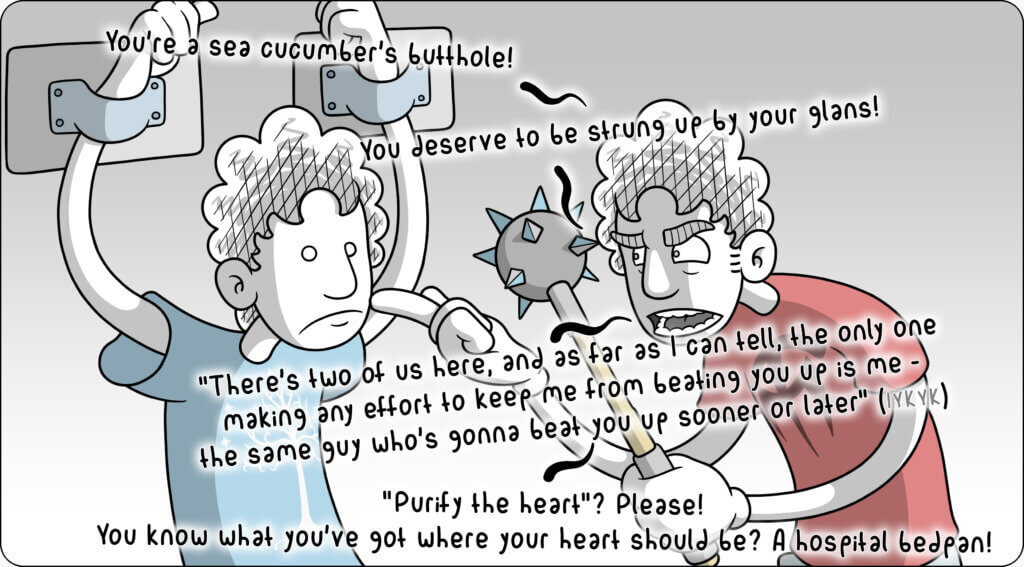
So if I tried to do this slow work of inner conversion on my own (and I’ve tried more than once), 99.99% of the time I’d only make things worse:
One can return into oneself and not find oneself facing anyone, be alone in one’s own heart, staring into that menacing, empty darkness left behind by things and by various idols, first set up as certainties and decisions and then made into the territory of one’s own will.
In the spiritual life, too, it happens that we set out on the path of purification and self-change without having the merciful Father before us, but only our own mind.
(MARKO IVAN RUPNIK, Gli si gettò al collo: lectio divina sulla parabola del padre misericordioso, Lipa, Rome 1997, p. 40)
Unfortunately, there’s no echocardiogram or EKG that can detect the moments when God purifies the heart. But here are a few signs that He’s the one at work:
- the inner change happens passively, without my forcing anything;
- the conversion comes from a kind gaze on my wounds, my weaknesses, my sins;
- it’s the fruit of a sweetness, a gentleness, a mercy that has filled my heart to the brim;
- it isn’t a moral effort but the result of something that didn’t start with me;
- God did it at a moment when I’d run out of ideas and landed flat on my butt, a moment in my life when He “came in even though my doors were shut” (cf. John 20:26).
Conclusion
In short, the heart is purified little by little when I let God be the one who tells me who I am, and not the Enemy:
In our hearts, Christ and the enemy are locked in a deep struggle for dominion over our weakness: Christ, to turn it into the place of His revelation and mercy; the enemy, to make it a reason for self-contempt. Both work on the details, both look for a breach to get in: one to bring His light and spread it in the world, the other to darken every fold of the heart, every thought. The spiritual life is nurtured by working on the details, not by grand proclamations and idealistic resolutions.
So our weakness can be either a theophany or the grain of sand that jams the whole machine.
(GABRIELE VECCHIONE, Sapienza collaterale: non sprecare il tuo dolore, Tau Editrice, Todi (PG) 2020, pp. 105–106)
In fact, thanks to [our] weakness, God’s mercy stops being just the title of a papal encyclical and becomes the oxygen we breathe.
(GABRIELE VECCHIONE, Sapienza collaterale: non sprecare il tuo dolore, Tau Editrice, Todi (PG) 2020, p. 108)
salt
(Fall 2021)
- MARKO IVAN RUPNIK, Gli si gettò al collo : lectio divina sulla parabola del padre misericordioso, Lipa, Roma 1997
- GABRIELE VECCHIONE, Sapienza collaterale : non sprecare il tuo dolore, Tau Editrice, Todi (PG) 2020
- ANDRÉ LOUF, Sotto la guida dello Spirito, Qiqajon, Magnano (BI) 2005
- LUIGI MARIA EPICOCO, Sale non miele. Per una fede che brucia, San Paolo, Cinisello Balsamo (MI) 2017
- MARKO IVAN RUPNIK, Dire l'uomo - Volume 1: Persona, cultura della Pasqua, Lipa, Roma 2011