1 • God: a sadistic, cynical master opposed to pleasure… (?)
Last summer, while reading a book, I came across this passage:
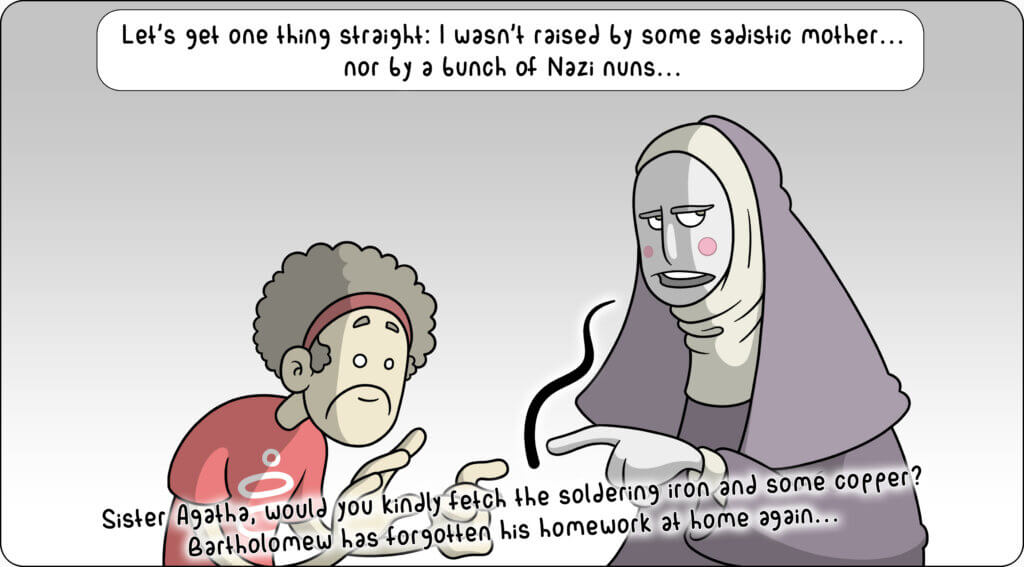
I remember commenting to a girl one day about the idea of God that tormented her: “Your god is more or less like this, a sadistic parent who has filled the house with many jars of Nutella, of which you are very fond, and then has plastered the walls with signs like ‘do not touch,’ ‘attention, it is strictly forbidden to eat Nutella,’ ‘danger: Nutella is harmful!'”
She had confused God with her mother’s truly sadistic experience.
And with certain nuns from the kindergarten she had attended…
[…]
A God who dominates, enjoying putting tempting pleasures in front of us and then frightening us with a thousand prohibitions!
God opposed to pleasure.
God opposed to what I am most fond of.
God opposed to fun, life, the body, the senses, sex…
God opposed to me!
This persecutory idea of God is precisely what the Tempter insinuated into Adam and Eve.
It’s the eternal temptation…: to plan life “defending” oneself from God.
(MIMMO AND CINZIA ARMIENTO, Lascerai tuo padre e tua madre: dalla schiavitù dei bravi ragazzi alla libertà dei figli di Dio, Porziuncola, Assisi 2006, p.181)
After reading it, I was literally struck.
…what a truth it’s hidden in the story told in the book!
How convincing is the impression that God – deep down – is a scoundrel.
How seductive is the suspicion that God wants to deceive me.
How suggestive is the idea that God is someone to whom I have to pay a ‘happiness tax‘…
…to live on the crumbs that fall from His table, slaloming through obligations and prohibitions, rewards and punishments, hoping that at the end of this suffocating zigzag, I still have some energy left to take care of myself.
All of this, following a sinusoidal pattern:
- there are moments in the week when one must live holding your breath, in apnea, trying to please God (strictly with a smile, otherwise, it doesn’t look good!);
- and then there are other moments when I can catch my breath and relax a bit from the schedule He imposes on me (but always with a certain composure, because the Heavenly Big Brother is still watching me!).”
Well…
…believe it or not…
…this is not the Christian God.
2 • ‘No one has seen God at any time…’ (John 1:18)
Parental Advisory: I’m about to say something a bit naughty.
The biggest tragedy of the Church is that most catechists, animators, scout leaders, and – probably – even some priests, talk about Someone they do not know…
I believe that 99 Christians out of 100 (*) are not actually Christians.
(*) (just to be clear, I am also among these 99)
Why do I say this unpleasant thing?
In one of his more challenging books, Father Marko Ivan Rupnik (born in ’54) has the wise Father Boguljub say these words during a prayer:
[…] if they have not known You as a Savior through integral experience and understanding, they cannot testify for You and make You known to others.
Who has never tasted honey is not very convincing when trying to explain its flavor, and sooner or later, they get tired of giving these explanations.
(MARKO IVAN RUPNIK, Il cammino della vocazione cristiana : di risurrezione in risurrezione, Lipa, Roma 2007, p.97-98)
And before him, in the 7th century, the Syriac bishop Isaac of Nineveh used to say:
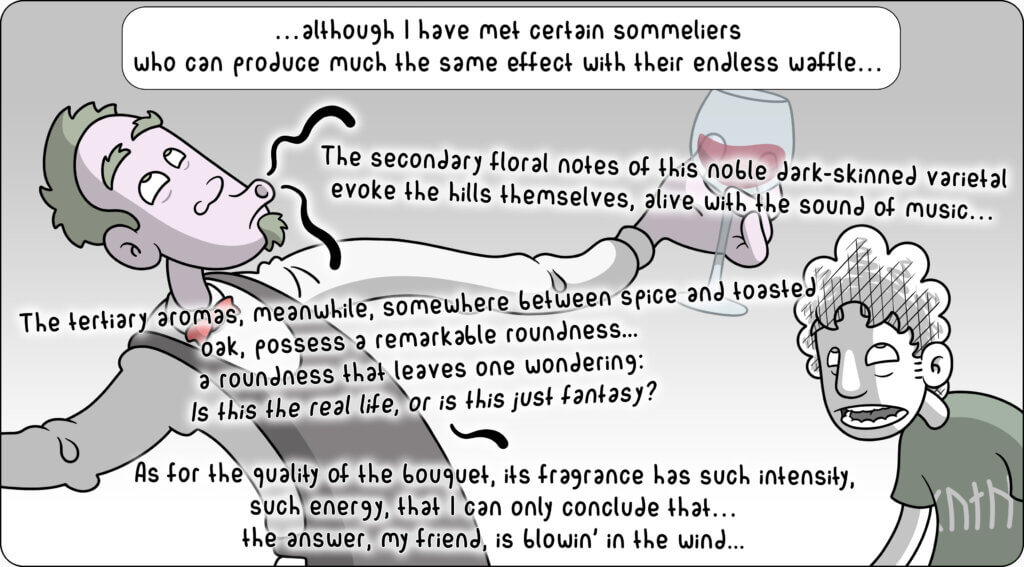
Whoever has not drunk wine does not get drunk by forcefully discussing wine […].
(ISAAC OF NINEVEH, Seconda collezione 18,2)
Why do I think that 99 Christians out of 100 (*) are not actually Christians?
(*) (I repeat – I am also among these 99)
One of the two must be true:
- Either Christianity is a cross between pseudo-moralistic voluntarism, an effort to try to behave well and respect others, an attempt to defend oneself from God… all of this, while feigning a forced smile;
- Or many – too many? – “Christian” individuals have not even glimpsed that “Father” mentioned by Jesus, not even by mistake, in passing, in reflection, in backlight…
3 • What does it mean that God is Father?
In one of his books, Don Fabio Rosini wrote that:
The fact that God revealed Himself as Father – and not as an ethical-religious entity – begins to fight against the lies contained in our fears.
(FABIO ROSINI, L’arte di guarire: l’emorroissa e il sentiero della vita sana, San Paolo, Cinisello Balsamo (MI) 2020, Kindle version, 44%)
What would be the ‘lies contained in our fears‘?
Left to his own devices and ‘good will,’ man struggles to think well of God.
I, at most – if life smiles at me and I have something to put under my teeth – imagine God as an Entity or as the ‘Prime Mover‘ (cf. ARISTOTLE, Metaphysics, 1071b 3-22)…
…but if something starts to creak, if there’s an unexpected turn, if ‘things don’t add up,’ I begin to think that God is:
- the Spectator amused by the tragicomic pantomime of my life;
- the ‘Cosmic Sadist‘ (cf. CLIVE STAPLES LEWIS, Diario di un dolore (A Grief Observed), Adelphi, Milano 2019, p.37);
- Someone who ‘controls me‘;
- a Scoundrel who, if I don’t tow the line, ‘makes me pay for it.’
I start to think of God as the Serpent presented Him to Adam and Eve (cf. Gen 3):
- a selfish God;
- a God jealous of His divinity;
- a God who wants to keep Adam and Eve at a safe distance from Himself.
In summary, a bad God.
At this point, a question might arise: how can I know that the fact that I think of God as a Father isn’t something that begins and ends in my own mind?
How can I be sure it’s not a selfconvincing work?
[Believing in “God the Father”] is not a “pious sentiment,” but the only possibility we have to be content.
Certainly, one must have a faith that trusts.
And to have faith, it is essential that we frequently return to this question: “What has the Lord saved me from?” “What would I be without Him?”
Answering sincerely and continually asking, remembering God’s goodness, is the beginning of authentic life.
(GIUSEPPE FORLAI, Vestirsi di luce : introduzione pratica alla vita nello Spirito, Paoline, Milano 2018, p.17)
“What has the Lord saved me from?” A very concrete question… that demands a very concrete answer…
If someone (thinking about their life) cannot answer clearly, they can join the 99 nonChristians I spoke about above…
4 • “[…] the only begotten Son, who is in the bosom of the Father, He has declared Him”(John 1:18)
In one of his books from the last century, Joseph Ratzinger asked this question:
How do we know […] that God, despite every appearance, does not play with the world at all but loves it and will always love it?
[…] God Himself had to reveal Himself, demolish the images, and introduce a new criterion of measurement. This happened in the Son, in Christ.
(JOSEPH RATZINGER, Il Dio di Gesù Cristo, Queriniana, Brescia 2012, p.30-31)
That God is Father can be revealed to us by only one Person: His Son.
Only by looking at Jesus – in reflection – do we discover the face of the Father:
In Him crucified [man] discovers the true image of God, and the false image insinuated by the ancient serpent is washed away.
If he thought that God was jealous, not a giver, one who seeks to dominate, now he sees before his eyes a God who not only gives but gives Himself, who does not want to control and subjugate man but deems him worthy of His trust, to the point of entrusting Himself into his hands.
But since man is still an enemy of God, he destroys and kills Him.
(MARKO IVAN RUPNIK, Il cammino della vocazione cristiana : di risurrezione in risurrezione Lipa, Roma 2007, p.49)
We “emancipated modern men,” after getting rid of God, have become totally incapable of experiencing this love. And of living it in turn.
A love that is “free, crazy, immeasurable” (Ibid.).
And indeed, in our “emancipated Western society,” we have (more or less explicitly) replaced the concept of “love” with that of “tolerance.”
Ah, what a beautiful (crappy) concept …
We have based our relationship with others on tolerance.
We have based relationships on tolerance.
We have based marriage on tolerance.
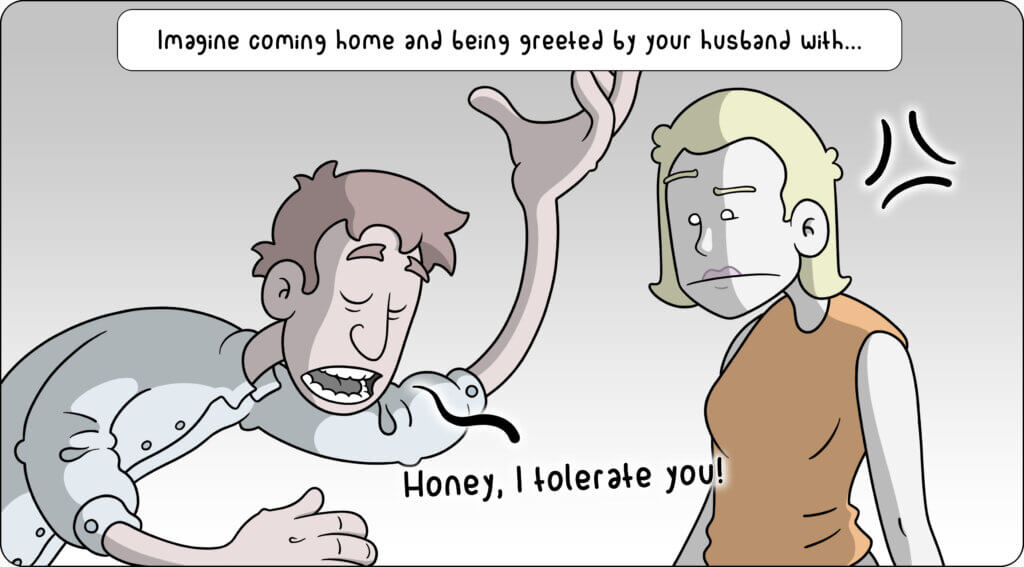
We tolerate poisons…
We tolerate harmful substances…
The love of the Father is something else…
5 • Performance Anxiety
Traveling towards Jerusalem to celebrate the Passover, Jesus passes through Jericho.
On that occasion (cf. Mark 10:46-52; Lk 18:35-43), he encounters a blind man; before healing him, Jesus asks him a single question:
“What do you want Me to do for you?”
(Mark 10:51)
Rupnik commented on this passage as follows:
[…] the question Jesus asks him is staggering: What do you want me to do for you?
This expression dismantles many deviations regarding the knowledge of God.
There is a real anguish in man at the thought that, if he knows God, he will have to serve Him, he will no longer be free. While [in this Gospel story] we have the blind man – an expression of all the poverty of man who cannot live according to his own knowledge, according to his own understanding, an expression of an injustice caused by this schism – standing before Christ recognized as the Son of David, and it is he, the Messiah, who now utters the typical phrase of every servant when called by his master: What do you want me to do for you? Here is the parable of the knowledge of God that gradually completes itself: God descends and goes to meet the man who cries out, presenting Himself to this man as a humble servant.
(MARKO IVAN RUPNIK, Dire l’uomo – Volume 1: Persona, cultura della Pasqua, Lipa, Roma 2011, p.181-182)
Not by chance, in the first letter of John, it is written:
In this is love, not that we loved God, but that He loved us […].
(1 John 4:10)
The 99 (so-called) Christians out of 100 I mentioned earlier are those who have not yet had this experience.
They are the ones who still live a “performance anxiety” towards God, disguising it now as social activism, now as stoic moralism, now with other nonsense that has nothing to do with life in Christ…
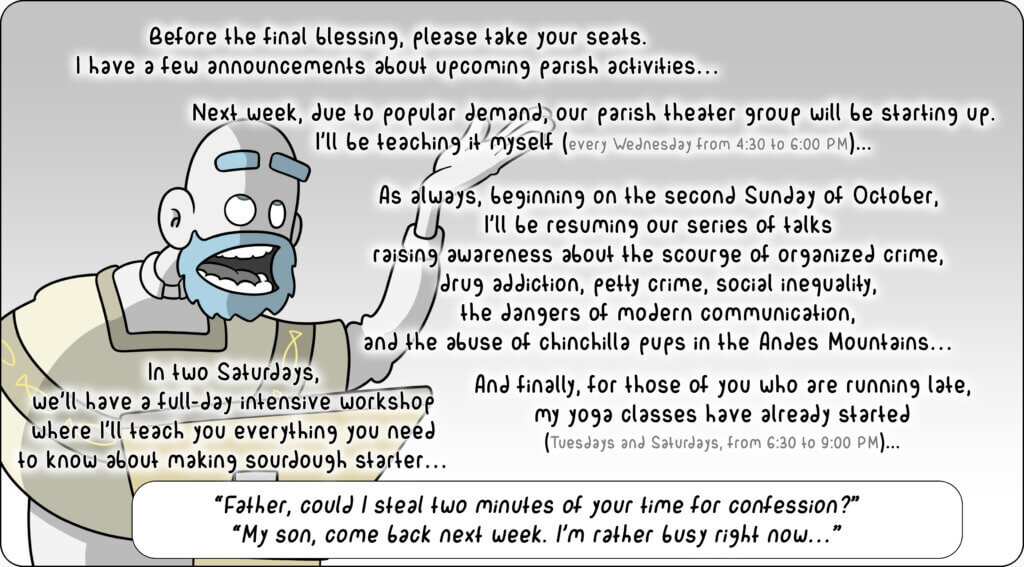
…but they have not yet experienced that love of which Rupnik says:
To be sure of being loved,one must live an experience of love that is completely gratuitous, that is, one must not deserve love, be surprised by a crazy love, without measure, without possible justification (cf. Titus 3:5-7).
We must undergo the experience of a free love, and therefore according to the most authentic categories of mystery: that is, freedom, outside of every bond, every cause, every necessity…
It must be a total, boundless love.
(MARKO IVAN RUPNIK, Il cammino della vocazione cristiana : di risurrezione in risurrezione, Lipa, Roma 2007, p.52-53)
A million-dollar question: how can I be sure that my relationship with God is not a suggestion?
That His love is something concrete? Experienced?
How do I know that God is truly a Father?
Why do I know that God is a Father? Is it because I like the concept or it warms my heart? No; I know because I have seen Him generate in me and in many people around me that life that does not come from man.
What we need is not to strive to be better or more consistent, or to discover some technique or follow some trendy personality, but to allow ourselves to be shaped by God.
It is about giving God permission to make you new, so that He can use you to experience His power as a Father.
(FABIO ROSINI, L’arte di guarire: l’emorroissa e il sentiero della vita sana, San Paolo, Cinisello Balsamo (MI) 2020, Kindle version, 74%)
Conclusion
It’s easy to say that “we are all brothers“…
Brother here… brother there…
Liberty, Equality, Fraternity…
Unfortunately, without the Father, there is no true brotherhood:
As believers, we are convinced that, without an openness to the Father of all, there will be no solid and stable reasons for an appeal to fraternity. We are certain that “only with this awareness that we are not orphans, but children, can we live in peace with one another”. For “reason, by itself, is capable of grasping the equality between men and of giving stability to their civic coexistence, but it cannot establish fraternity”.
(POPE FRANCIS, Encyclical Letter Fratelli tutti, n.272)
salt
(Summer 2021)
- MIMMO ARMIENTO, CINZIA ARMIENTO, Lascerai tuo padre e tua madre. Dalla schiavitù dei «bravi ragazzi» alla libertà dei figli di Dio, Porziuncola, Assisi (PG) 2006
- FABIO ROSINI, L'arte di guarire : l'emorroissa e il sentiero della vita sana, San Paolo, Cinisello Balsamo (MI) 2020
- MARKO IVAN RUPNIK, Il cammino della vocazione cristiana : di risurrezione in risurrezione, Lipa, Roma 2007
- MARKO IVAN RUPNIK, Dire l'uomo - Volume 1: Persona, cultura della Pasqua, Lipa, Roma 2011
- JOSEPH RATZINGER, Il Dio di Gesù Cristo: meditazioni sul Dio uno e trino, Queriniana, Brescia 2011