1 • Humility: trying to convince yourself you’re ugly and bad (?)
A lot of people think humility looks something like this:
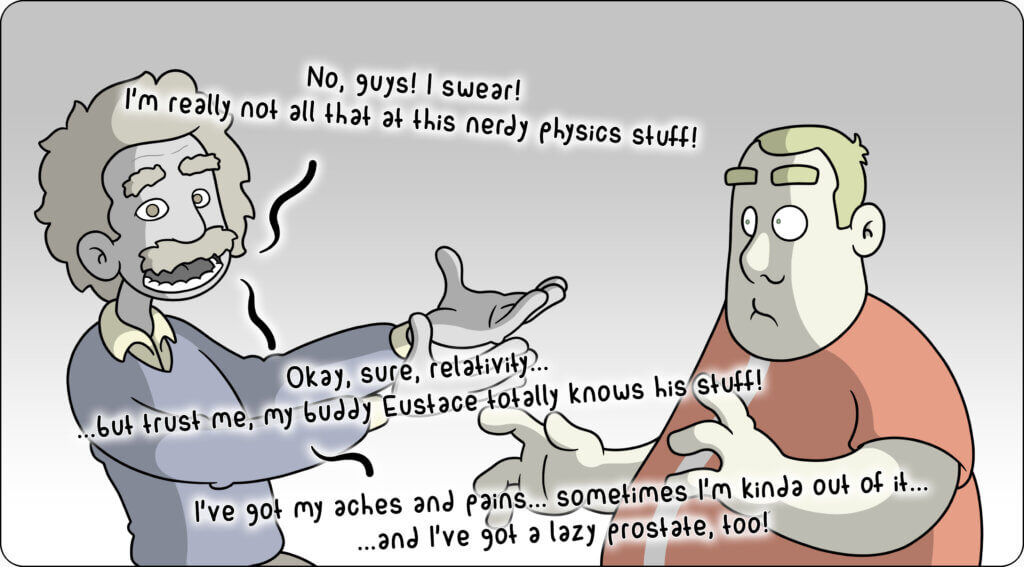
In short, there’s a widespread idea that humility means downplaying the talents we have, trying really hard to convince ourselves we don’t actually have them.
And since that’s sometimes objectively impossible (see the Einstein cartoon), people often end up feeling bad because they can’t bring themselves to believe something obviously absurd.
That is not humility.
It’s not even close.
It’s light-years away from what Jesus asks of us when He says, “Learn from Me, for I am meek and humble of heart“ (Matthew 11:29).
2 • An Uncomfortable Virtue
In Greek, the word for humility is tapeinōsis (ταπείνωσις, from the verb ταπεινόω, tapeinoō; see, for example, Luke 1:48; Luke 18:14; Matthew 23:12; Acts 8:33; Philippians 2:8; James 4:10).
The word is connected to ideas of insignificance, humiliation, keeping a low profile, and being small (see the entry for “tapeinōsis” on biblehub.com).
In Latin, the word is humilitas (from humus, meaning “earth”), so here too the idea is being down-to-earth.
Paul of Tarsus wrote:
What have you that you did not receive? If then you received it, why do you boast as if it were not a gift?
(1 Corinthians 4:7)
Riffing on these words, Paul Claudel (1868-1955), a French poet, playwright, and diplomat, put it this way:
Christian humility does not consist in the hypocritical lie of denying that we have particular gifts. Humility is truth: recognizing those gifts, if we have them, but also acknowledging that we did nothing to earn them, that they come entirely from God as His free gift, and that they are meant to be put at the service of our brothers and sisters.
Humility doesn’t mean pretending to be incompetent.
It doesn’t mean putting on a show of false modesty (which usually just annoys everyone around us).
Humility means being able to design the best cathedral in the world…
…and know it to be the best, and rejoice in the fact, without being any more (or less) or otherwise glad at having done it than he would be if it had been done by another.
(CLIVE STAPLES LEWIS, The Screwtape Letters, Letter XIV)
Now, let’s not kid ourselves.
Reaching this kind of humility is a bit like the extra-credit question at the end of the test, the one that gets you an A+.
I mean, I don’t know about you, but I’m barely scraping by with a C…
…case in point: in everyday life, I manage to feel proud even of things I deserve zero credit for…
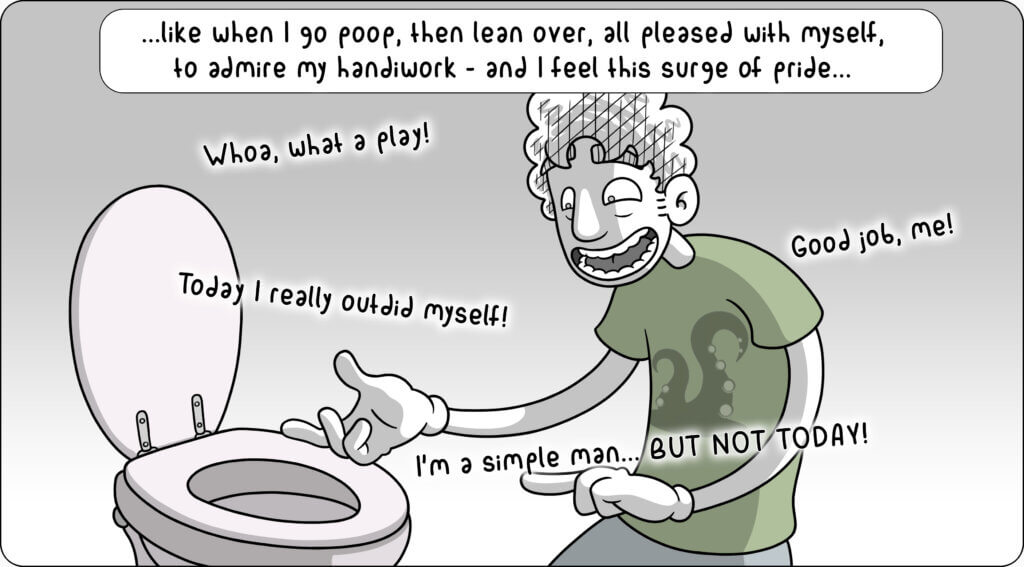
3 • How do you become humble?
I said earlier that humility isn’t a mental exercise in talking yourself into something.
I can’t force myself to be humble.
So how do you become humble?
In the tradition of the Church (from the Fathers of the early centuries to 20th-century spiritual writers), there’s broad agreement on the remedies for acquiring humility:
- Humiliations
- Temptations
- Falls
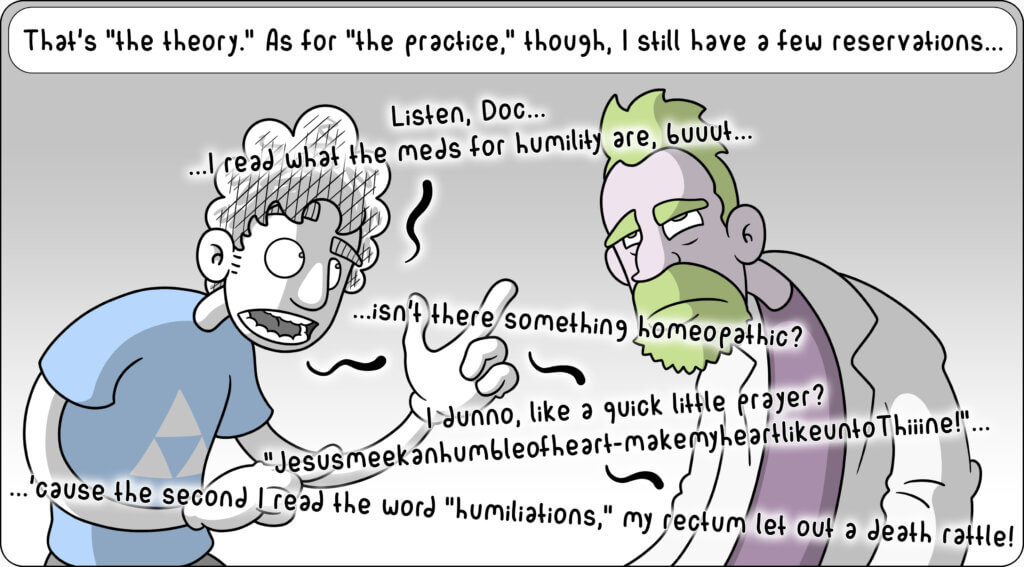
The word “humiliation” is terrifying.
Nobody wants to be humiliated.
Personally, the moment I read that the Fathers talked about humiliations as “a path to humility,” I started cranking out excuses:
- “What’s with this ancient idea of humiliations?”
- “Honestly, if I just roll up my sleeves, I can handle this pride problem on my own!”
- “The Church Fathers didn’t know what we know about psychology and psychotherapy!”
- “This whole mortification thing seems a bit outdated!”
- “It’s the third millennium. There have to be more effective methods by now!”
The problem is, the Fathers of the early centuries weren’t the only ones talking about humiliations.
Just to give you one example, here’s what Pope Francis wrote in 2018:
Humility can only take root in the heart through humiliations. Without them, there is no humility or holiness. […] The holiness that God bestows on his Church comes through the humiliation of his Son. He is the way.
(POPE FRANCIS, Apostolic Exhortation Gaudete et Exsultate, 118)
He added:
I am not saying that such humiliation is pleasant, for that would be masochism, but that it is a way of imitating Jesus and growing in union with him. This is incomprehensible on a purely natural level, and the world mocks any such notion. Instead, it is a grace to be sought in prayer: “Lord, when humiliations come, help me to know that I am following in your footsteps.”
To act in this way presumes a heart set at peace by Christ, freed from the aggressiveness born of overweening egotism.
(POPE FRANCIS, Apostolic Exhortation Gaudete et Exsultate, 120-121)
It’s not about masochism.
It’s not about glorifying pain.
And it’s not about going looking for mortifications (because sooner or later, life takes care of that on its own… trust me, I speak from experience!).
It’s about experiencing that God is a Father, and a good Father at that (Matthew 23:9; Luke 18:19).
And that there is wisdom in the cross (1 Corinthians 1:18-31), which can only be discovered through a deep, gut-level relationship with Jesus.
And sooner or later, this relationship with Him leads down the narrow path of humiliations.
4 • Why humiliations and temptations?
Isaac of Nineveh (c. 613 – c. 700), an Eastern Christian bishop, wrote:
When grace sees that a hint of self-satisfaction is creeping into someone’s thoughts, and that they are beginning to think highly of themselves, it immediately allows temptations to grow stronger and even prevail, so that the person may come to know their own weakness, flee, and humbly take refuge in God. For it is in this way that one attains the stature of the perfect man, in faith in the Son of God, and is raised up to love.
(ISAAC OF NINEVEH, First Collection 77)
These words echo those of Madeleine Delbrêl (1904-1964), a French mystic and social worker:
Humility can only be given to us by God, and most of the time it can only be given hidden inside humiliations. Yet these are among His most beautiful gifts.
(MADELEINE DELBRÊL, notes written for her groups, 1956, from La gioia di credere, Gribaudi, Turin 2012, p. 119)
Wait…
…what does “among His most beautiful gifts” even mean???
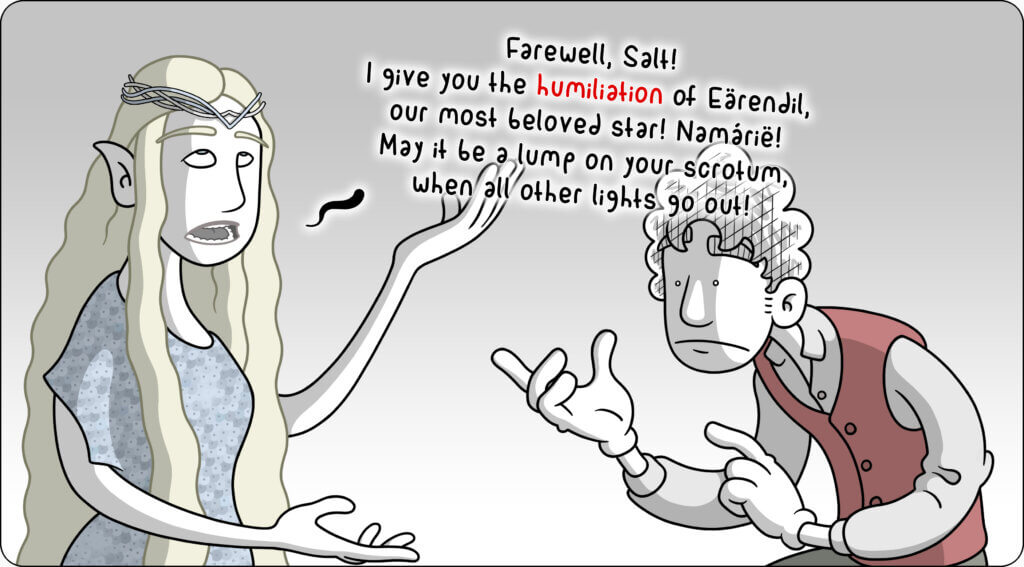
Let me say it again: this isn’t about masochism!
It’s much simpler than that: as long as I trust in myself, in my strength, in my abilities, in my “look how good I am”…
- …I’ll spend my whole life on guard, gritting my teeth and hoping that no wave ever comes along higher than the dam I’ve built;
- …dreading the day the dam gives way and I discover the truth about myself.
When that happens, I have two options:
- Look at myself in the mirror and be crushed by my shattered expectations, by having let myself down, by my superego (shaped by my surroundings, by culture, by what others think, by my pride);
- …or discover myself under the gaze of God, the only One who does not condemn me (cf. Mark 2:16), who is moved by my poverty (cf. John 11:33), who comes looking for me (cf. Matthew 18:12), who promises me that “the best is yet to come” (cf. John 2:1-11), and who gives true peace (cf. John 14:27).
5 • …and what about our falls?
Basil of Caesarea (330-379), bishop and Greek Church Father, says this in a homily on humility, about the moment when Peter denies Jesus:
[God] then abandoned him to his weakness as a man, and he fell into denial, but his fall made him wise and kept him on guard. He learned to be lenient with the weak, having come to know his own weakness, and from that moment on he clearly understood that it was by the strength of Christ that he had been saved when he was in danger of death because of his lack of faith, in the storm of scandal, just as he had been saved by the right hand of Christ when he was about to sink into the sea.
(BASIL OF CAESAREA, Homily on Humility 4, PG 31, 532D-533A)
In fact, all the talents we have, all our virtues, all the gifts God gives us, if they aren’t lived in humility…
…are a ruin for those who receive them… If God grants you a gift, ask Him to teach you how that gift can help you grow in humility… or beg Him to take that gift away from you, so that it doesn’t become the cause of your ruin. Not everyone, after all, can hold on to wealth without being harmed by it.
(ISAAC OF NINEVEH, First Collection 58)
Every gift from God can become a stumbling block (for us or for others):
- our looks;
- a physical ability or talent;
- a particular aptitude for a certain line of work;
- money.
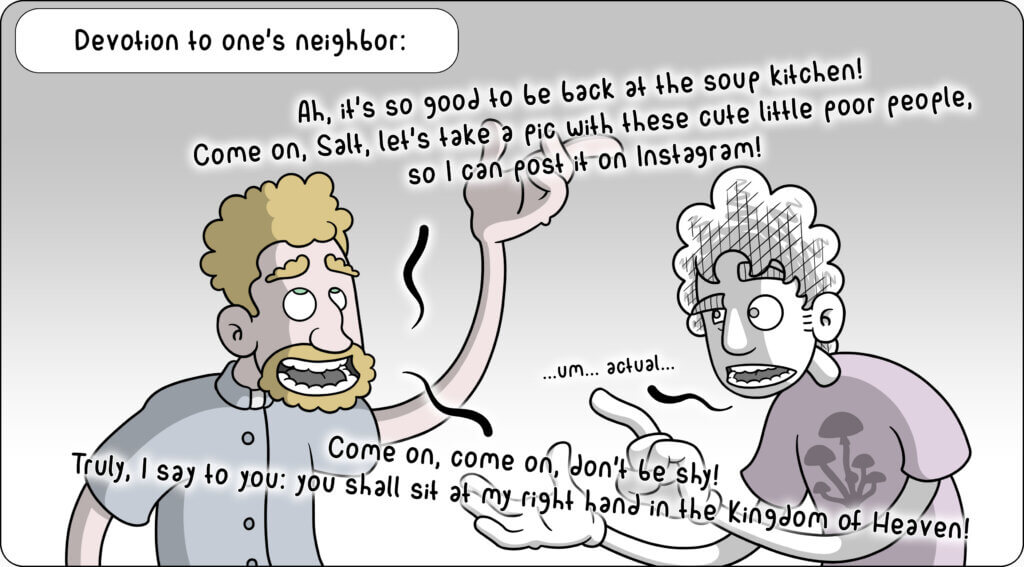
So, like humiliations, falls are also a tool God often uses to teach us not to rely on our own strength, but to find our rest in Him alone (cf. Psalm 55:7; 116:6-7):
But temptation is not the only school of humility; even sin, permitted by God when He seems to have almost run out of other means, can become a doorway to salvation. Just think of King David: it is from him, in the famous Psalm 51, that the spiritual tradition took the image of the “contrite and humbled heart.” David had indeed fallen into sin, but his sin became for him a felix culpa, a happy fault, that set him on the path to salvation.
(ANDRÉ LOUF, L’umiltà; con antologia di testi patristici, Qiqajon, Magnano (BI) 2000, p. 42)
6 • Rolling up your sleeves and trying to “be good” without humility
Isaac of Nineveh wrote:
As long as a person is not humble, they receive no reward for their asceticism. The reward is not given for asceticism, but for humility… The reward is not even given for virtue, but for the humility that springs from both. Without humility, asceticism and virtue are in vain.
(ISAAC OF NINEVEH, First Collection 58)
…and also:
Even without works, humility obtains forgiveness… without humility, works are of no use… What salt is to food, humility is to the virtues… without it, all our works are in vain, every virtue and every ascetic effort.
(ISAAC OF NINEVEH, First Collection 72)
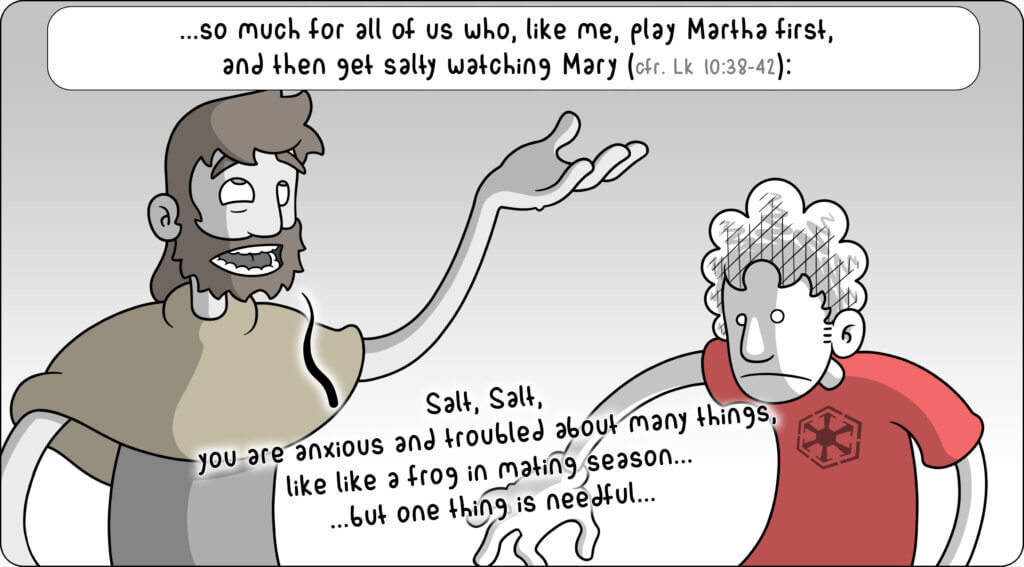
On the journey of conversion, the initiative isn’t mine, but God’s.
It is God who brings about this change, who stoops down to fill my poverty: in the Creed we say that “for us men and for our salvation he came down from heaven.” It is He who comes down.
Without rushing, on His timing and in His ways, not mine:
No wonder Augustine of Hippo said:
Conclusion
A few months ago, I read a book by Fr. Giuseppe Forlai (b. 1972) that included these lines:
Many people believe they were born to do great, pious, or useful things for others. Over time, you come to understand that the greatness of a soul is measured within the small story it is given to live.
To believe wholeheartedly that the little I am given to do today, hidden and unnoticed, saves the world is an act of faith that moves mountains.
(GIUSEPPE FORLAI, Vestirsi di luce: introduzione pratica alla vita nello Spirito, Paoline, Milan 2018, pp. 27-28)
Fr. Giuseppe is right…
…it’s just that I’m stubborn, and I often act like the donkey in the fable by Jean de La Fontaine (1621-1695), a French writer and poet:
An ass, with relics for his load,
Supposed the worship on the road
Meant for himself alone,
And took on lofty airs,
Receiving as his own
The incense and the prayers.
Someone who saw his great mistake
Cried, “Master Donkey, do not make
Yourself so big a fool.
Not you they worship, but your pack;
They praise the idols on your back,
And count yourself a humble tool.”
‘Tis thus a brainless magistrate
Is honoured for his robe of state.
(JEAN DE LA FONTAINE, Fables, Book IV, 14)
salt
(Fall 2021)
- ANDRÉ LOUF, L'umiltà; con antologia di testi patristici, Qiqajon, Magnano (BI) 2000
- GIUSEPPE FORLAI, Vestirsi di luce : introduzione pratica alla vita nello Spirito, Paoline, Milano 2018
- CLIVE STAPLES LEWIS, Le lettere di Berlicche, Mondadori, Segrate 2016