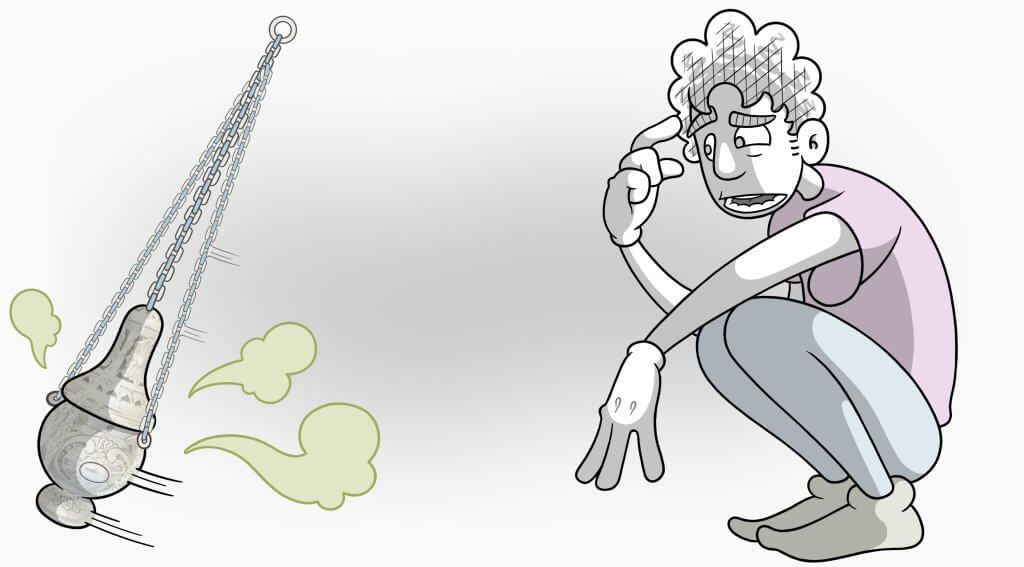
1 • Sweeping pain under the rug
Contemporary society, at the macro level (*), seems to have found just one solution to pain: hide it.
(*) (and I stress “at the macro level”: these are generalizations that – by their nature – don’t describe all of reality… but they’re a good approximation of the prevailing mindset)
We like to numb ourselves.
We love to have fun.
We can’t wait for the weekend so we can distract ourselves from the crappy week we just had.
As Blaise Pascal wrote (1623-1662):
Diversion – Since men have found no cure for death, misery, or ignorance, they have decided that the way to be happy is not to think about them.
(BLAISE PASCAL, Pensées, no. 168)
But there’s a problem: you don’t clean the house by hiding the dust under the rug.
Metaphor aside: if you only remove the symptoms and don’t get to the root of the problems, the problems stay unsolved.

2 • Dealing with your own wounds
Until a few years ago, I believed (*) that psychotherapy was “that thing for people with mental problems.”
(*) (like many other Italians… I don’t know why, many of us have this cognitive bias…)

Thank God, though, over the last few years, on endless walks with my best friend, I heard him talk again and again about how beautiful, good, useful, and fruitful his psychotherapy was turning out to be (*).
(*) (A friend who, obviously, is perfectly sane; in fact, he’s one of the most empathetic, wise, and emotionally intelligent people I know)
I started to see things differently.
After all…
- …every time I’ve played a sport in my life, it wasn’t because I was in poor health or had physical or muscular problems, but because, even with a healthy body, sports made me feel better and helped me stay in shape, and I liked having toned muscles, etc.
- …so, in the same way, even though I don’t have any psychiatric disorders, I began to suspect that psychotherapy would be for my psyche what the gym was for my body.
And that’s exactly how it turned out.
I mean, to be honest, it wasn’t just that.
Actually, even though I didn’t realize it at the time, there was a lot of dust “under the rug in the living room of my psyche.”
Hidden, deep, intimate stuff.
That was bleeding.
Vulnerabilities, scars, emotional wounds, relationships that ended badly, and a whole bunch of other things that were rotting away “down there.”
Psychotherapy helped me discover what was under the rug.
To put a name to some of the things inside me.
To recognize them.
To become aware of them.
It was truly a breath of fresh air!
3 • You don’t heal yourself by “rolling up your sleeves”
Anyway, as I was saying, holy and blessed psychotherapy!
It’s been one of the best decisions I’ve made in years!
I’d recommend it to anyone!

However…
However…
However…
…as I mentioned a while back, according to Christian anthropology (1 Thessalonians 5:23), man is made up of:
- body
- soul (in Greek ψυχὴ, psychē)
- spirit
You can have a healthy psyche and a physical problem.
You can have a healthy body and a psychological issue.
But you can also have a healthy body and a healthy psyche, and still have wounds that have to do with your spiritual life.
Health (physical or psychological) is one thing.
Salvation is something else.
“Fixing myself” – or having a trained professional “fix me” – is one thing.
“Saving myself” is something else.
I can’t save myself.
And no doctor, psychologist, psychiatrist, or therapist can do it.
Um…
What do I mean by “salvation”?
Let’s see… I’ll take the long way around…
I don’t know if you remember the Gospel story where Jesus raises Lazarus from the dead.
When Jesus arrives at the tomb and asks them to take away the stone sealing the entrance, Martha points out that it would be better not to, because a terrible stench would come out, since her brother has been dead for four days (John 11:39).
But Jesus insists: the stone closing off the tomb has to go!
Beyond the headline (which is beautiful anyway… I mean, Jesus brings a man back to life), this Gospel passage describes something deeply true from a spiritual perspective too:
There are those things about which we say, “Don’t open this tomb, because I smell bad, because I’ve been dead so long…” and Jesus says instead, “But with the glory of God, it’s a different story. I can handle your smell. It doesn’t disgust me.”
When they move the stone for Lazarus – and the stench comes out – that’s the moment when Jesus sings out His gratitude to the Father. Why? Because this is exactly what He came for. And what’s that? To grapple with our poverty all the way to the end.
There are things about myself that I cannot look at… that’s where the Lord must enter: this is what healing is, this is precisely healing: that I stop running away, because many of the things I do, I do to escape that emptiness, that foul smell that horrifies me.
But that emptiness doesn’t need to be removed or hidden; it needs to be loved.
(FABIO ROSINI, L’arte di guarire: l’emorroissa e il sentiero della vita sana, San Paolo, Cinisello Balsamo (MI) 2020, Kindle version, 48-49%)
Pope Francis, commenting on this Gospel episode, said:
[…] each one of us already has a small sepulchre, some area that has somewhat died within our hearts; a wound, a wrongdoing endured or inflicted, an unrelenting resentment, a regret that keeps coming back, a sin we cannot overcome. Today, let us identify these little sepulchres that we have inside, and let us invite Jesus into them. It is curious, but we often prefer to be alone in the dark caves within us rather than invite Christ inside them. We are tempted to always seek [solutions for] ourselves, brooding and sinking into anguish, licking our wounds, instead of going to him, who says, “Come to me, all who labour and are heavy laden, and I will give you rest”, (Mt 11:28).
(POPE FRANCIS, from the homily for the Fifth Sunday of Lent during his visit to Carpi and Mirandola, April 2, 2017)
4 • (Not) staying under His gaze
What happens when “the tomb stays closed“?

No, not literally!
Let me rephrase: what happens if I don’t let God heal my wounds?
What if I don’t let Him take care of them?
What if I hide them from Him?
Wounds not tended by a redeeming hand always remain a serious danger to the spiritual life, and to the psychological life as well.
If this situation isn’t resolved into something positive in our Lord and Savior, from now on you run the risk of always looking at many things through the filter of these episodes, which amounts to having blurred vision, as when we have a smudge on our glasses that keeps us from seeing things as they really are.
[…]
Sadness is a feeling the enemy loves to play on, and plays on well.
We have to be careful because, as St. Paul says, there is a godly sadness and a worldly one (cf. 2 Corinthians 7:10).
(MARKO IVAN RUPNIK, L’arte della vita: il quotidiano nella bellezza, Lipa, Rome 2011, p. 226)
Let me say it again: holy psychotherapy! Blessed psychotherapy! Going to therapy has been one of the best decisions of my life! I recommend it to everyone!
But whatever therapy you go through, it will stay on that level: the psychological.
It lets you work things out with yourself, or between you and your therapist.
It helps, don’t get me wrong!
But it doesn’t get to the root.
It doesn’t get to the only thing that saves: realizing that you are under His gaze.
Experiencing that good gaze.
Welcoming.
Benevolent.
Merciful.
Under which even the most painful wound finds meaning.
Which means it’s redeemed.
Which means I can give it a kiss and thank God, because if it weren’t for that wound, He would never have truly entered my life.
5 • Letting God have the last word on my wounds
For most of my life, I thought of God as a vending machine.
If I put in a coin (i.e., prayed) and got a drink, the machine had worked fine; if I put in the coin and no drink came out, the machine must have jammed.

In reality, as I mentioned when I talked about prayer, God doesn’t work that way.
The same goes for wounds: God doesn’t take shortcuts.
God doesn’t take away wounds (*)…
God doesn’t take away the cross (*)…
God doesn’t take away death (*)…
(*) (usually, at least. Being God, of course, He’s always free to do as He pleases)
…He doesn’t need to do these things, because He has a much greater power: the power not to let these things have the last word.
~
Million-dollar question: how can I tell that it’s God speaking in my wounds? That it’s God acting? That it’s God who is “working on me“?
In other words, how can I tell that trying to accept my wounds, my vulnerabilities, and my crosses isn’t just “my own effort,” which risks turning me into a frustrated person?
I haven’t found a better answer than the one given by Father Marko Ivan Rupnik:
You see, this part is up to you: ask for grace, implore, and knock on the door of Wisdom, the wisdom of the cross. In fact, when it comes to wounds, it is wise to make a prolonged epiclesis, so that the Father may send the Holy Spirit, who alone can communicate their meaning to us in a true and convincing way. Only the Spirit can open our eyes to see our wounds in the wounds of Christ. Only when we manage to discover the meaning of our wounds in Christ do things begin to change. But our participation in Christ is not our own work – it is the acceptance of the work of the Spirit in us.
(MARKO IVAN RUPNIK, L’arte della vita: il quotidiano nella bellezza, Lipa, Rome 2011, p. 228)
Conclusion
I wrote that wounds are God’s gateway into my life…
…and God only knows how true that is!
But wounds serve another purpose too: letting others into my life, and letting me into theirs.
As Father Fabio Rosini said in a catechesis a couple of years ago:
People hate you for your strengths and love you for your poverty.
Your poverty leaves room for others in your life; your strengths put you in competition.
When you flaunt your strengths, the other person becomes an antagonist; when you show yourself as fragile and incomplete, the other person can breathe and can love you.
(FABIO ROSINI, from the catechesis “Sei abbastanza debole per essere Santo?” (“Are you weak enough to be holy?”) at the parish of Our Lady of Lourdes in Rome, October 2020)
salt
(Spring 2022)
Sources/insights
- FABIO ROSINI, L'arte di guarire : l'emorroissa e il sentiero della vita sana, San Paolo, Cinisello Balsamo (MI) 2020
- ANDRÉ LOUF, Sotto la guida dello Spirito, Qiqajon, Magnano (BI) 2005
- MARKO IVAN RUPNIK, L'arte della vita : il quotidiano nella bellezza, Lipa, Roma 2011
- GABRIELE VECCHIONE, Sapienza collaterale : non sprecare il tuo dolore, Tau Editrice, Todi (PG) 2020
- FËDOR DOSTOEVSKIJ, Memorie dal sottosuolo, Biblioteca Economica Newton, Roma 2005