1 • Verbal and nonverbal messages
Psychology is a science that has always fascinated me.
I know (almost) nothing about it, but I’m lucky enough to have a few friends who’ve actually studied it…
…and since I’m a pain in the neck, I’m constantly bombarding them with questions: I ask them how children learn, how our upbringing helps shape our conscience, how the psyche works in the first years of life, etc.
They explained that between birth and age 7, we receive verbal and nonverbal messages from our parents (and/or caregivers) that have a great influence on us, at a time when our psyche is very vulnerable (a child has no filters, no structured thinking, and absorbs everything from mom and dad, etc.).

2 • “Never make mistakes!”
I don’t know about you, but one of the messages that’s sunk deepest into my noggin goes something like this:
“Never make mistakes!”
“Mistakes are unacceptable!”
“You can’t afford a single misstep!”
“If you blow this chance, you won’t get another one!”
“If you made a mistake, what would people think of you?”
“If you made a mistake, the people around you would suffer!”
“If you do these things, God won’t love you anymore!”

As I said above, the messages we internalize often reach us NONverbally:
- I don’t remember my mother or father ever telling me to “never make mistakes“;
- Nor have I ever read a passage in the Bible, the Gospels, or the Catechism where God says anything like what He says in the comic above (*).
(*) (I can’t say the same about priests: I’ve met way too many who presented God to me as a taskmaster, a tormentor, or a cranky old spinster… and very few who showed Him to me as a Father).
But that’s exactly the point: an overprotective parent, a perfectionist mom, an anxious priest, a high-strung nun… can often say far more with a look, a gesture, a sigh, a nod—in other words, with a NONverbal message—than they ever say with words.
3 • Performance anxiety
I’d always thought perfectionism was a good thing…
…that it motivated me to roll up my sleeves…
…that it might even be—why not?—a Christian virtue…
…that it pushed me to do good, to take “half a step forward” toward others…
…but then I started connecting the dots differently:
- We live in a schizophrenic society;
- We’re constantly bombarded with marketing, advertising, and promotional messages;
- The ideals our culture imposes on us are deliberately out of reach;
- And I don’t just mean financially: in relationships, in friendships, in our love lives, in everyday life, in our weekly commitments, the air we breathe is the same: “I have to be perfect!” “I have to be flawless!” “If I live up to people’s expectations, they’ll love me!” “If I don’t let them down, they’ll give me their affection in return!” and so on;
- This fuels a sense of widespread frustration: if I don’t measure up to the ideal I’ve been handed, I’ll inevitably end up with a “guilty conscience“;
- That sadness will then drive me to fill the void by treating myself (i.e., spending money), because deep down “I deserve a little comfort.”

This is the rat race I was born and raised in.
My mom, my dad, my grandma, and all the people who did the most to shape my conscience were born and raised in it.
My closest friends, my teachers, my favorite singers, and so on were born and raised in it.
…
Suddenly, I realize that the perfectionism I was chasing has very little to do with Christianity…
…and is actually rooted in pride and the fear of being judged by others.
4 • The Eye-of-Sauron god
Oh, don’t think I came up with that glimmer of self-awareness at the end of the last section all on my own…
…nor did Saint Lucifer of Cagliari appear to me while I was kneeling on uncooked rice…
…it was much more mundane than that: I stumbled across these lines by Jacques Philippe, a French religious, priest, and theologian (born in ’47):
On the other hand, we’d really like to be infallible, but this desire often hides a lot of pride, and also the fear of being judged by others.
Whoever is willing to make mistakes now and then, even in front of others, shows genuine humility and a sincere love for God.
Let’s free ourselves from the false idea we have of what God demands of us: God is a father, good and compassionate; he knows the frailties of his little ones and knows that their judgment is limited.
He asks us for good will and a right intention, but in no case does he demand that we be infallible and that all our decisions be perfect!
What’s more, if all our decisions were perfect, it would do us more harm than good.
We’d immediately start thinking of ourselves as supermen.
(JACQUES PHILIPPE, La pace del cuore, EDB, Bologna 2020, p. 52)
There’s no way around it…
…a few months ago I even wrote a short post about the fatherhood of God…
…about how He welcomes us… His kindness… His gaze, which is always loving…
…I know “the theory“…
But when it comes to putting it “into practice“—when life throws me a curveball, when something doesn’t go according to plan, the moment an obstacle pops up, when I make a mistake—there’s often another (false) image of God in my heart…
A demanding god…
A god who’s the enemy of my happiness…
A god who expects something in return…
An orc god…
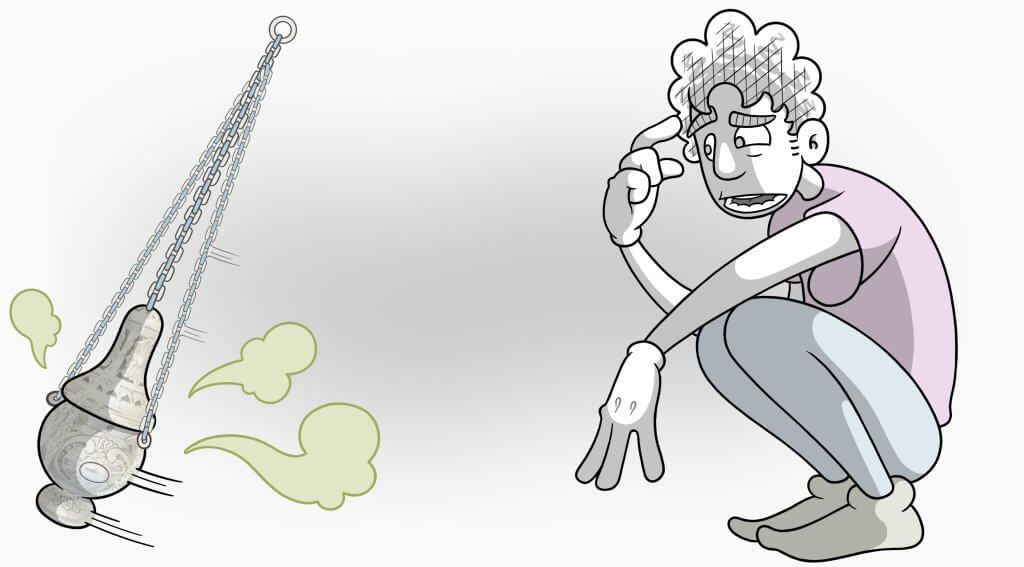
An Eye-of-Sauron god…

Jacques Philippe continues:
Just as there is such a thing as false humility and false compassion, there is sometimes what we might call a “false obedience” to God: we’d like to be always and absolutely certain that we’re doing his will in every choice, however small, and never make a mistake.
Yet there’s something not quite right about this attitude, for several reasons.
On the one hand, this desire to know what God wants sometimes conceals a certain difficulty in tolerating uncertainty: we’d like to be spared from having to make the decision ourselves.
Often, however, the Lord wants us precisely to be able to make decisions, even when we’re not sure ours is the best one.
In fact, being able to make decisions amid uncertainty involves an attitude of trust and surrender:
“Lord, I have reflected and prayed to know what your will is. I don’t see things very clearly, but I am not troubled. I don’t intend to spend hours and hours racking my brain: I’m choosing this because, all things considered, it seems best to me, and I leave everything in your hands. I know very well that even if I made a mistake, you wouldn’t hold it against me, because I acted with an upright intention, and you will be able to bring something good out of this mistake. It will be a source of humility for me, and I’ll learn something from it!”
(JACQUES PHILIPPE, La pace del cuore, EDB, Bologna 2020, pp. 51–52)
5 • Holiness is the opposite of perfectionism
All Christians are called to holiness (cf. Dogmatic Constitution on the Church Lumen Gentium, nos. 39–42).
Okay.
Fair enough.
That’s something more or less “everybody knows” (even non-believers).
But (as I wrote last month) I suspect that many people tend to confuse holiness with:
- grand gestures;
- personal growth strategies;
- rolling up your sleeves;
- working hard;
- being impeccable;
- always knowing what to do.

All the self-analysis (read: overthinking) I do…
All the effort I put into sweeping things under the rug…
All the “concealer” I use to cover up my shortcomings…
…have nothing to do with Christianity.
Perfectionism has nothing to do with holiness.
(JACQUES PHILIPPE, La pace del cuore, EDB, Bologna 2020, pp. 52–53)
Jo Croissant (born in ’49), a French laywoman and member of the Community of the Beatitudes, wrote:
It isn’t analysis that will help us understand our inner workings.
It takes a whole asceticism, which consists in turning our gaze away from ourselves in order to expose ourselves to God’s gaze and discover who we are.
Since our natural tendency is to turn in on ourselves, we have to keep turning back toward God and let ourselves be looked at by Him.
It is by forgetting ourselves that we find ourselves.
His gaze heals us.
Only He can enter our innermost depths without wounding us.
Only He can lay bare our poverty without plunging us into despair.
(JO CROISSANT, Il mistero della donna, Berica, Arzignano (VI), Kindle edition, 22%)
Conclusion
In the apostolic exhortation Gaudete et Exsultate (2018), Pope Francis talks about Pelagianism…
…which (boiled down to the bare bones, and oversimplifying a bit) means building your life on “good will,” commitment, and human “effort.”
I’ll close this short post with the pope’s own words:
(No. 49) Those who yield to this pelagian or semi-pelagian mindset, even though they speak warmly of God’s grace, ultimately trust only in their own powers […].
When some of them tell the weak that all things can be accomplished with God’s grace, deep down they tend to give the idea that all things are possible by the human will, as if it were something pure, perfect, all-powerful, to which grace is then added.
(No. 50) Ultimately, the lack of a heartfelt and prayerful acknowledgment of our limitations prevents grace from working more effectively within us […].
[…] Underneath our orthodoxy, our attitudes might not correspond to our talk about the need for grace, and in specific situations we can end up putting little trust in it.
(No. 57) Still, some Christians insist on taking another path, that of justification by their own efforts, the worship of the human will and their own abilities. The result is a self-centred and elitist complacency, bereft of true love.
(POPE FRANCIS, Gaudete et Exsultate, Apostolic Exhortation on the Call to Holiness in Today’s World, nos. 49, 50, 57)
salt
(Winter 2021–2022)
Sources/insights
- JACQUES PHILIPPE, La pace del cuore, EDB, Bologna 2020
- TERESA DI LISIEUX, Storia di un'anima, Shalom, Camerata Picena (AN) 2008
- PAPA FRANCESCO, Gaudete et Exsultate (esortazione apostolica sulla chiamata alla santità nel mondo contemporaneo)
- GIUSEPPE FORLAI, Vestirsi di luce : introduzione pratica alla vita nello Spirito, Paoline, Milano 2018
- JO CROISSANT, Il mistero della donna, Berica, Arzignano (VI) 2018