1 • Man’s freedom vs God’s will?
Are we truly free?
How is this freedom reconciled with the fact that we “must” do the will of God?
Does doing the will of someone who is an “Other” than me negate my own will?
How do we hold together the freedom of man and the will of God?
Isn’t it a contradiction?
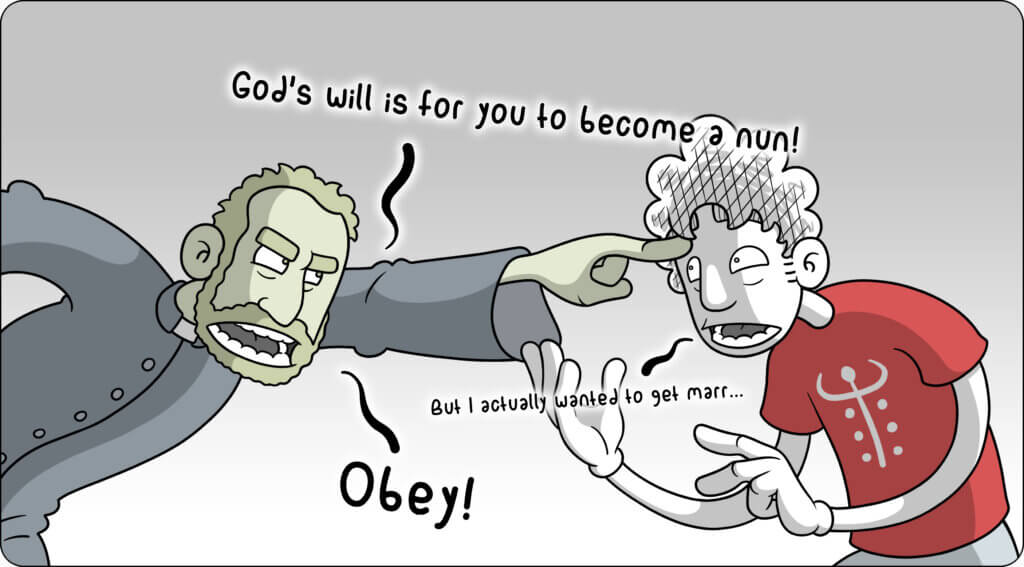
2 • “Will of God”: Distortions, deformations, and cognitive biases
In one of his books, Father Marko Ivan Rupnik recounts the story of Aljaž and Nuša, two young engaged individuals.
The two, eager to get married, turn to Father Boguljub to seek advice for their discernment.
Nuša
studies psychology.
One of the first questions the girl addresses to the monk is this:
[…] I can’t overcome the fear that, if I accept the will of God and submit to it, my personality will suffer. I have heard of too many pathological cases, the result of a kind of depersonalization caused by a religion I don’t want to say is wrong, but at least perceived incorrectly. I think that for our generation, freedom is now a given. Freedom as we understand it and live it. With this freedom, I don’t know how I could remain responsible for the choices I make if I had to fulfill the will of a God who, no matter how good, remains fundamentally different from me.
(MARKO IVAN RUPNIK, Il cammino della vocazione cristiana : di risurrezione in risurrezione, Lipa, Roma 2007, p.33)
Initially, her boyfriend responds (who wants to play the role of Hermione Granger this time…), telling her that “in our attempt to understand the mystery, it is important not to import categories that are not in line with it…“
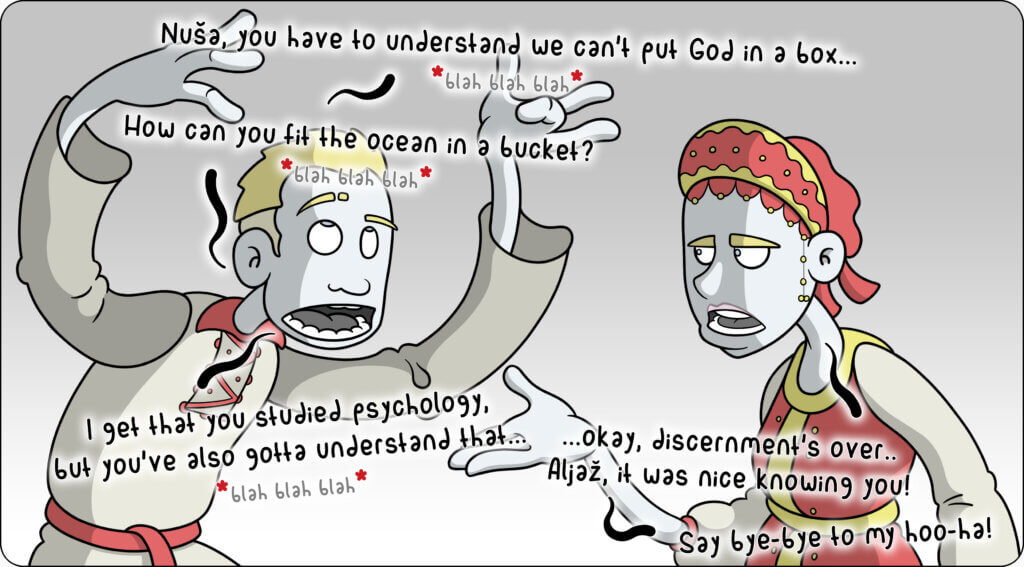
…Afterwards, Father Boguljub continues the discourse:
One must slowly learn a bit of discipline in thinking.
If I think about a house in terms of construction, it is clear that I will reason much better the more I use categories typical of building.
If I think about its aesthetic forms, it’s good that I use categories of architecture.
And if I think about the family life of those who will live there, I will use yet other categories.
We cannot approach every thought always with the same categories, and even with the same dimension of reason.
So, when we talk about the will of God, we must proceed with caution and not apply the categories with which any of our sciences, in your case, psychology, thinks about it too mechanically.
These categories can be enlightening on certain aspects, on some details, but they cannot play a fundamental role in the general framework of our way of thinking about the mystery.
(MARKO IVAN RUPNIK, Il cammino della vocazione cristiana : di risurrezione in risurrezione, Lipa, Roma 2007, p.33-34)
In summary: psychology is interesting, beautiful, and useful…
…but one cannot think of the “will of God” (solely) with psychological categories.
Otherwise, one makes a rather gross approximation.
3 • What is the will of God?
Father Boguljub continues:
“The will of God cannot be anything other than what God is. And if God is love, His will cannot deviate from what He is, that is, from love.”
Boguljub had slowly emphasized this last sentence, accompanying it with an almost imperceptible movement of his hands. Then he continued, exemplifying:
“The will of love, a will oriented towards communion, a will oriented towards the other with love, for love, and in love… And, if you have a bit of patience, you will see that we are not talking about something romantic, but deeply serious, even dramatic.
The will of God is practically one: that all men may discover themselves loved by God the Father and may receive this love with a response of love. […] the love of God is experienced by each person in a totally personal way.
So, everyone can experience the will of God as something entirely unique, personally directed to oneself, since love is personal and communicates from Face to face.
But what to do in life to be more deeply and fully penetrated by this love and respond to it depends on each of us.
The will of God, being love, is one.
But it is up to each individual to perceive for themselves, personally, where they can more radically expose themselves to this love, doing what can be more fully in the service of this love.”
(MARKO IVAN RUPNIK, Il cammino della vocazione cristiana : di risurrezione in risurrezione, Lipa, Roma 2007, p.34-35)
In other words, making an analogy: if God’s love is the warmth of the sun, doing the “will of God” – or if you prefer, “following one’s vocation” – means finding the place where we are most exposed to its rays.
All of this, of course, holds generally…
…then there are the worriers/overthinkers/scrupulous individuals like me, who have a hundred existential dilemmas, a thousand worries, and ten thousand inner struggles that…
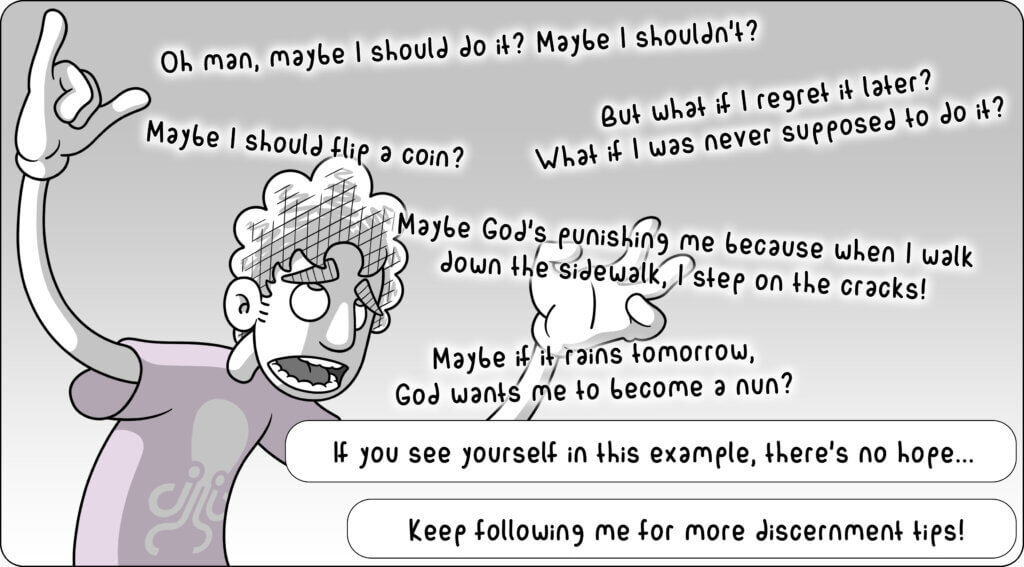
Anyway, beyond clinical cases like myself…
…Father Boguljub continues his discourse, transitioning from the “will of God” to the discovery of one’s vocation:
Vocation means finding one’s place in love. In seeking this place, one is already acting in synergy, that is, in collaboration with the will of God.
Synergy… a beautiful word that the Fathers used. Literally, it means co-action, an action resulting from the combined energies of God and man in Christ. More precisely, the energy of the Spirit that penetrates the inner energy of man and makes him conform to Christ, to this image on which we have been created.
This is how we find our place.
(MARKO IVAN RUPNIK, Il cammino della vocazione cristiana : di risurrezione in risurrezione, Lipa, Roma 2007, p.35)
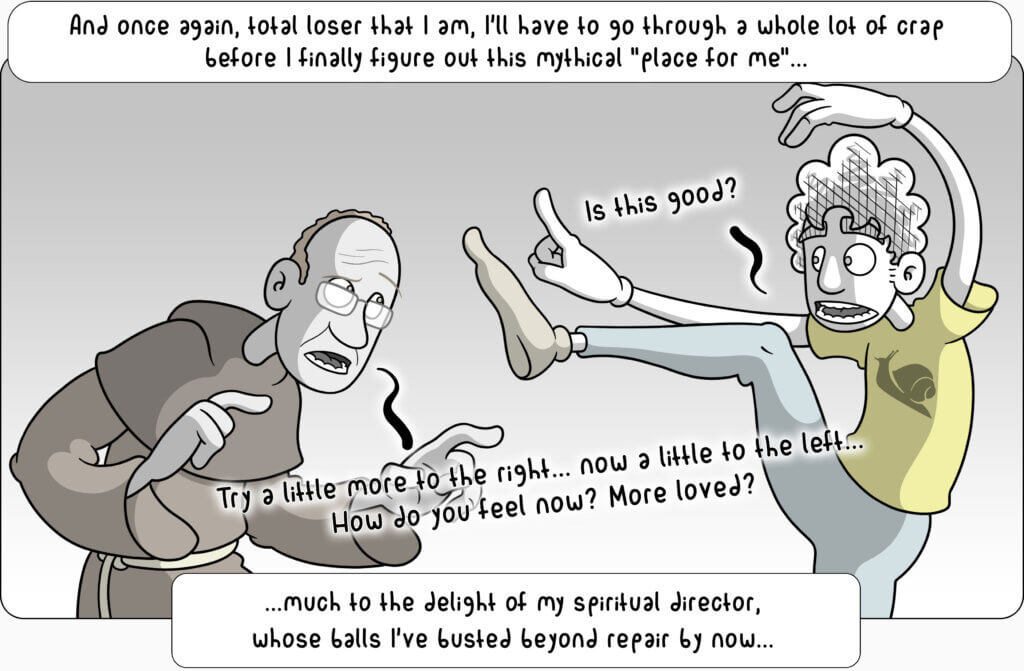
4 • Philautia, or: Why the freedom of man doesn’t work well
Alright.
If we thought we had managed so far, Father Boguljub adds another layer:
All of us experience a will that we struggle to orient towards the other, and with a lot of effort, we try to keep directed towards communion.
Indeed, it is so natural for us to have a selforiented tendency, to think of preserving the individual by enclosing it in oneself and separating it from others. Our will attributes absolute value to itself, which is not inherently wrong, except when it denies or ignores this same absolute value to others.
We all experience the strength of our self-affirming will, generating an energy capable of exalting our individuality in an exclusive, unilateral way.
The Fathers called this movement, this energy, ‘love for one’s own will,’ philautia.
[…]
You see, I think we need to be honest: we cannot talk about vocation, the fulfillment of the will of God, or even its understanding if we do not also talk about sin.
It is the common inheritance of all humanity, and it is not just a perversion of love but even a destruction of relationality.
It is the dramatic event where man rebelled against the One who created him by breathing into the dust of the earth. This has led to a kind of rupture, or if you prefer, a wall of separation between the mud and the breath.
(MARKO IVAN RUPNIK, Il cammino della vocazione cristiana : di risurrezione in risurrezione, Lipa, Roma 2007, p.37-38)
In essence: it is not possible to talk about the freedom of man, the will of God, or vocation without reckoning with original sin.
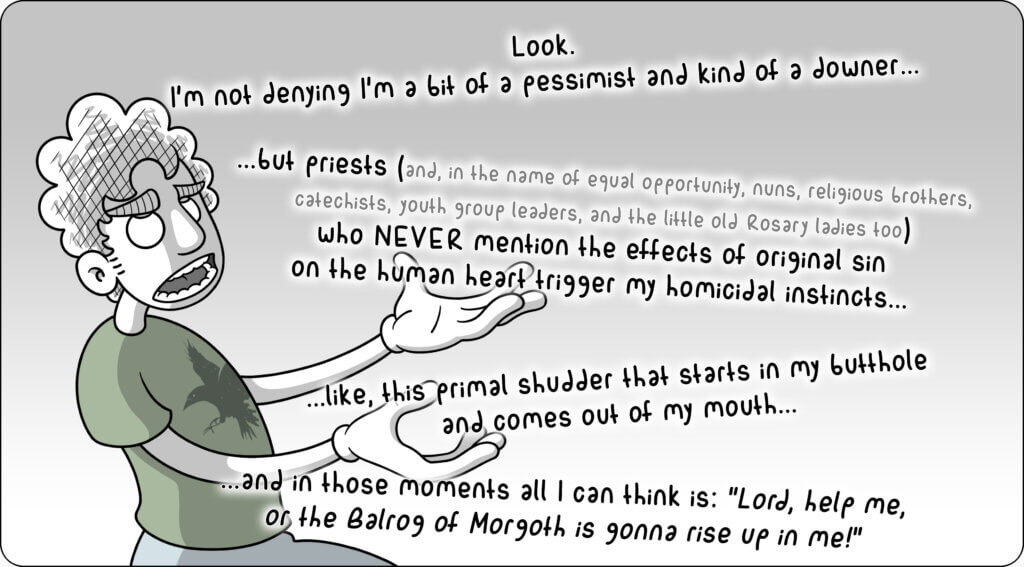
After the original sin…
…the perspective was overturned, and man turned again to the earth. In it, he seeks his dwelling. He would like to be the master of creation, but his use of the created world can’t extend beyond a mercantile approach because he lacks life within himself.
He would like to manage the entire world as a kind of creator, making himself the true epicenter of everything. But each generation adds its failures to the list.
Now, it is clear that sin makes man perceive God as a limit to his management of things. Man would like to dominate the creation of the first five days, feeling like its head since he arrived last on the sixth day, like a king when everything was already prepared.
But since he does not embrace the breath of life, he cannot manage the universe, yet he also does not want to let God do it.
(MARKO IVAN RUPNIK, Il cammino della vocazione cristiana : di risurrezione in risurrezione, Lipa, Roma 2007, p.39)
After the original sin…
…God represents a limit to man’s selfmanagement. Managing the world according to one’s own will: a kind of radical autonomy proclaimed by man makes God his greatest enemy.
By detaching himself from love, man begins to attach a long series of categories, ideas, concepts, and images to God to justify removing Him from his horizon.
All the culture we have breathed in recent centuries is full of arguments to root us in these convictions.
(MARKO IVAN RUPNIK, Il cammino della vocazione cristiana : di risurrezione in risurrezione, Lipa, Roma 2007, p.39)
5 • Being humble enough to admit failure
But the tragedy that the human person continually experiences is that with sin, there has been a tearing from the source, a distancing from the origin, and concerning everything in life, human will incessantly collides with an unbearable impotence.
Therefore, this human will that cannot produce life, that cannot keep life, that cannot even preserve itself in life, becomes aggressive and violent.
And it is clear that a self-affirming will does not help the intelligence – already wounded on its own and thus oriented to things and no longer to faces – to admit the committed sin.
The greatest illness of human will is not wanting to admit failure.
(MARKO IVAN RUPNIK, Il cammino della vocazione cristiana : di risurrezione in risurrezione, Lipa, Rome 2007, p.40)
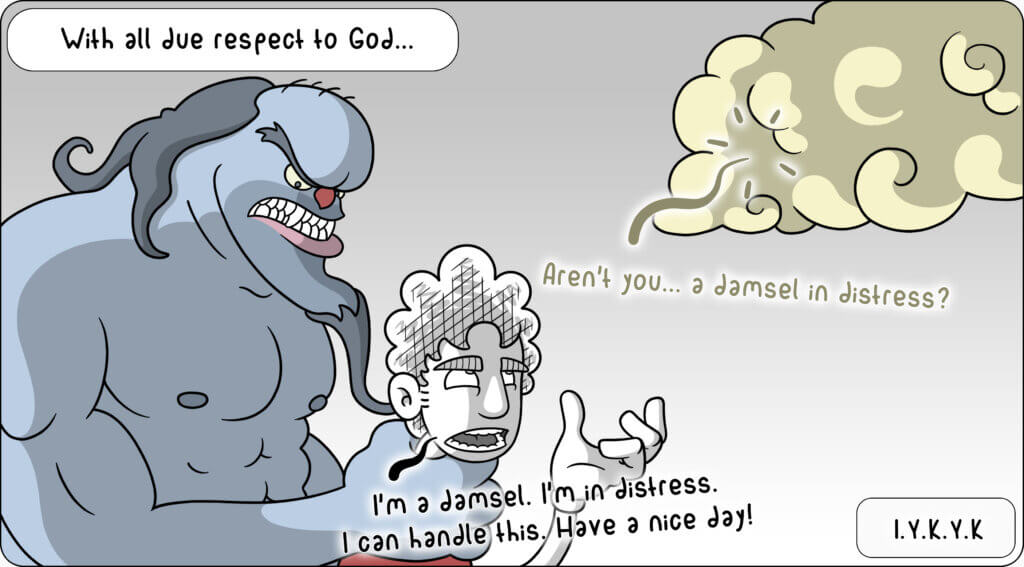
And here again comes into play the idea of God that the Serpent insinuates into the minds of Adam and Eve.
This is a classic…: “Thanks, God, but I don’t need Your help…“
- “…no hard feelings, but I don’t trust You!“
- “…also because I suspect You want to deceive me!“
- “…no, it’s just that I respect You as the CEO of the universe, but I don’t esteem You as a Person…“
- “...just sit there; You’ve already done enough damage in my life!“
- “…because if I listen to You, it feels like entering a vicious circle of moral blackmail…“
- “…and I’m afraid of losing my freedom…“
Every time, we return to seeing God as a master; interpreting His Will with psychological categories; and reading His words in a manipulative way.
[…] We cannot heal our will on our own.
We cannot heal our will simply with commands, imperatives, or even, in the end, with therapies.
[…]
Only the love [of God] is the force that can capture our will and pull it out from the confines of the small world of our self.
Without the intervention of a personal love, with the human will oriented towards itself and guided by an intelligence incapable of crossing the boundary of individuality, society becomes fragmented—a mishmash of atoms at the mercy of many centrifugal forces, where each individual seeks to support and assert themselves.
But a human being reduced in this way becomes an open wound on their own identity. Our assistance to such a person often boils down either to consoling — granting various pleasures to alleviate wounds and pains — or imposing goals to rise from this mud.
I wouldn’t say that we oscillate between satisfaction and moralism, but by now, you’ve understood me and I hope you have also grasped that this situation needs to be approached and discussed with tenderness and compassion, though a man wounded in his pride struggles with compassion, because he has overlaid it with his own prejudices.
(MARKO IVAN RUPNIK, Il cammino della vocazione cristiana : di risurrezione in risurrezione, Lipa, Roma 2007, p.41-42)
Conclusion
At this point (and I’m closing), Nuša poses a formidable question to Father Boguljub.
The response she receives is quite surprising, but it is true.
Because it comes from a father:
“Father, I apologize again, but don’t you think you’re exaggerating by emphasizing so strongly the incapacity of man, the pathology of his will, and so many other problems?
It’s like saying we are incapable of love!”
“Indeed, Nuša, that’s exactly it. There’s no need to go too far. Last time, when Aljaž came, he told me that you have uncertainties, doubts about your own love. It’s not a sign missing even in you, who say you love each other, the adherence to that force of love that manages to overcome the moments when relationships normally collapse? There’s nothing aggressive in admitting that man, in himself, alone, does not have the source of life.”
(MARKO IVAN RUPNIK, Il cammino della vocazione cristiana : di risurrezione in risurrezione, Lipa, Roma 2007, p.42)
salt
(Summer 2021)
- MARKO IVAN RUPNIK, Il cammino della vocazione cristiana : di risurrezione in risurrezione, Lipa, Roma 2007
- GABRIEL BUNGE, Akedia. Il male oscuro, Qiqajon, Magnano (BI) 1999